
Journal of Food: Microbiology, Safety & Hygiene
Open Access
ISSN: 2476-2059
ISSN: 2476-2059
Research Article - (2025)Volume 10, Issue 3
A study was taken up to find out the prevalence of Aflatoxin B1 (AFB1) contamination in certain feed ingredients and compounded feed, received from 2019 to 2021, to assess the pattern of occurrence of AFB1 with respect to two broader climatic seasons of non-rainy or dry (January to May) and rainy or wet (June-December) in India and to envisage the status of Aflatoxin M1 (AFM1) in milk from the stand-point of feeding such compound feeds. Data of AFB1 contamination in the commonly used feed ingredients known for their susceptibility to mycotoxins maize, De- Oiled Groundnut Cake (DOGNC), Cotton Seed Meal (CSM), De-Oiled Rice Bran (DORB) and the compounded feeds, received at Animal Feed Analytical and Quality Assurance Laboratory, Veterinary College and Research Institute, Namakkal were statistically analyzed. 3% maize showed highest incidence of >101 μg/kg AFB1 during wet season while it was 1.50% in dry season. Similar trend was observed in 21-100 μg/kg category. On the contrary, DOGNC was found to be more contaminated during the dry season; while 31.67% of samples showed >101 μg/kg during dry season, it was 19.64% in wet season. When both 21-100 and >101 μg/kg were considered together, 90.64% of samples showed positive in dry season against only 59.54% in wet. CSM, a lowly analyzed ingredient, showed similar % of occurrence of AFB1 in both seasons under the categories of >21-100 (4.08 vs. 4.04) and >101 μg/kg (10.20 vs. 10.10). While no DORB samples registered contamination in >100 μg/kg category, >21-100 μg/ kg category showed more in wet season. The trend of pattern of AFB1 that occurred in most feed ingredients, was also seen in finished compound feeds. While 95% feeds remained within safe mark of 20 μg/kg AFB1 during dry season, it was only 92.54% which were within the safe limit in wet season. More samples of compounded feeds were recorded under >21-100 and >101 μg/kg category in wet season, thus predisposing them to a possibly increased AFM1 presence in milk of cross bred dairy animals, with parallel increases in quantum of feeding of such AFB1 contaminated feeds and in the conversion efficiency of AFB1 to AFM1. The study advises intensive testing of feed ingredients prior to feed manufacturing throughout the year, more intensively during wet season.
Aflatoxin; B1-compounded feeds; Ingredients-seasonal incidence
Aflatoxins are fungal metabolites produced by fungus Aspergillus spp., viz., A. parasiticus, A. nomius and A. flavus. These toxins are elaborated under favourable conditions of moisture, temperature, relative humidity and poor storage. Contamination of feed materials by aflatoxin B1 continues to be of serious concern for humans as well as animals. Most of the times, it could be a chronic exposure when the level of toxin is below the permissible limit. The ingestion of sub-acute concentrations over a prolonged period will lead to a range of health conditions like growth impairment, suppression of the immune system, reproductive disorders, renal disease and teratogenicity and in severe cases results in fatality in both humans and animals.
Aflatoxin B1 (AFTB1) is readily transmitted from feed to milk; approximately 1.0 to 6.0% of aflatoxin B1 present in the feed is transferred to milk as aflatoxin M1. AFM1 is the principal hydroxylated AFB1 metabolite which occurs in milk of cows fed with a diet contaminated with AFB1 and excreted within 12 hours of administration. On withdrawal of contaminated feed, the AFM1 in milk has been shown to decline. Aflatoxin contamination results in severe economic loss to producers, handlers, processors and marketers of contaminated crops [1]. Experience, in the animal feed sector, also has taught the stakeholders about the influence of season over contamination [2]. A hot and humid environmental condition with changes in the weather pattern in recent years has encouraged the growth of the fungus which in turn has posed serious aflatoxin B1 contamination issues.
In fact, the range in which the variation in climate influences the infestation with toxin production with predictable change in aflatoxin level in compounded feed and feed ingredients and the mechanisms through which season influences contamination were the hypothetical questions in mind which urged to carry out this survey work to screen certain key feed ingredients for Aflatoxin B1 (AFB1) contamination during three full years from 2019 to 2021.
AFB1 was quantified in the commonly used feed ingredients known for susceptibility to mycotoxins, viz. maize, De-Oiled Groundnut Cake (DOGNC), Cotton Seed Meal (CSM), De- Oiled Rice Bran (DORB) and compounded feed that were received during the period of three years from 2019 to 2021 by Animal Feed Analytical and Quality Assurance Laboratory, Veterinary College and Research Institute, Namakkal. The samples were analyzed and compared between two broader seasons of non-rainy or dry (January to May) and rainy or wet season (June-December) (Indian Meteorological Department, India) to understand if any pattern pops up and document the same.
AFB1 screening was done by the standardized in-house method of AFAQAL (Modified method of Romer et al. and quantification by TLC). AFB1 was extracted with acetone, treated with cupric carbonate and ferric gel to eliminate fluorescent materials other than the toxin, washed with acid and alkali and extracted with chloroform, dried, re-diluted with known quantity of chloroform and spotted using pre-coated Merck aluminum sheets. After spotting the working AFTB1 standard (Sigma, US) and the sample, spots were developed in an unsaturated developing tank containing chloroform: Acetone in the ratio 88:12 [3]. After eluting to three fourth of the plate, the plate was carefully removed from the tank, dried well and viewed in a UV cabinet viewer under long wavelength (364 nm) and the concentration was ascertained by visual comparison method. The in-house TLC method for AFB1 detection had a Z score between <1.0 and <2.0 for 2019, 2020 and 2021 (Proficiency test, Lab. no. 1177, Texas A and M University, USA). The LOQ of the method was 5 μg/kg.
Contamination of feed and feed ingredients by aflatoxin B1 continues to be a serious concern for animal health. In the present study, key feed ingredients used for manufacturing the compounded feed for cattle were screened for the presence of AFB1 contamination. The details of compounded cattle feed and feed ingredient samples analyzed, the results of the range and percentage contamination with AFB1, season-wise, for three-year period between 2019 and 2021, are presented in Figures 1 and 2.
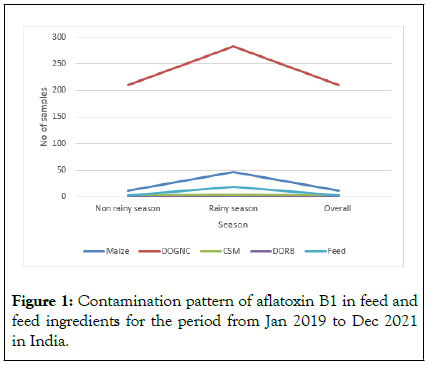
Figure 1: Contamination pattern of aflatoxin B1 in feed and feed ingredients for the period from Jan 2019 to Dec 2021 in India.
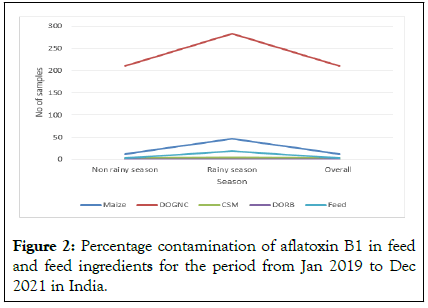
Figure 2: Percentage contamination of aflatoxin B1 in feed and feed ingredients for the period from Jan 2019 to Dec 2021 in India.
Maize
The major cereal, maize, used consistently in most of the livestock and poultry feeds showed contamination with >100 μg/kg of AFB1 in 3.68% of samples (46 out of 1249) during the wet season whereas it was only 1.50% in dry season. More samples were received for aflatoxin screening during the wet season. The incidence of samples showing <5 μg/kg was seen to be low in wet season which eventually resulted in higher incidence of samples with >5 μg/kg. This clearly conveys that maize should be an ingredient subjected to careful screening during rainy season for livestock and poultry feed manufacturing, as most of the maize produced during monsoon is used immediately after harvest for feed and starch production. An overall picture suggests that about 9% of the maize samples showed contamination with AFB1 of >21 μg/kg. Higher AFB1 incidence in rainy season could be due to high fungal incidences encountered in maize in tropical climate experienced in countries like India which could be attributed to
• Harvest of high moisture corn.
• Transport of such high moisture corn.
• Prolonged stocking of maize with cobs or and
• A combination of all.
De-oiled groundnut cake
Surprisingly against the presumed thoughts, DOGNC was found to be showing higher percentage of contamination in the categories of >21 and >101 μg/kg mainly during dry season rather than during wet season. When both >21 and >101 μg/kg categories were put together, a little higher than 90% samples were found to come under this category during dry season whereas it was 59.54% during wet season. More than double the number of samples were received for analysis for AFB1 in wet season when compared to dry season and this probably indicates a possible higher incidence of aflatoxin related problems in animals. The generally higher incidence of AFB1 could be attributed to the stocking of the oil seeds meant for solvent extraction during the times of excess production especially during mid and late rainy season of this country and release of the seeds during the times of demand in the dry season [4,5]. Fungal infestation during pre-harvest and post-harvest is the commonly reported menace due to high temperature and humidity which exist in typical tropical rainy periods of July to September by south-west monsoon over the entire India and October to December by north-east monsoon covering all southern states of India and production of AFTB1 usually predispose to the synthesis of toxins during storage.
Cotton seed meal
Cotton seed meal was showing a similar (4.08 vs. 4.04%) AFB1 contamination in both the seasons under category of >101 μg/kg which shows the perennial contamination pattern of AFB1 in CSM. Though the highest AFB1 incidence was only around 4.0%, the number falling in the range of 21–100 μg/kg was above 1/10th of the total samples submitted for analysis. However, the number of samples of CSM requested for AFB1 was extremely low.
De-oiled rice bran
DORB is one of the feed ingredients widely used in livestock and poultry feeds throughout the year and is an ingredient of major concern when the final feed is to be monitored for its AFB1 level and thus AFM1 in milk. DORB was found to be contaminated with AFB1 in the range of >21-100 μg/kg, more so during the wet season than during the dry season. While the incidence of <5 μg/kg was one-third in both the seasons (32.39-37.21%), most of the remaining samples fell in the category of >5–20 μg/kg. None of 748 DORB samples analyzed during the three-year period showed >101 μg/kg of AFB1. DORB, a byproduct of rice milling, showed a slightly higher incidence of AFB1 during wet season only, which could be due to tropical climate that matches with the harvest and milling [6].
Compounded feeds
As far as compounded feeds which were supposed to be mostly made up of the ingredients covered in our report, it could be seen that dry season accounted for >95% samples that remained safe with <20 μg/kg, the limit specified by BIS, India for cattle, most of the poultry. Whereas, for wet season, it was a little lower at 92.54%. The category of more than 21 μg/kg AFB1 showed an uptrend in incidence during the season of wet (7.46% against 3.95%). Contamination of >101 μg/kg was also found to be slightly higher with 0.62% (18 samples out of 2923 samples) during the wet season when compared with dry season (0.11%, 2 in 1747 samples). Though the feed ingredients subjected in our study were limited to only vulnerable ones, there can also be other primary ingredients like cereals and secondary feed ingredients like cereal by-products and by-products of food processing industries, that are increasingly available and used in cattle feeds, a source of AFB1 contamination.
The trend or pattern seen in most of the ingredients was reflected in the finished feeds and this suggests that the need for quality control in the ingredient screening prior to feed manufacturing should be more in wet seasons to control the AFB1 in feeds. The IS 2052 (Amendment 4) for raw materials of plant origin used for manufacturing cattle feed shall not have AFTB1 >20 μg/kg. Though specific level are not there in India, for DORB, rice polish and wholegrains, the level shall not be >50 μg /kg. As per BIS, AFTB1 in cattle feed shall be within 20 μg/kg. Accordingly, the Food Safety and Standards Authority of India (FSSAI, FSS Regulation, 2011), the maximum permissible level for aflatoxin M1 in milk is set at 0.5 μg/kg.
The results in our study are in accordance with the previous reports wherein researchers have reported that during drought climate, in the tropical countries, contamination of crops is a common manifestation even during the key stage of crop development and aflatoxin contamination is always a perennial threat.
Either rain occurring during harvest or closer to harvest creates favorable environment for fugal growth and toxin production. In consistent with the results of this study, numerous studies have suggested that there are competitive interactions between the fungi in dry and hot conditions and that secondary metabolites may play a role. This will certainly produce an impact on agricultural productivity especially of commercial crops such as maize and also will influence the interaction between plants, insect pests and the fungal infection of staple foods. Modified weather regimes also have an impact especially during summer in the Mediterranean region where drought and elevated temperatures resulted in significant contamination of grains with Aspergillus flavus and aflatoxin production. Similar study in Hungary also reported increase in aflatoxin due to climate change. The interaction results in a considerable effect on toxin production during the pre-harvest and post-harvestperiod. In most of the developing countries, substantial amount of aflatoxin has always been noticed in the food and feed materials which results in deterioration of quality. Though developing crops are resistant to A. flavus infection, favourable environmental contamination with optimum temperature and humidity above 80% favours well-established fungal growth and subsequent toxin production may enhance fungal growth and susceptibility [7]. Aflatoxin contamination occurs in two distinct phases with infection of the growing crop in the first phase and the second phase occurs after maturation. However, season influences both the phases.
Aflatoxin M1
The conversion of AFB1 to AFM1 is estimated to occur at an average of 3.4 within the ruminant animal’s body and may reach even 6.0%. An average Indian cross bred animal produces 7.85 kg of milk per day (25% of annual milk production in India. Considering the BIS specified limit of 20 μg/kg of AFB1 in feeds meant for cattle, the quantum of AFM1 that could be liberated in the total quantum of milk of a dairy animal could be from a possible low of 0.20 μg to a possible high of 1.20 μg from one kg of consumed feed (Table 1). As the level of AFB1 increases from 20 to 100 μg/kg of feed, the quantum of AFM1 that can be generated from AFB1 may also increase and reach a maximum of 1.00 μg to 6.00 μg for every kg of contaminated feed that would be consumed. However, when the contamination of AFB1 in the feed exceeds 101 μg/kg, the quantum of AFM1 secretion in milk also increases beyond 1.00 μg/kg keeping the range from 1.01 to 6.06 μg through consumption of one kg of AFB1 contaminated feed. An average Indian cross bred animal produces 7.85 kg of milk per day and their milk contribution is more than 25% of the annual milk production in India. Under the above scenario, the risk of distribution of AFM1 in the milk of cross bred animals to show an MRL value of 0.5 μg/kg (FSSAI) in milk appears to be likely when the feed contains only70 μg/kg of AFB1 and beyond, provided the conversion of AFB1 to AFM1 happens at the maximum efficiency of 6%. Neither the lowest conversion efficiency (1%) nor the mid-value conversion efficiency (3.5%) would lead to an MRL value of 0.50 μg/kg of milk. As the above AFTM1 figures were worked out assuming one kg of feed consumption, the risk of showing an MRL value of 0.50 μg/kg of milk further increases with increase in quantum of feed supplied to the animals [8]. From this study, it has been understood that season-wise, risks of AFM1 exceeding the MRL value was found to be low in dry season (3.95%) compared to wet season (7.46%) which further also depends on the efficiency of conversion of AFB1 to AFM1 [9-11].
|
|
Possible AFM1 formation |
National average milk yield (kg/animal)-Crossbred animal 7.85 L/day |
||||
|
Lowest (1%) µg |
Highest (6%) µg |
Mid (3.5 %) µg |
||||
|
20 |
0.2 |
1.2 |
0.7 |
0.025 |
0.153 |
0.089 |
|
30 |
0.3 |
1.8 |
1.05 |
0.038 |
0.229 |
0.134 |
|
40 |
0.4 |
2.4 |
1.4 |
0.051 |
0.305 |
0.179 |
|
50 |
0.5 |
3 |
1.75 |
0.064 |
0.381 |
0.225 |
|
60 |
0.6 |
3.6 |
2.1 |
0.077 |
0.457 |
0.269 |
|
70 |
0.7 |
4.2 |
2.45 |
0.09 |
0.533 |
0.314 |
|
80 |
0.8 |
4.8 |
2.8 |
0.103 |
0.609 |
0.359 |
|
90 |
0.9 |
5.4 |
3.15 |
0.116 |
0.685 |
0.404 |
|
100 |
1 |
6 |
3.5 |
0.129 |
0.761 |
0.449 |
|
101 |
1.01 |
6.06 |
|
|
|
|
Table 1: Possible conversion of B1 to M1 based on the level of contamination in the compounded cattle feed.
It may be seen from the data that the order of AFB1 occurrence in raw materials selected for the present study in terms of highest to lowest was DOGNC>Cotton seed meal>maize>Deoiled rice bran in both the seasons; however thus elucidated a clear pattern of highest occurrence of AFB1 in wet season, though it was perennially observed.
In order to lower the risk of AFM1 in milk, farmers should be sensitized on the pattern of occurrences of AFB1 in feed ingredients, their occurrences during the predominant two weather seasons in India, the reasoning behind the decision of MRL of 20 μg/kg in finished feeds, the choice of ingredient usage and periodical testing of ingredients and compounded feeds.
A combination of quality check of ingredients and feeds for AFB1 and periodical checking of AFM1 in milk are the needs of today’s food safety for milk consumption and export.
The authors are highly thankful to Tanuvas and technicians of Animal Feed Analytical and Quality Assurance Laboratory, Veterinary College and Research Institute, Namakkal.
The authors declare that they have no conflict of interest.
[Crossref] [Google Scholar] [PubMed]
[Crossref] [Google Scholar] [PubMed]
[Crossref] [Google Scholar] [PubMed]
[Google Scholar] [PubMed]
[Crossref] [Google Scholar] [PubMed]
[Crossref] [Google Scholar] [PubMed]
[Crossref] [Google Scholar] [PubMed]
[Crossref] [Google Scholar] [PubMed]
Citation: Natarajan A, Priya SM, Janani SR (2025) Influence of Season on the Occurrence of Aflatoxin B1 in Certain Feed Ingredients in India. J Food Microbiol Saf Hyg. 10:349.
Received: 06-Sep-2024, Manuscript No. jfmsh-24-33880; Editor assigned: 11-Sep-2024, Pre QC No. jfmsh-24-33880 (PQ); Reviewed: 25-Sep-2024, QC No. jfmsh-24-33880; Revised: 03-Jun-2025, Manuscript No. jfmsh-24-33880 (R); Published: 10-Jun-2025 , DOI: 10.35841/2476-2059.25.10.349
Copyright: © 2025 Natarajan A, et al. This is an open-access article distributed under the terms of the Creative Commons Attribution License, which permits unrestricted use, distribution and reproduction in any medium, provided the original author and source are credited.