Journal of Nutrition & Food Sciences
Open Access
ISSN: 2155-9600
ISSN: 2155-9600
Research Article - (2026)Volume 16, Issue 1
This study investigates the presence of inorganic sulfates and nitrates as adulterants in milk and their potential harmful effects on gut probiotics. Samples were collected from various regions in Lahore and Raiwind, with a focus on detecting these adulterants and evaluating their antimicrobial impact on beneficial gut bacteria, specifically Lactobacillus and Bifidobacterium. Qualitative analysis revealed that sulfates were present in most samples, while nitrates were less frequently detected. Using the disc diffusion method, the antimicrobial activity of probiotics against these salts was assessed, revealing significant inhibitory effects, particularly from nitrates on gram-negative bacteria. The results suggest that the presence of inorganic sulfates and nitrates in milk not only compromises the nutritional quality but also poses serious health risks by adversely affecting the gut microbiome. The findings highlight the urgent need for stricter regulatory measures to prevent milk adulteration and protect consumer health, emphasizing the importance of consumer awareness and the potential therapeutic role of probiotics in mitigating the adverse effects of food adulterants.
Adulteration; Probiotics; Antimicrobial; Disc diffusion
Milk is a nutrient rich liquid of white color, produced by the mammary glands of mammals, crucial for providing complete nutrition to infants until they can digest other foods. It is known for its composition of essential nutrients including starch, sugar, fat, vitamins and minerals, supporting overall health and development.
Despite its nutritional value, milk is highly perishable, especially vulnerable during hot summers. Issues arise from unregulated marketing and immoral practices aimed at temporarily preserving milk to mitigate financial losses from spoilage during transportation and sale. These practices include adding water to increase volume, thickening agents like starch or whey powder to boost solids content and substances such as vegetable oil or urea to mimic fat or protein levels commonly referred to as adulteration.
Adulterants extend shelf life and alter appearance using chemicals like hydrogen peroxide, antibiotics and formalin or by adding ice and detergents. Harmful salts like inorganic sulfates and nitrates are added to enhance the milk's SNF (Solids-Not- Fat) levels or aid in preservation, despite posing health risks. Nitrate conversion to nitrite in the digestive tract can lead to the formation of potentially carcinogenic compounds, highlighting the serious health consequences of adulteration [1].
Food adulteration has become a widespread issue, particularly in developing countries, compromising access to nutritious food and increasing the prevalence of acute illnesses. The impact on physical and mental development in future generations is concerning, with serious implications for public health.
In countries like Pakistan, where water is often adulterated with milk, the risk extends beyond nutritional degradation to include health hazards. Globally, contaminated food products contribute significantly to both acute and chronic health conditions, presenting a substantial threat to public safety. Reports indicate that millions of Asians die annually from non-communicable diseases exacerbated by food adulteration.
In contrast, probiotics-beneficial bacteria such as Lactobacillus and Bifidobacterium-are recognized for their role in promoting digestive health by maintaining microbial balance. Research into probiotics highlights their potential to address dysbiosis and enhance overall well-being, emphasizing the importance of rigorous trials to validate their specific health benefits [2].
Ultimately, safeguarding the integrity of milk and addressing food adulteration requires stringent regulatory measures and heightened consumer awareness. Meanwhile, exploring probiotics offers a promising avenue for improving gut health and mitigating the broader health impacts associated with adulterated food consumption.
A plenty of research has been done on adulteration on food products and dairy products. The current study was carried out to check the impacts of these adulterants on the beneficial gut probiotics present in the body [3].
Experimental work
A total of thirty raw samples were collected from different areas of Lahore and Raiwind from milk shops and some samples from the homes. Milk was tested for the said adulterants and all the samples were free from nitrates although the samples contained sulfates adulteration. Sulfate was present in milk in the form of ammonium sulfate added for specific intention of increasing the SNF value and some other. Sulfate was detected and then antimicrobial activity of this probiotics; bacteria i.e., Lactobacillus and Bifidobacterium and yeast Saccharomyces boulardi was tested, that showed inhibition zones at specific sites.
Detection of sulphate: The lactometer reading is increased by adding the sulfate salts. Moreover, it raises the SNF level of milk. For detection of sulfates, phenol test was used. First of all, solutions were being prepared; 2% sodium hydroxide, 2% sodium hypochlorite and 5% phenol. 2 g of NaOH was weighed in 98 ml distilled water to make it 2%. Then, 2 g of NaClO was weighed in 98 ml water and 5 ml of phenol was added in 95ml water to make 5% phenol. Moreover, control sample was also applied to check the heat effects at regular time intervals.
5 ml of all samples of milk was taken in different test tubes and added 2.5 ml of 2% Sodium Hydroxide (NaOH) solution, 2.5 ml of 2% Sodium Hypochlorite (NaClO) solution and 2.5 ml of 5% phenol solution. Then the test tubes were heated in a boiling water bath for about 20 seconds. Samples were heated for variable time period of 5, 10, 15, 20, 25 and 30 seconds. If milk is adulterated with the ammonium sulfate salts, it gives deep blue color. However, the presence of pink color shows that the sample is free of ammonium sulfate salts.
Detection of nitrate: Adulteration of milk with inorganic nitrates can be detected easily. Anyhow, nitrate adulteration is rare. For this detection, the reagent was prepared, (2% w/v in sulfuric acid) 2 g of diphenylamine was weighed and added in 98 ml of sulfuric acid to obtain the final volume 100 ml. Then, 2 ml of all sample milks were taken in different test tubes. The test tubes were rinsed with milk and drained out from test tubes. Then 2-3 drops of reagent prepared were added along the walls of test tubes. The color developed was noticed. If nitrates are present in the milk, the sample turns deep blue. If milk is not adulterated with nitrates, it will not develop any color.
Antimicrobial activity of probiotics against these adulterants: The inorganic salts of sulfates and nitrate are thought to be dangerous for probiotics. To check this hypothesis, the antimicrobial activity of specific strains of probiotics was checked against these adulterants using well diffusion method. The disc diffusion method is technically used to measure the bacteriostatic measure of bacteria against specific antibiotics.
In this method, strain of bacteria is spread over a petri plate, then antibiotic is poured over it and then it is left to incubate for some time. When an antibiotic prevents the bacteria from developing or inhibits the growth of bacteria, there may be a region around the culture where the bacteria have not evolved sufficiently to be visible. This region of no growth is called zone of inhibition. Zone of inhibition is measured in different measurements.
In order to measure the zone of inhibition, first of all, the plate was placed on a non-reflective surface in order to measure the inhibition region. A millimeter ruler was taken and put the "0" in the middle of the antibiotic disc. Then measured from the middle of the disc to the rim of the zero growth region. Millimeters were considered for the calculation. It tells the radius of the inhibition zone. In order to get the diameter, it was multiplied by two [4].
Few samples of common milk were taken and analyzed for the adulteration of inorganic sulfate and nitrate. After checking the adulteration, it was checked either these salts are inhibitory for the growth of beneficial gut flora commonly called probiotics or not. For this purpose, the antimicrobial activity of probiotics was checked against probiotics using the technique; disc diffusion test. Then the zone of inhibition was measured.
Detection of sulphate: For detection of sulfates, phenol test was performed. During the test, it has been observed that both the control and the adulterated milk sample had got blue color as shown in Figure 1. No color change was observed in control and adulterated samples when heated up to 15 seconds in boiling water. When the sample was heated for up to 20 seconds, the color in the adulterated test stayed blue but control turned yellowish. The obtained result was not changed after further heating up to 25 seconds and remained same to the heat result up to 20 seconds [5-7].
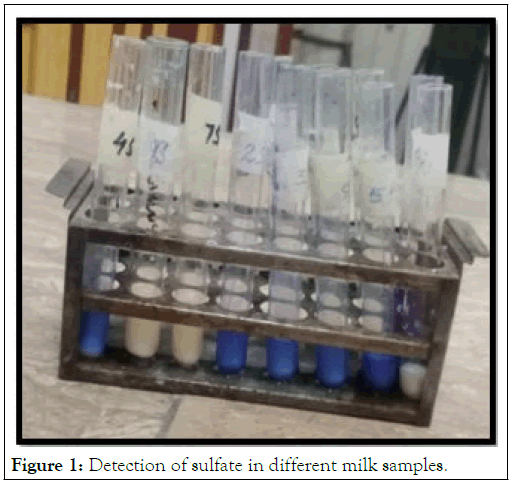
Figure 1: Detection of sulfate in different milk samples.
However, the control color remained orange in the event of heating up to 30 seconds, but the adulterated sample color was somewhat fading. The color of the adulterated sample slowly faded and the color of the adulterated sample turned yellowish when heated for 60 seconds, which was close to that of the control sample as shown in Figure 2.
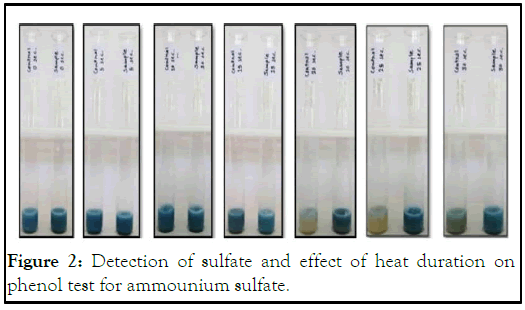
Figure 2: Detection of sulfate and effect of heat duration on phenol test for ammounium sulfate.
For the identification of ammonium sulphate in milk using phenol tests, a heating time of up to 20 seconds can therefore be suggested.
Detection of nitrate: Nitrate adulteration was also checked in milk samples using the reagent and all the two out of eleven samples showed nitrate detection as shown in Figure 3, as no color change was observed in others.
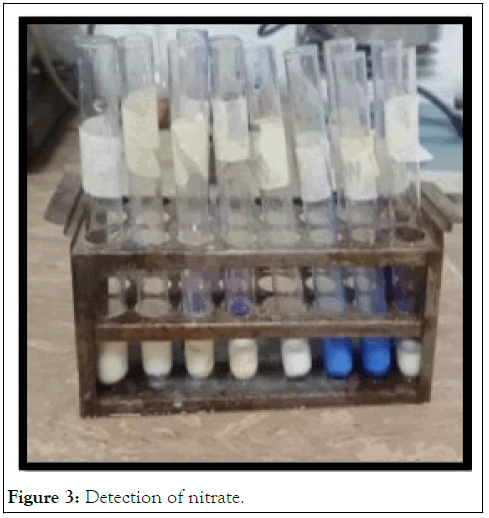
Figure 3: Detection of nitrate.
Antimicrobial activity of probiotics: To check whether these salts are potentially harmful for the beneficial bacteria in the body mostly called gut flora or gut probiotics, the antimicrobial activity of strains of probiotics i.e., E. coli Nissle, Lactobacillus acidophilus, Lactobacillus plantarumand, Saccharomyces cerevisiae were checked against these salts at concentration ranging from 50 μg/mL (10 μL) to 1000 μg/mL (200 μL). It illustrates the zone of inhibition against these them. Against sulfate, zone of inhibition observed was 15 mm-20 mm while against nitrate, it was observed 16 mm-40 mm.
The probiotics showed inhibitory activity against both of the salts. Although inhibitory activity was seen minimal at 10 μL.
The results suggested that the inorganic salts of sulfates and nitrates added for the purpose of milk adulteration may be potentially harmful and bactericidal for the gut probiotics.
The adulteration of milk with inorganic sulfates and nitrates poses significant health risks, particularly regarding the integrity of gut probiotics. This study aligns with previous research highlighting the prevalence and dangers of food adulteration in various contexts. The qualitative analysis of milk samples from Lahore and Raiwind indicated that sulfates were commonly detected, while nitrates were less prevalent, echoing findings from Aslam et al., which reported widespread adulteration practices in the region. This underscores a critical public health issue, as these adulterants are often introduced to enhance the physical properties of milk, such as density and shelf life, despite their potentially hazardous effects on human health.
Sulfates, specifically in the form of ammonium sulfate, were identified in the tested milk samples. This corroborates earlier studies like those by Gahukar, which noted the introduction of various chemical adulterants into food products to circumvent regulations and market demands. The implications of these findings are concerning, as the adulteration not only compromises the nutritional quality of milk but also threatens the gut microbiome, which is crucial for digestion and overall health. In particular, the study found that the antimicrobial activity of probiotics such as Lactobacillus and Bifidobacterium was significantly inhibited by the presence of these inorganic salts, highlighting a detrimental impact on beneficial gut flora. This observation aligns with the work of Temmerman et al., which established that food adulterants could adversely affect probiotic viability and functionality [8].
Further, the research employed the disc diffusion method to measure the inhibitory effects of sulfates and nitrates on probiotic strains. The study reported a higher zone of inhibition for nitrates compared to sulfates, particularly among gram-negative bacteria. This is consistent with findings by Liu et al., who demonstrated that various chemical agents could exert more significant inhibitory effects on gram-negative species due to their thinner cell walls. Such findings emphasize the need for a thorough understanding of how different probiotic strains react to specific food adulterants (Table 1).
| Serial no. | Bacterial species | Zone of inhibition | |||
| Against sulfate | Against nitrate | ||||
| 10 µL | 200 µL | 10 µL | 200 µL | ||
| 1 | E. coli Nissele | 10 ± 0.40 | 23 ± 2.69 | 11 ± 0.47 | 27 ± 0.65 |
| 2 | Lactobacillus acidophilus | 21 ± 0.68 | 44 ± 3.00 | 20 ± 0.56 | 40 ± 0.48 |
| 3 | Lactobacillus plantrum | 14 ± 0.54 | 32 ± 2.30 | 21 ± 0.68 | 38 ± 0.55 |
| 4 | Saccharomyces cerevisiae | 15 ± 0.45 | 38 ± 2.45 | 22 ± 0.56 | 41± 0.44 |
Table 1: Zone of inhibition (in mm) exhibited by various bacterial species against sulfate and nitrate at two different volumes (10 μL and 200 μL). Data are presented as mean ± standard deviation.
Moreover, the conversion of nitrates to nitrites in the human digestive system can lead to the formation of carcinogenic compounds, a phenomenon previously documented by Kalayc ± ogglu and Erim. This presents a dual threat: Not only do these substances compromise the health of probiotics, but they also pose broader health risks to consumers. The potential for long-term chronic health issues resulting from consistent exposure to these chemicals necessitates immediate attention from regulatory bodies to mitigate the risks associated with food adulteration.
The findings of this research further illuminate the urgent need for enhanced regulatory measures to address the issue of milk adulteration. Countries like Pakistan, where regulatory frameworks may be lacking, require stringent guidelines and monitoring systems to ensure food safety. As reported by Handford, et al., the implications of food fraud extend beyond individual health, affecting national health systems and economic stability.
In contrast, probiotics play a crucial role in maintaining gut health and combating the negative effects of food adulterants. Research shows that probiotics can help restore microbial balance and mitigate dysbiosis induced by harmful substances. Thus, understanding the interactions between adulterants and probiotics not only aids in highlighting the risks associated with milk adulteration but also paves the way for future research into protective measures and therapeutic interventions [9].
In conclusion, this study reaffirms the findings of prior research on the hazardous effects of inorganic sulfates and nitrates in milk adulteration. The consistent detection of these adulterants and their detrimental effects on gut probiotics underscore the need for increased consumer awareness and regulatory action to ensure food safety. As food adulteration continues to be a significant public health challenge, collaborative efforts between researchers, health professionals and policymakers are essential to safeguard the integrity of food products and promote public health (Table 1).
This research project focused on the analysis of inorganic sulfates and nitrates used as adulterants in milk. Certain milk samples were collected from different regions of Lahore and Raiwind. These samples were checked for the presence of sulfates and nitrates by using different analytical tests for both. Adulteration was observed for both of the salts. Although few samples showed nitrate adulteration. After the qualitative analysis of milk, antimicrobial activity of probiotics was checked against these salts and it showed bacteriostatic activity. Zone of inhibition was observed and measured.
It was concluded that these salts used as milk adulterants have potentially hazardous effects on gut probiotics.
This research by completed at department of chemistry, University of engineering and technology, Lahore. I declare that this research wasn’t funded by any funding agency and was done our own.
[Crossref] [Google Scholar] [PubMed]
[Crossref] [Google Scholar] [PubMed]
[Crossref] [Google Scholar] [PubMed]
[Crossref] [Google Scholar] [PubMed]
Citation: Riaz I, Gilani SR, Riaz R (2025) Hazardous Effects of Inorganic Sulphates and Nitrates Added in Milk Adulteration on Gut Probiotics. J Nutr Food Sci. 16:894.
Received: 03-Oct-2024, Manuscript No. JNFS-24-34468; Editor assigned: 08-Oct-2024, Pre QC No. JNFS-24-34468 (PQ); Reviewed: 22-Oct-2024, QC No. JNFS-24-34468; Revised: 16-Feb-2025, Manuscript No. JNFS-24-34468 (R); Published: 23-Feb-2025 , DOI: 10.35248/2155-9600.26.16.894
Copyright: © 2026 Riaz I, et al. This is an open-access article distributed under the terms of the Creative Commons Attribution License, which permits unrestricted use, distribution and reproduction in any medium, provided the original author and source are credited.