
Journal of Nutrition & Food Sciences
Open Access
ISSN: 2155-9600
ISSN: 2155-9600
Research Article - (2025)Volume 15, Issue 5
With two billion people lacking key micronutrients in their dietary composition, and 155 million children being stunted and 52 million children emaciated, the developing world is in acute need of functional food in their diet. The commonest staple diet in South Asia, including Sri Lanka, is rice. With 15% of the children below 5 years being anemic, and 5% showing zinc-deficiency symptoms, Sri Lanka could be considered an ideal geographical entity to adopt the fortification of rice. Nevertheless, the consumer acceptance of fortified rice is a crucial determinant in any successful introduction of this novel product in developing countries. A survey conducted among 385 potential consumers to assess the consumer attitudes and purchase intention in respect of fortified rice, revealed consumerwillingness to pay a premium price for branded fortified rice, and also positive consumer behavior towards the novel product in the top income quartile of the population. The research would thus be an impetus for future studies in South and Southeast Asia on the popularizing of nutrient rich food varieties in contextually similar emerging economies. This study also highlights how novel products can be used to eradicate nutrition deficiencies by altering consumer behavior.
Fortified rice; Consumer behavior; Innovation; Consumer attitude; Purchase intention
Research has demonstrated that the health and wellbeing of a person has a close affinity with his/her diet and food habits. Based on research findings, the Department of Health and Human Services, USA, asserts that most of the chronic diseases including the more common heart diseases, cancer and diabetes are regularly triggered off by diets that includes salt, cholesterol, refined sugar, and relatively high content of fat. The consumption of foods fortified with vitamins have proved as having the efficacy to decrease the risk of such diseases and enhance physical and mental well-being [1]. The fortification process of food takes place when nutrients are added scientifically so that the process will have a positive impact on health. Such a product is categorized as functional food. With the rise of health consciousness in society, there is an increasing demand for functional food especially in developed countries, with Japan leading the way. To avoid high medical bills resulting from non-adherence to a healthy diet, and to proactively secure a good physique, there is a growing trend among consumers to look at functional food or pharma foods/designer foods. This innovative development in the food sector is creating new market opportunities for producers, and the need has arisen to carefully analyze consumer behavior in regard to these novel products. The fortification of rice, the staple food in many developing countries, is one way by which micronutrients can reach the population of a country easily.
The analysis of the problem and the literature clearly indicates that there is a theoretical gap, an empirical gap in addition to the performance gap. The theory of reasoned action and, its extension, the theory of planned behaviour have been extensively adopted in numerous studies but not employed in respect of an innovative product of this nature (evident in the literature review), using the key behavioural controls of willingness to pay and brand consciousness together with other key variables directly affecting purchase intention: Attitudes and subjective norms.
Studies have been conducted on how fortificants (iron, zinc etc.) assist reducing malnutrition. The literature review has also revealed that there has been much research relating to consumer behaviour on genetically modified food, including genetically modified rice. There is a significant price difference that producers can capitalize on when selling genetically modified food; but such products elicit, among consumers adverse perceptions regarding health. Therefore, firms spend a great deal in trying to understand the reasons behind this negative sentiment and also on ways to address. The attention given to consumer behaviour on functional fortified food is relatively less in comparison with genetically modified food. Nguyen, et al., emphasize the need to conduct research on functional food in emerging markets, more specifically in Asia. There are also calls for further research to be conducted in the field of consumer behaviour, and more particularly in the area of rice with regard to the quality, certification and price in South and Southeast Asia [2]. Recent research conducted on consumer attitudes and purchase intention regarding vitamin-enriched extra virgin olive oil in Italy encourages researchers to conduct further research into the drives that motivate consumers towards fortified products, especially in view of the limitations seen in the sample and product category.
The research questions that will be addressed in this study are:
•What possible factors contribute to the formation of utilitarian and hedonic attitudes with regard to fortified rice?
•In what ways do perceived innovations of fortified rice impact their purchase intention?
•What factors contribute to the formation of purchase intention with regard to fortified rice?
•How do utilitarian and hedonic attitudes formed in relation to fortified rice lead towards purchase intention?
•How does purchase intention affect the level of appeal towards branded/unbranded fortified rice?
Theory of reasoned action and theory of planned behavior
The theory of reasoned action is concerned with understanding human behavior as it is a key predictor of its drives. The theory looks at how one’s attitude has an impact on his/her behavioral intent. Attitude is the amount of affect for or against an object. The theory proceeds to explain the relationship of attitude to action, as involved in the context of cognitive, connotative and affective behavior. Opportunities and resource availability are key factors that have not been considered by the theory of reasoned action, although it is evident that they will have a significant impact on individual behavior. As a result, the theory of reasoned action has been extended to add the new determinant of perceived behavioral control to the model. Many studies in the food industry have explored the relationship between consumer attitude and purchase intention using the theory of planned behavior. This inquiry will use the theory of planned behavior as a basis for assessing the consumer attitude in relation to purchase intention [3].
Conceptual model and development of hypotheses
This investigation resolves the five research questions related to the research project, which attempts at developing the hypotheses to investigate fortified rice related consumer attitudes and purchase intention. The investigation commences with consumer perceived innovativeness leading towards consumer’s attitude with subjective norms and other key perceived behavioural control variables leading towards purchase intention. The conceptual model thus developed, based on the constructed relationships, will, thereafter, be followed by the discussion of the related variables and the relevant hypotheses.
Consumer Perceived Innovativeness (CPI): Consumer perceived innovativeness is the key to obtain sustainable competitive advantage. The most comprehensive definition of consumer perceived innovativeness is provided by Lowe and Alpert in their article on forecasting consumer perception of innovativeness. They state that consumer perceived innovativeness is derived from perceived concept newness, perceived technology newness and perceived relative advantage.
A consumer will associate creativity with the novelty of a product. When the product concept is new, the easier it becomes to gain consumer acceptance and competitive advantage. Consumer perception of novelty is the key for a novel product to be successful. For example, the reason for the unsuccessfulness of smokeless cigarettes was because the consumer responded negatively to the novelty and utility of the product. Technology newness is an important aspect to consider from the angle of the consumer. Consumers tend to compare innovativeness by comparing how technologically advanced a product is compared to another competitor product or the previous version of the same product. If the product is technically advanced, as for example the bagless cyclonic vacuums made by Dyson, the product will have a positive impact on consumer perception. The perceived relative advantage of an innovation can be defined as what the consumer perceives as better or superior to the idea it supersedes. This is another important factor for an innovative product to be successful in the long run. Consumer research has demonstrated that the relative advantage of a product is one of the main attributes a consumer applies when s/he evaluates the innovativeness of the product [4].
H1: The greater the perceived concept newness, the greater the consumer perceived innovativeness.
H2: The greater the perceived technology newness, the greater the consumer perceived innovativeness.
H3: The greater the perceived concept newness, the greater the consumer perceived innovativeness.
Utilitarian and hedonic attitude: Hirschman and Holbrook refer to the utilitarian attitude as the functionality of the product, and the hedonic attitude as the affective and sensory attributes of a product from the consumer perspective. Even though the degree and mix of utilitarian and hedonic attitudes towards a product will vary depending on the product attributes, innovative products are assumed to offer higher utilitarian and/or hedonic value. The reason behind this assumption is that if an invention is to be commercially successful, it must possess a relative advantage over an existing product to the consumer.
H4a: The greater the consumer perceived innovativeness, the greater the utilitarian attitude.
H4b: The greater the consumer perceived innovativeness, the greater the hedonic attitude.
Personal relevance: Personal relevance is the stimulus created in the consumer by innovation in this context, where the meaning of relevance is based on the needs, values and interest of the individual concern. If the product is not personally relevant to the consumer, the purchase intention will not occur, but the consumer will still consider the product as an innovative one. Hence, personal relevance is not included in the consumer perceived innovativeness but as having a moderating effect on the utilitarian and hedonic attitude.
H5: The greater the perceived relevance, the stronger the positive relationship between consumer perceived innovativeness and utilitarian attitude.
H6: The greater the perceived relevance, the stronger the positive relationship between consumer perceived innovativeness and hedonic attitude.
Perceived risk: Personal risk is the expectation of a loss, which is subjective in nature, and can be associated with or lead to personal relevance. Personal risk is a separate construct; it is altogether different from personal relevance. For example, personal relevance to a consumer of high-tech novel aircraft which travels fast, might be the risk/danger cognitive thoughts which can be linked to the relationship between CPI and the utilitarian attitude. There will be a negative moderating relationship between CPI and the utilitarian attitude, and will not be linked to the hedonic attitude of the consumer as the affective is minor, compared to cognitive behavior of a consumer.
H7: The greater the perceived risk, the more attenuate the positive relationship between consumer perceived innovativeness and utilitarian attitude.
Purchase intention: Based on the theory of reasoned action, the attitude towards behavior and subjective norms are the predictors for the purchase intention. Attitudes are broken into utilitarian and hedonic. Higher the CPI leading towards utilitarian and hedonic attitude, the higher the purchase intention.
H8a: Utilitarian attitude mediates the relationship between the consumer perceived innovativeness and the purchase intention.
H8b: Hedonic attitude mediates the relationship between the consumer perceived innovativeness and the purchase intention.
This voluntary action is further modified in the theory of planned behavior which looks at factors that interfere with the intended behavior. If we relate the theory to consumer decisionmaking via the purchase intention, this will relate to the capabilities of the consumer in exercising control over this decision. When considering these factors (which may be internal or external to the consumer) which are termed perceived behavioral controls, one must consider all the key factors that affect the purchase intention of consumers. When considering the food industry, some of the key perceived behavioral controls are the ability to purchase based on price, personal relevance and perceived risk. Brand consciousness was an additional construct brought into the conceptual model based on the indepth interviews conducted during the qualitative study. These constructs are addressed individually in the conceptual model.
Subjective norms: According to the theory of reasoned action, subjective norms are not personal in nature and they depend on the social pressure exerted on an individual to perform or not to perform behavior. The theory of planned behavior which is an extension to the theory of reasoned action clearly identifies subjective norms as one of the three key determinants of the purchase intention leading towards behavior [5].
H9: Subjective norms positively influence the consumer’s intention to purchase fortified rice.
Willingness to Pay a Premium (WPP): A consumer will be willing to pay a premium for a product based on the values/he places on the product offered. Superfoods (e.g. chia, avocados, moringa) with high nutritional value and fiber content have captured the attention of consumers, resulting in an increase in demand, which in turn has resulted in the ability of supplier of these products to charge a premium price.
H10: Consumers’ willingness to pay a premium positively influences the intention to purchase fortified rice.
Brand consciousness: Brand consciousness can be defined as “consumer orientations toward buying the more expensive, wellknown national brands”, and it was an inclusion to the model, as explained earlier.
H11: Consumers’ brand consciousness influences positively the intention to purchase (Figure 1).
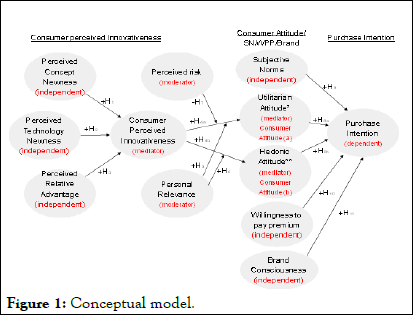
Figure 1: Conceptual model.
The research design, based on the research issues and hypotheses, was mainly a post-positivistic research philosophy, using a deductive research approach and quantitative techniques. Initially, an exploratory approach was adopted in conducting in-depth interviews with industry experts, and in four focus group discussions with consumers in innovator and early adopter consumer categories. This exploratory approach leading to normative models has facilitated in finalizing the conceptual model appropriate to the study. Questionnaires using google forms were sent via emails to innovator and earlyadopter customers to obtain their attitudes and opinions. Owing to the COVID-19 pandemic that affected the country, this was seen as the only viable method to obtain data from a sample of 385 potential consumers. The approach placed greater emphasis on quantitative techniques, but the model was initially tested using qualitative methods so as to test its validity in the Sri Lankan context. Finally, the quantitative findings were validated using semi-structured interviews with potential consumers (Figure 2).
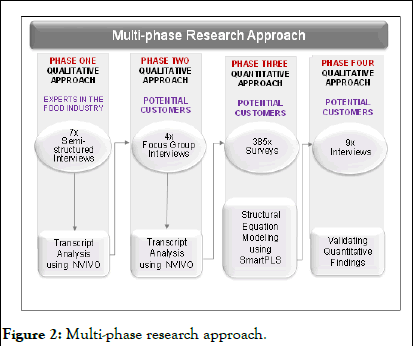
Figure 2: Multi-phase research approach.
Sampling and data collection
The target population for the survey was the Sri Lankan urban and suburban consumers of both sexes as the urban and suburban consumers have a significantly higher income and education levels than those in rural Sri Lanka. The ideas and the requirements of innovators and early adopters were critical for the success of an innovative product as they were the opinion leaders for the other customer to follow. Hence, potential consumers from the top quintile income group were selected for the focus group discussions, the survey and interviews of potential consumers as they are the most likely consumers to comprise the innovators and early adopters. Further, research has confirmed that, in addition to income, the level of education of the innovators and early adopters plays a pivotal role in consumer attitude and purchase intention when purchasing novel products. The urban and suburban families selected were from the top quintile income range in the two highest per capita income and literacy level districts, namely, Colombo and Gampaha, according to the data gathered by the census and statistics department of Sri Lanka. Hence, purposive sampling was used followed by stratified random sampling within the district to ensure that the sample is more representative of the district. The respondents’ profiles are given in Appendix 1.
Data analysis
The primary data has been collected in four phases (as explained). In the three qualitative phases, NVivo 11 software was used to document the data. Yin and Creswell’s framework was used for the content analysis of data. This framework was helpful in the testing of the entire conceptual model in the Sri Lankan context as well as to validate quantitative findings. The third phase was the quantitative data analysis to test the research hypotheses based on the answers to the sample questionnaires administered to a representative cross-section of the Sri Lankan population. Using a questionnaire survey method, questionnaires were served on 553 consumers in the segments of innovators and early-adopters. Prior to analyzing the data, it was checked to ensure that these were accurate, complete and suitable. After cleaning the data, 385 responses were obtained. The data was coded, and thereafter, entered into SPSS and edited for inconsistent data, and, then, followed up. SPSS 25 and SmartPLS 3 software was used for data analysis [6,7].
Quantitative data analysis
Descriptive statistics and model assessment: Descriptive statistics analysis items were conducted using SPSS on the sample of 385 potential consumers. Mean, standard deviation, coefficient of variations and skewness of all variables are given in Appendix 2. To ensure common factor variance was not prevalent in the data collected, Harman’s one-factor test was conducted using SPSS. The value was less than 50% (% of variance is 23.78%), and it can, therefore, be concluded that common method bias is not prevalent.
Indicator reliability and construct reliability was conducted to check the reliability of the data. Factor loadings and composite reliability were above the threshold levels (Appendix 3). The Average Variance Extracted (AVE) of all constructs was greater than 0.5, and as a result convergent validity of the items of the construct was established. The next step was to look at discriminant validity. When cross loadings were checked, it was clear that all the item loadings were the highest in respect of the relevant construct.
The multicollinearity of all dependent variables was calculated as the first criterion to validate all formative indicators. High correlations between formative indicators were not present as indicated by the VIF values, and it could thus be concluded that there are no collinearity issues with the model (Appendix 4). The next step was to assess the path coefficients and their significance. SmartPLS 3.3.5 bootstrapping procedure was used, setting the minimum number of bootstrapping at 5000. Predictor constructs and the dependent constructs with path coefficients and their significance (within bracket) are given in Figure 3. All coefficients other than perceived relative technology on consumer perceived innovativeness were significant at 5% threshold.
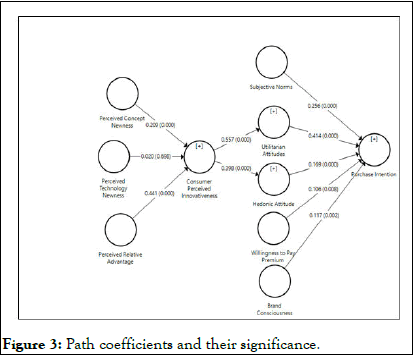
Figure 3: Path coefficients and their significance.
The coefficient of determination (R2) value of the conceptual model is given in Figure 4. The predictor variables of purchase intention indicating a value of 58.5% can be termed as moderate. Predictive relevance (Q2), which indicates the model’s predictive accuracy, was higher than the threshold value of zero (Appendix 5).
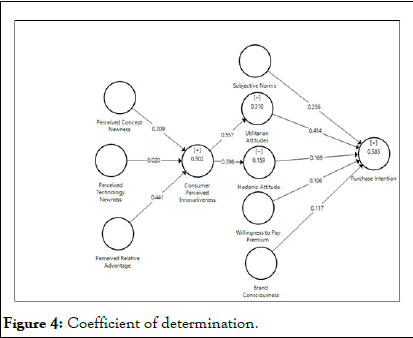
Figure 4: Coefficient of determination.
Hypotheses testing: To analyze the proposed relationships in the conceptual model, the significance of each path coefficient was assessed via the bootstrapping technique. Using Partial Least Squares Structural Equation Model (PLS-SEM) setting, bootstrapping was conducted using 5,000 samples; 0.05 significance level was chosen to generate standard error and tstatistics. In addition to the direct relationship given by the direct effect (Table 1) and indirect relationship given by indirect effect (Table 2), the mediating relationships were tested.
| Hypotheses | Causal paths | Original sample (O) | T statistics (|O/STDEV|) | P values | Support |
| H1 | Perceived concept newness ≥ consumer perceived innovativeness | 0.21 | 3.66 | 0 | Yes |
| H2 | Perceived technology newness ≥ consumer perceived innovativeness | 0.02 | 0.39 | 0.7 | No |
| H3 | Perceived relative advantage ≥ consumer perceived innovativeness | 0.44 | 8.26 | 0 | Yes |
| H4a | Consumer perceived innovativeness ≥ utilitarian attitudes | 0.56 | 12.23 | 0 | Yes |
| H4b | Consumer perceived innovativeness ≥ hedonic attitude | 0.4 | 7.08 | 0 | Yes |
| H8a | Utilitarian attitudes ≥ purchase intention | 0.41 | 9.23 | 0 | Yes |
| H8b | Hedonic attitude ≥ purchase intention | 0.17 | 3.41 | 0 | Yes |
| H9 | Subjective norms ≥ purchase intention | 0.26 | 6.34 | 0 | Yes |
| H10 | Willingness to pay premium ≥ purchase intention | 0.11 | 2.66 | 0.01 | Yes |
| H11 | Brand consciousness ≥ purchase intention | 0.12 | 3.09 | 0 | Yes |
Table 1: Direct effect.
Apart from perceived technology newness relating to consumer perceived innovativeness (H2), the balance hypotheses were supported and significant at 5%.
| Hypotheses | Causal paths | Original sample (O) | T statistics (|O/STDEV|) | P Values | Support |
| H12 | Perceived concept newness -> Utilitarian attitudes | 0.12 | 3.57 | 0 | Yes |
| H13 | Perceived concept newness -> Hedonic attitude | 0.08 | 3.08 | 0 | Yes |
| H14 | Perceived concept newness -> Purchase intention | 0.06 | 3.34 | 0 | Yes |
| H15 | Perceived technology newness -> Utilitarian attitudes | 0.01 | 0.39 | 0.7 | No |
| H16 | Perceived technology newness -> Hedonic attitude | 0.01 | 0.38 | 0.7 | No |
| H17 | Perceived technology newness -> Purchase intention | 0.01 | 0.38 | 0.7 | No |
| H18 | Perceived relative advantage -> Utilitarian attitudes | 0.25 | 5.86 | 0 | Yes |
| H19 | Perceived relative advantage -> Hedonic attitude | 0.18 | 5.01 | 0 | Yes |
| H20 | Perceived relative advantage -> Purchase intention | 0.13 | 5.22 | 0 | Yes |
| H21 | Consumer perceived innovativeness -> Purchase intention | 0.3 | 8.37 | 0 | Yes |
Table 2: Indirect effect.
Apart from perceived technology newness relating to utilitarian attitudes (H15), hedonic attitude (H16) and purchase intention (H17), the balance hypotheses were supported and significant not only at 5% but also at 1% level. Hypotheses for moderating variables and the result are given next.
H5: The greater Perceived Relevance (PRL), the stronger the positive relationship between Consumer Perceived Innovativeness (CPI) and The Utilitarian Attitude (UA). To identify the moderation effect of PRL on the relationship between CPI and UA, the interactive term (PRL × CPI) was developed. After introducing the interactive term, the reliability and validity of the model were assessed again. These were satisfactory. However, the moderating effect was insignificant (β=-0.009 and P=0.421).
H6: The greater the perceived relevance, the stronger the positive relationship between Consumer Perceived Innovativeness (CPI) and the hedonic attitude. The interactive term (PRL × CPI) was significant (β=0.124, p=0.018). Thus, it can be concluded that the PRL moderates the relationship between CPI and HA.
H7: The greater the perceived risk, the more attenuate the positive relationship between consumer perceived innovativeness and utilitarian attitude. The interactive term (PR × CPI) was significant (β=-0.073, p=0.049). Thus, the perceived risk moderates the relationship between CPI and UA.
In-depth interviews key findings and insights
All the main constructs leading to purchase intention were covered in detail during the interviews and were identified in the conceptual model. The comments made by experts confirm that fortification is a way forward and fortified rice possesses the potential to be a successful product in Sri Lanka, as in some other Asian countries mentioned by them. According to the interviewees, the risk mitigation will need to be handled by the government and its departments in food and research. Their actions will address doubts about the risk perceived by the consumers. In addition to consumer attitude, willingness to pay a premium price and subjective norms play a critical part in consumer purchase intention in respect of fortified rice according to the experts. Brand consciousness is the new variable that elicited significant interest among the interviewees, resulting in a variable being added to the conceptual model. All variables incorporated in the conceptual model were addressed in the in-depth interviews in detail, and it justified the conceptual model. To get a comprehensive view of consumer perception regarding the novel product, and to justify the model from an alternative perspective, focus group discussions were conducted in phase two of the research.
Focus groups key findings and insights
The literature review states that consumer perceptions are the key factor for a product to be a success or failure in the marketplace. Each variable in the conceptual model was discussed in detail from the consumers’ perspective probing, based on their comments made during the discussions. The consumers thought that fortified rice was an innovative product, and each variable leading towards consumer perceived innovativeness was investigated. They held the view that fortified rice was the way forward to solve the micronutrient problem in Sri Lanka. Potential consumers were happy with the benefits they would acquire from fortified rice, and thus conceived a positive attitude towards the product. They accepted that there would be a marginal increase in price due to the addition of fortificants. They preferred the product to be branded and endorsed by the government. Further they opined that subjective norms would have an impact on the propensity purchase of the product, especially in families with children. Potential consumers were interested in purchasing fortified rice, and their comments indicated their eagerness to purchase the product. The focus group discussions confirmed the conclusions reached by the in-depth interviews of experts, and this ultimately justified the conceptual model.
Validating quantitative findings
The fourth, and last, phase of the analysis is the validating of quantitative findings via semi structured interviews. Using an interview guide for perceived technology newness and relative advantage, potential consumers were queried regarding their answers and their thinking. The main purpose of the exercise was to understand the reasons behind the deviation of the result from expectations of the model. The perceived technology newness coefficient value was not significant, according to the values in the survey data analyzed via SmartPLS. Some potential consumers thought fortified rice was technologically similar to other fortified food products even though concept of fortification of rice was new. Some did not have a clue as to the process of fortification. The answers given by consumers clearly reveal what potential consumers thought about perceived technological newness and why it was not seen as significant in the area of fortified rice. The moderation of consumer perceived innovativeness on the utilitarian attitude by personal relevance was not significant. Cultural reasons were highlighted by some potential consumers where there is a preference to have a lot of curries, whereas fortified rice might be ideal with a few curries.
Formation of consumer attitudes
When referring to the path coefficients, the impact of perceived concept newness on consumer perceived innovativeness was positive (β=0.209; p<0.000) supporting hypothesis H1 . This was similar to the research conducted in the area of forecasting consumer perception of innovativeness by Lowe and Alpert which result was positive (β=0.358; p<0.001). The path coefficient relating to perceived technology newness on consumer perceived innovativeness was positive (β=0.020; p<0.698), and was not supportive of the hypothesis H2 . This result was the opposite of the result obtain in the project conducted by Lowe and Alpert in which there was a positive result (β=0.161; p<0.001) supportive of the hypothesis in the same area. The last variable to influence consumer perceived innovativeness was perceived relative advantage. The result was positive (β=0.441; p<0.000), supportive of the hypothesis H3 . Owing to the nature of the product, fortified rice had a higher impact than the previous research conducted in the same area which had a positive value (β=0.389; p<0.001). When consumers purchase food items, they tend to look at the relative advantage, especially before considering switching to a better alternative. In fact, the potential consumers will perceive the product as a superior product on the basis of the relative advantage. The coefficient value is encouraging for the organizations planning to market the product in Sri Lanka. The quantitative results were confirmed by the qualitative findings.
Purchase intention of the novel product from a consumer perspective
The results indicate that consumer perceived innovation had a positive impact on the utilitarian attitude (β=0.557; p<0.000) and the hedonic attitude (β=0.398; p<0.000). Given the nature of the product, the utilitarian attitude coefficient was higher than the hedonic attitude coefficient. This was similar to the inquiry in the area of forecasting consumer perception of innovativeness by Lowe and Alpert which indicated a positive (β=0.168; p<0.001) for the utilitarian attitude, and a positive (β=0.562; p<0.001) for the hedonic attitude. In the case of this project, however, the utilitarian coefficient was significantly higher than in the latter one owing to the nature of the product. The next step was to analyze the results of the moderating variables and their impact on the relationship between consumer perceived innovativeness and the utilitarian and hedonic attitudes. The negative value coefficient indicates that the relationship between consumer perceived innovativeness and the utilitarian attitude diminished if the consumer perceived that the risk of the product is high. However, in the study conducted by Lowe and Alpert, the coefficient was significant only at 10%. The qualitative study conducted in Tunisia among 34 consumers confirmed that Tunisian consumers accepted functional food.
The next step was to analyze the personal relevance impact on the relationship between consumer perceived innovativeness and the utilitarian and the hedonic attitudes. In this project, the relationship between consumer perceived innovativeness and the utilitarian attitude being moderated by personal relevance was not significant at even 10% level. In another country where the context is different, there could be a positive moderating effect which is significant. In the study conducted by Lowe and Alpert, the same moderating variable was tested, indicated a positive moderation at a 1% significant level. The relationship between consumer perceived innovativeness and the hedonic attitude as moderated by personal relevance was significant at even 2% level. Thus, the hypothesis H6 was supported. This means that personal relevance has a positive impact on the relationship between consumer perceived innovativeness and the hedonic attitude. Similar results were obtained by Lowe and Alpert at 10% significant level.
Attitude formation towards consumer purchase intention
This area of study is one of the most important, as according the theory of reasoned action and, its extension, the theory of planned behavior-the individual’s positive or negative attitude leads towards purchase intention [8]. Both the utilitarian attitude (β=0.414; p<0.000) and the hedonic attitude (β=0.169; p<0.001) had positive coefficients towards purchase intention, and was significant even at 1%. This was like the research conducted in the area of forecasting consumer perception of innovativeness by Lowe and Alpert, which indicated a positive (β=0.562; p<0.001) for the utilitarian attitude and a positive (β=0.343; p<0.001) for the hedonic attitude. Further more, the reason for the slightly higher values in the later inquiry may perhaps be due to the nature of the product/s that were analyzed. In a recent study of functional food by Nystrand and Olsen, the same trend was evident. In this investigation, the attitude leading towards the purchase intention hypothesis was supported (β=0.430; p<0.001), thereby signifying the propensity to purchase owing to attitude formation. Another study conducted in Taiwan by Wang and Chu, on certified functional food validated the relationship between attitude and purchase intention (β=0.860; p<0.001). During the focus group discussions, potential consumers had the highest interest in this section, ratifying the quantitative finding.
Branded or unbranded fortified rice?
Brand consciousness coefficient was positive (β=0.117; p<0.002) and significant even at 1% level. Thus, branding fortified rice markedly impacts the purchase intention of the consumer, confirming the study conducted on fortified products by Chaloupkova, et al. When contemplating the initial target market, planned by the producers, the experts’ view of a brand obtained from an existing industry player was endorsed by the potential consumers; it appears to be the safest option.
Purchase intention of consumer
While variables that lead towards purchase intention will impact the purchase intention of the consumer; these will lead to the final behavior of the consumer in purchasing the product. All variables leading towards purchase intention were positive and significant at 1%. Thus, all the predictor constructs had an impact on the purchase intention towards fortified rice. The coefficient of determination (R2 ) value 58.5% variance that explains the endogenous construct through the predictor variables is quite a high value considering the nature of the product. The subjective norms coefficient was positive (β=0.256; p<0.000), supporting hypothesis H9 . In the study conducted by Nguyen, et al., in Vietnam, among 596 consumers, regarding functional yogurt, subjective norms relating to purchase intention were supported (β=0.201; p<0.01). The quantitative results were in line with the experts’ views, that subjective norms have a significant influence in creating purchase intention among the target consumers. The willingness to pay a premium had a positive relationship leading toward purchase intention (β=0.106; p<0.007). Similar results were obtained in a recent study conducted by Hamam, et al., in Italy among 225, mainly women, with a high level of education; heir interest to pay a higher price for functional vitaminized olive oil was 0.564 (K– means with p<0.001).
Theoretical contribution
Lowe and Alpert, in their study, examined how perceived concept newness, perceived technology newness and perceived relative advantage led to consumer perceived innovativeness, which in turn led to creating utilitarian and hedonic attitude, resulting in purchase intention. They did not include the other variable involved, as stated by Ajzenin the theories of reasoned action and planned behavior. When testing the purchase intention of innovative products, it is necessary to take a holistic view, and to be cognizant about all the key variables that affect purchase intention, without considering only the most important variable. When selecting the variables influencing purchase intention two qualitative studies were conducted to affirm that the variables selected were the correct ones. Based on their findings, subjective norm, willingness to pay a premium and brand consciousness (last two being the key variables of behavioral control according to the theory of planned behavior for this study) were used in the model. Hypotheses supporting the three variables add validity to the inclusion of the given variables in this inquiry. This is the first time that these three variables have been used to test an innovative product. Further, this inquiry confirms the extension to the Theory of reasoned action and planned behavior by adding an additional variable to the existing model, arising from this project, so as to suit the product and the context [9-12].
Implications
A careful analysis needs to be carried out in regard to vitamins and minerals required for each segment that marketing managers are planning to target. It was clearly identified in the consumer feedback that the requirements of consumers may vary, and therefore, one generic product may not be suitable for all potential consumers. Schiffman and Wisenblit, asserted that consumer attitude can be changed by generating favorable images of the product. According to the quantitative analysis, the most significant path was relative advantage via CPI to utilitarian attitude leading towards purchase intention. Marketing managers will need to communicate effectively the advantages of the novel product to the target consumer groups. The additions of vitamins and minerals that the potential consumers seek will help bridge the nutritional gap in the diet of potential consumers. Moreover, consumers perceive the product as an incrementally novel product. Thus, it is necessary to create an awareness of the product. Obtaining government accreditation not only gives a quality guarantee to the product but also the desired publicity for fortified rice. These actions will assist in the successful launch and sustainability of the product in the country. Fortified rice could be priced at a 10% premium, in comparison with unfortified rice as both qualitative and quantitative findings indicated the willingness of consumers to pay a premium price. This would cover the cost of fortificants and other incremental costs of making the fortified grains, and mixing the fortified grains with unfortified rice and generating a reasonable profit for the value-addition. The desired positive influences can emanate from brand ambassadors, nutritionists, peers, friends, and relatives. Consumers are unwilling to go beyond normal limits to search for information on novel products. Hence, potential consumers need to be provided with the information they expect/require, and increase building trust towards the product especially if innovative (in this case the vitamins and mineral that are included in the product), and possess benefits that could be obtained through utility/due to consumption, so as to satisfy their needs and wants (Supplementary matter).
This study can be used as a foundation for research into innovative products from a consumer perspective, highlighting the theory of diffusion of innovation, the theory of reasoned action and, its extension, the theory of planned behavior. It is clear from this study and market trends in South and Southeast Asia that fortified rice could penetrate the Sri Lankan market. In the long run, if there is a policy shift to make fortified rice mandatory, the first movers to the industry will have an edge over the rest of the competitors. The results of this study justify the introduction of fortified rice to the Sri Lankan market. Marketing strategy and branding will need to play an active role when introducing and sustaining the demand for fortified rice. More importantly, introducing fortified rice will increase the quality of life and, hopefully, be a panacea for the nutritional problems facing the country.
Research limitations and future research directions: In this research project, only the upper income quartile was taken as the sample, on the basis of the Theory of diffusion of innovation so as to focus on the potential consumer behavior of innovators and early adaptors. However, further research could investigate the potential of fortified rice at other income levels to see whether their intention to purchase fortified rice will generate the same conclusions. Along this line, the 10% premium could be “manipulated” to examine the elasticity of demand for 2-3 price premium levels. Like the initial qualitative study conducted in this project, a preliminary study should be conducted to see if any new variable/s should be included in the conceptual model, and also to see whether the existing variables are applicable when other income levels and other price premium levels are added. The purchase intention was used as a proxy for noting the behavior or adoption of the product in the theory of planned behavior (the respondents were only given information about the product). The difference between purchase intentions and actual purchase has been shown to be substantial particularly for frequently purchased products. Given the availability of the product, in any future research, the behavior/adoption can be measured, as an even better predictor of consumer behavior regarding this novel product. Findings from the study may be applicable only to fortified rice in Sri Lanka and other South Asian countries, and also to similar socio-economic contexts elsewhere. To generalize my findings, further studies need to be conducted in other contexts in developing and developed countries. The conceptual model may also be applicable for studies on other innovative products and services.
[Crossref] [Google Scholar] [PubMed]
[Crossref] [Google Scholar] [PubMed]
[Crossref] [Google Scholar] [PubMed]
[Crossref] [Google Scholar] [PubMed]
Citation: Goonetilleke D (2025) Empirical Investigation into Consumer Attitudes and Purchase Intention Regarding Fortified Rice in an Emerging Economy. J Nutr Food Sci. 15:96.
Received: 05-Jun-2024, Manuscript No. JNFS-24-31884; Editor assigned: 10-Jun-2024, Pre QC No. JNFS-24-31884 (PQ); Reviewed: 24-Jun-2024, QC No. JNFS-24-31884; Revised: 14-Oct-2025, Manuscript No. JNFS-24-31884 (R); Published: 21-Oct-2025 , DOI: 10.35248/2155-9600.25.15.96
Copyright: © 2025 Goonetilleke D. This is an open-access article distributed under the terms of the Creative Commons Attribution License, which permits unrestricted use, distribution, and reproduction in any medium, provided the original author and source are credited.