Autism-Open Access
Open Access
ISSN: 2165-7890
ISSN: 2165-7890
Research Article - (2026)Volume 16, Issue 2
This become the first look at to take a look at the outcomes of the self-determined mastering model of education (SDLMI) on purpose attainment of academic college coursework for college students with Autism Spectrum Disorder (ASD). The intervention turned into designed to facilitate scholar development and participation in network university path settings, increase instructional and vocational purpose attainment and self-decided behavior, even as lowering guide needs. The SDLMI has shown to be powerful for teaching college students with disabilities the way to get right of entry to the overall education curriculum and boom self-willpower abilties to gain educational goals. A multiple probe design across contributors with four university-aged college students with ASD, evaluated the outcomes of the intervention for three one of a kind Put Up-Secondary Education (PSE) dreams to expose the volume to which the intervention affects participants’ ability to be extra self-decided in their choice-making regarding the control of instructional goals and direction necessities the use of self-directed gaining knowledge of. The SDLMI instructor’s guide for version implementation changed into used for intervention implementation fidelity. The observe in comparison actual time facts in point-by way of-factor agreement ratios to quantify the range of times the observers agreed in each statement to determine variations all through facts series. The baseline, intervention and maintenance classes lasted 1 semester and records were accumulated for the duration of all classes. Effects from the intervention outcomes showed a useful courting (reason-effect) among the intervention and purpose attainment and assist desires were decreased. Members multiplied their ability to apply self-decided behaviors to reap dreams thru student questions, instructor objectives and academic supports. Self-determined behaviors multiplied at the same time as aid wishes greatly reduced.
Development; Implementation; Autism spectrum disorder; Intervention
The diagnosis of Autism Spectrum Disorder (ASD) affects 1 in 36 children, while just 5 years ago, 1 in 44 children were identified. Each year, the number increases significantly and new data consistently indicates growth. Some individuals with autism have average intelligence, while some individuals have significant cognitive disabilities (Centers for Disease Control and Prevention (CDC)). The Diagnostic Statistical Manual for Mental Disorders-5 (DSM-5) ASD diagnosis includes:
There are three levels of severity identified in the manual: Level one-requiring support; level two-requiring substantial support; and level three-requiring very substantial support. Severity is based on social communication deficits, restricted and repetitive behavior and social, occupational or other areas of current functioning [1].
Intellectual disability and ASD can co-occur, and specificity of with or without accompanying intellectual impairment and language impairment, is included in the DSM-5 diagnosis to provide specific details of the disorder.
Accommodations are in the classroom setting or are used during testing. Some examples of general classroom accommodations are access to instructor presentations or notes, alternative textbook formats, audio recording of lectures, breaks as needed, exam/attendance/assignments accommodations, note taking, preferential seating and text to speech or speech to text. Examples of testing accommodations are extended time, reduced distraction or separate setting environment, text to speech and use of a computer [2].
Self-determination requires the ability to act as the primary causal agent in one’s life and to make choices regarding one's actions free from undue external influence or interference. Examples of SD include choice-making in how to manage daily activities, how to reach academic goals, deciding post-school outcomes, breaking long-term goals into short-terms tasks and involvement in educational planning [3].
Self-determination plays a role in participation in Postsecondary Education (PSE) for students with disabilities and PSE is particularly important for employment and long-term goals. According to Newman and Madaus, postsecondary completion rates for all students are around 60%, students with disabilities around 50% and students with ASD are 10% lower (39%). For students with ASD, services provided by PSE institutions, facilitated through disability support services offices, may not be intensive enough to address accommodations and modifications related to their educational needs. Despite the legislation and requirements for education and employment, many students with ASD experience unsuccessful integration into society. Selfdetermination skills may increase participation in activities after high school. Using the Self-Determined Model of Instruction (SDLMI), an evidence-based practice in transition literature and student development and ASD-specific services and supports, the study sought to demonstrate how students with ASD can create and meet self-directed goals and education-related activities through learning and utilizing self-determined behavior [4].
This was the first study to examine the effect of the selfdetermined learning model of instruction in Postsecondary Education (PSE) on goal attainment in the requirements for college coursework. The purpose of this study was to use the SDLMI with autism-specific supports to increase skills goal attainment and self-determined behavior, while decreasing support needs in PSE settings for students with ASD. Selfdetermined behavior in the PSE setting promotes access to college learning experiences while concentrating on the importance of instruction that assists and supports students interacting with the content in college-level courses [5].
This was a single-case multiple probe across participants design that utilized the SDLMI and specific services and supports for students with ASD to increase their ability to attain self-directed goals. Other data collection methods included student questions, teacher objectives and educational supports (Table 1). Factors related to SD and motivation in the study were presented in percentage data based on task lists, formal pre-and post-data collection and decreased intensity of support to learn and apply skills. Establishment of the relationship between the intervention, acquisition of academic and vocational skills, goalattainment, self-determined behavior and support intensity were examined. Interobserver Agreement (IOA) were compared between the researcher and research assistant during each weekly data collection session using point by point agreement [6].
| Research question | Independent variable | Dependent variable | Analysis/Measure |
| 1 | SDLMI | Goal attainment | Percentage data |
| 2 | SDLMI | Self-determination | Pre/Post ARC-SDS |
| 3 | SDLMI | Support intensity | Pre/Post SIS: Lifelong learning |
Table 1: Description of research questions, intervention and measurement.
Variables
Independent variable: SDLMI with autism-specific supports (i.e., direct instruction with repetition, task analyses, lists and visual supports).
Dependent variables: Goal attainment, SD, support intensity.
Participants
Four transition-aged students with autism all aged 21 participated in the study. Students were supported at the community college through a non-profit organization. All participants had taken classes previously at the community college and received autism-specific support. The participants had not worked with a model of self-determination. Two participants were non-degree seeking vocational courses based on their interests and employability skills (diploma or certificate seeking). Two participants were degree-seeking, taking required electives and courses for associate degree completion [7].
Subjects were chosen based on convenience, variability in secondary academic achievement, earned high school credential and wide range of autism characteristics and support intensity needs related to academic and communication skills. The sample included 3 males and 1 female. A standard course of study diploma was academically driven and the OCS diploma was vocationally based. Participants 1 and 2 earned an occupational course of study diploma.
The OCS diploma required 22 credits and does not require Credit by Demonstrated Mastery (CDM) like the standard credential. The occupational diploma limited acceptance into a 4-year college or university until completion of specific academic college course requirements. A description of participants is provided in Table 2 [8].
| Participant | Race/Gender | Age | HS Autism programming | HS Diploma | Credential/Degree seeking |
| 1 | C/Male | 21 | Yes | Occupational course of study | Certificate/Diploma |
| 2 | C/Male | 21 | Yes | Occupational course of study | Certificate/Diploma |
| 3 | C/Male | 21 | Yes | Standard course of study | Associate degree |
| 4 | C/Female | 21 | No | Standard course of study | Associate degree |
| Note: C indicates Caucasian ethnicity; HS indicates high school autism programming support instruction in behavior, organization, academic and social skills | |||||
Table 2: Participants.
Setting
Participants were provided in-class and outside of class support on the community college campus, and participants 3 and 4 only received assistance outside of courses. The researcher and research assistant were both present for implementation of the intervention. The researcher taught the supports and the assistant monitored completion of the task lists. Curriculum courses included classes taken 2-3 days a week or online, offering academic, technical and vocational programs.
Accommodations specified by the college, as well as autismspecific supports were implemented by the researcher and research assistant during the courses and outside of class at a location beside the campus at a non-profit organization. Accommodations provided in courses were established through meetings with DSS at the community college with the director, participant, researcher and assistant. Before students begin classes at the college, procedures for the institution include a student discussion about identified accommodations with the professor after meeting with disability support services personnel to provide information about the requests. Participants 1, 2 and 3 have been allowed a personal attendant for any classes they attend at the college for autism-based needs. Participant 4 did not require in-class educational supports related to needs of the disorder.
Measures/Data sources
The different measures/data sources that were used in this study included: The steps on the task list completed during each data collection session were converted to percentage data and visually displayed. The Arc’s Self-Determination Scale (ARC-SDS), a self-report measure administered by the researcher to the participants before baseline data were collected and after the study maintenance sessions were completed [9].
This scale was used to assess student’s strengths and weaknesses in relation to SD and involvement in educational plans. The Support Intensity Scale (SIS) Lifelong Subscale was used to determine the intensity of support needs and assessed adaptive behavior of students with disabilities to participate in daily life by identifying the levels of support needed to participate in the postsecondary environment.
Interrater reliability and agreement
The researcher and observer trained to collect Inter-Observer Agreement (IOA) data. The SDLMI Teaching Procedures and Teacher’s Guide provided instructions of how educational supports are used to implement the intervention. When participants were measured for goal attainment, both the researcher and assistant compared percentages for 80% of the intervention study goals of vocational goal attainment, selfdetermination ratings and support intensity. After training using the Guide, the researcher and research assistant gained an average IOA score of at least 80% across three intervention trials and three baseline sessions before collecting recorded IOA data. IOA were monitored twice a week when the participant discussed progress towards their goal. The researcher and assistant agreed on the progress of the goal based on percentages correct on the task list and goal scaling.
The percentage data for within sessions were analyzed for level, trend and variability for each session. To analyze the data for the SDLMI intervention effects, the researcher determined the level of each session and the mean of the data within the session. Using a split-middle method, trend was analyzed by determining the slope of the best-fit straight-line describing data within the baseline, intervention and maintenance sessions. The researcher evaluated the between-session analysis for change in level, trend and variability. The immediacy of effect, percentage of nonoverlapping data and consistency of data patterns across the sessions for each goal, were also assessed (Figure 1).
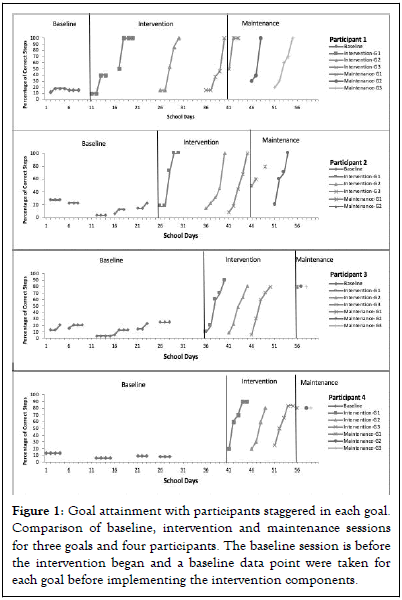
Figure 1: Goal attainment with participants staggered in each goal. Comparison of baseline, intervention and maintenance sessions for three goals and four participants. The baseline session is before the intervention began and a baseline data point were taken for each goal before implementing the intervention components.
The purpose of this study was to use the SDLMI with autismspecific supports to increase goal attainment and selfdetermined behavior, while decreasing support needs in PSE settings for students with ASD. The results of the percentage data and assessments indicated the SDLMI increased the participants’ ability to set and attain goals using tasks analysis, including increased SD skills for three of four participants based on percentile data, decreased support needs, learning and applying skills in educational and community settings. Students with ASD in this study were unprepared to maintain their own requirements and responsibilities entering PSE and required instruction to learn how to use self-determination skills to learn to self-direct educational activities.
The participants in the intervention learned to use the educational supports based on ASD strategies independently. At the beginning of the week, participants in the intervention planned their activities for at least one class independently. Students required support to manage courses by breaking down the information into smaller, more understandable parts, but begin tasks without initial questions.
Anecdotal data showed differences in support for students who had not received the intervention required to meet the expectations of their courses, compared to the participants who have learned how to organize and complete college coursework using self-directed strategies. Future research could establish specific instructions for each educational support to replicate the procedures using autism-based learning strategies.
[Crossref] [Google Scholar] [PubMed]
[Crossref] [Google Scholar] [PubMed]
[Crossref] [Google Scholar] [PubMed]
[Crossref] [Google Scholar] [PubMed]
Citation: Moates MM (2026) The Effects of the Self-Determined Learning Model of Instruction on Goal Attainment and Self-Determination for Students with Autism Attending College. Autism-Open Access. 16:468.
Received: 27-Nov-2024, Manuscript No. AUO-25-35436; Editor assigned: 02-Dec-2024, Pre QC No. AUO-25-35436 (PQ); Reviewed: 16-Dec-2024, QC No. AUO-25-35436; Revised: 02-Jun-2026, Manuscript No. AUO-25-35436 (R); Published: 09-Jun-2026 , DOI: 10.35841/2165-7890.26.16.468
Copyright: © 2026 Moates MM. This is an open-access article distributed under the terms of the Creative Commons Attribution License, which permits unrestricted use, distribution, and reproduction in any medium, provided the original author and source are credited.