
Journal of Agricultural Science and Food Research
Open Access
ISSN: 2593-9173
ISSN: 2593-9173
Review Article - (2025)Volume 16, Issue 1
Amino acid are organic molecules that are important for stimulation for cell growth. It can directly or indirectly influence the physiological activity in plant growth and development because they are considered precursor and constituent of protein. They are also responsible for enhancing the biosynthesis of protein, plant pigment, vitamin and natural hormones such as IAA and ethylene which stimulate cell division. Fulvic acid is a kind of plant growth regulator which can promote plant growth. It is the most significant component of organic and natural substances and is highly beneficial for plants as well as soil its increases microbial activity, promotes nutrient uptake and enhances vegetative characteristics. Humic acid is known as the organic material that helps the plant to withstand harsh environment when applied in small quantities. It also stimulates enzymes in many biological processes, enhances plant resistance to biotic stress, photosynthesis rate, promotes sugar and amino acid metabolism and increases cell wall thickness, prolonging fruit storage period.
Amino acid; Fulvic acid; Humic acid; Fruit crops; Bio stimulants
Amino acid, fulvic acid and mumic acid are organic compounds or bio stimulants. Bio-stimulants at very low concentrations improve basic biochemical processes or other physiological processes in plants and soil, thereby improving growth, development, yields, quality, post-harvest shelf life and increasing stress resistance. Amino acid, any of a group of organic molecules that consist of a basic Amine group (-NH), an acidic Carboxyl group (-COOH) and an organic R group (or side chain) that is unique to each amino acid. The term amino acid is short for α- amino (alpha-amino) carboxylic acid. Each molecule contains a central Carbon (C) atom, called the α-carbon, to which both an amino and a carboxyl group are attached. The remaining two bonds of the α-carbon atom are generally satisfied by a Hydrogen (H) atom and the R group. Fulvic acid, one of two classes of natural acidic organic polymer that can be extracted from humus found in soil, sediment or aquatic environments. Its name derives from the Latin Fulvus, indicating its yellow colour. This organic matter is soluble in strong acid (pH=1) and has the average chemical formula C135H182O95N5S2. It's good plant growth regulator, promotes the growth of plants, improve the ability of plants to resist stress and drought and improves crop yield and quality. The main application is on peanut, tobacco, apple, grapes, melon fruit, vegetables and so on. Humic acids, are the fraction of humus that is soluble in water, except for conditions more acidic than pH 2. Common colors are dark brown to black. Humic acids are the final breakdown constituents of the natural decay of plant and animal materials. The humic matter is formed through the chemical and biological humification of plant and animal matter and the biological activities of microorganisms. Humic acids are complex molecules that exist naturally in soils, peats, oceans and fresh waters [1].
Amino acid
The essential unit responsible for protein molecule formation. They are organic carbon acid made up of Amino (NH2) and Carboxyl (COOH) groups in addition to the Alkyl (R) group which is specific to each amino acid and known as a side chain. Amino acids are the basic ingredient in protein biosynthesis.
More than 20 types of amino acids play a role in the biosynthesis process (Figure 1).
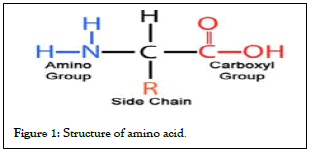
Figure 1: Structure of amino acid.
Points have to be considered during spraying amino acids on plant:
• Spraying the amino acids during the early morning.
• Avoid mixing compounds containing calcium and sulphur with mineral oils.
• Spraying amino acids at the beginning of the critical growth stages in order to enhance the root and shoot growth.
• In the case of use of individual amino acids, it is preferable to treat the lack of elements before spraying (Table 1).
| Essential amino acids | Non-essential amino acids | Special amino acids |
| Lysine | Cysteine | GABA |
| Methionine | Tyrosine | DOPA |
| Valine | Serine | Citrulline |
| Valine | Alanine | Ornithine |
| Isoleucine | Arginine | Taurine |
| Phenylalanine | Aspartic acid | |
| Threonine | Glutamic acid | |
| heroine | Proline |
Table 1: Types of amino acids.
General features of plant amino acid
• Protein synthesis and regulate stomatal opening.
• Stress resistance, hormones and PGRs.
• Effect of photosynthesis.
• Cheating agent.
• Pollination and fruit formation.
Effect of amino acid on fruit crops: Foliar application of 100 ppm tryptophan at full bloom and four weeks later gave a minimum number of cracked fruits (18 and 7), fruit cracking percent (8.04% and 7.42%) and maximum fruit weight (408 g and 417 g) and fruit diameter (9.08 cm and 9.63 cm) during both years, respectively in pomegranate cv. Manfalouty. Foliar spraying of seaweed extract @ 2 ml/L+amino acid @ 0.5 ml/L at full bloom stage recorded maximum shoot length (48.11 cm and 49.12 cm), number of leaf (47.0 and 48.33), leaf area (38.77 cm2 and 38.97 cm2) and chlorophyll content (37.59 mg/g and 36.44 mg/g) during both years, respectively in Anna apple [2].
Foliar application of 0.50 % amino acid at 14 days after full bloom and 15 days after the first spray gave maximum fruit retention (89.28 %) and minimum fruit drop (10.71%) in peach cv. ‘Florda Prince’. Foliar application of glutamic acid @ 400 ppm at the fruit setting stage recorded maximum fruit diameter (9.12 cm), fruit length (11.28 cm), fruit weight (458.7 g), pulp weight (368.50 g) and juice volume (120 cm3). This treatment also improves the quality of mango fruit cv. Zebda [3].
Fulvic acids
Fulvic acids are a family of organic acids, natural compounds and components of the humus (which is a fraction of soil organic matter). They are similar to humic acids with differences being their carbon and oxygen contents, acidity, degree of polymerization, molecular weight and color [4].
General features of plant fulvic acid
• Reduce stomatal opening to improve crop drought resistance.
• Improve a variety of plant enzyme activity and chlorophyll content, so as to improve the crop cold resistance, disease resistance and other resilience.
• Complex trace elements, excellent complexing agent, improve plants' ability to absorb and operate trace elements.
• Form pesticides-fulvic acid complex through physical and chemical effects, reduce pesticide toxicity, reduce pesticide dosage, enhance pesticide efficacy.
• Improve fertilizer absorption.
Effect of fulvic acid on fruit crops: Maximum yield per palm (174.16 kg and 169.33 kg), fruit weight (33.29 g and 32.45 g) and flesh weight (30.93 g and 30.07 g) during both years, respectively were recorded under 50 cm depth soil application of fulvic acid @ 83.33 ml L/palm, micro-element (Fe 3.12 g, Zn 1.56 g, Mn 1.56 g) and micro-organism 83.33 ml L/palm in Zaghloul date palm. Foliar application of fulvic acid @ 4 liter/fed with calcium (0.4%)+zinc (250 ppm)+boron (20 ppm) at after complete fruit set gave maximum fruits number/tree (297.3 and 298.60), fruit yield (52.63 and 54.96 kg/tree) and yield (17.52 and 18.30 ton/ fed) during both years, respectively in Anna apple [5].
Foliar application of chitosan+salicylic acid+fulvic acid @ 500 ppm at one week after fruit set and at version stage recorded maximum yield (10.08 and 10.15 kg/vine), cluster weight (560.33 and 577.0 g), 100 berry weight (255 and 266 g) during both years, respectively in Thompson seedless grapevine. Foliar application of fulvic acid (9 ml/L/vine) with Mg (1%) and K (2 %) recorded maximum shoot length (151.17 and 152.97 cm), leaf surface area/leaf (114.96 and 115.70 cm2) and total chlorophyll (12.40 and 13.10 mg/g FW) during both the year, respectively in King Ruby grapevines [6].
Humic acid
Humic acid is an organic chemical produced by decaying plants and animals’ residues by a process called “Humification”. One source of humic acid is the sedimentation layers referred to as Leonardite. These layers were originally deep in the Earth’s crust, but over many years have been exhumed to near-surface location. Humic acids are found in high concentrations in these layers. Humic acid has the ability to hold seven times their volume in water, a greater water holding capacity than clay soils. Water stored within the topsoil enables plant roots to quickly access the available nutrients required for plant growth and yield [7].
General features of plant humic acid
Physical benefits:
• Improves soil structure
• Increases water holding capacity.
• Increases aeration of soil.
• Reduces soil erosion.
• The dark colour of soil, which helps in absorption of the sunlight.
Biological benefits:
• Increases germination of seeds.
• Stimulates root growth.
• Improve microbial growth.
• Increases quality and quantity of yields.
• Protection of plants from drought, temperature, salt and alkali stress.
Effect of humic acid on fruit crops: Soil and foliar application of humic acid @ 0.50% after fruit set gave maximum fruit length (5.48 and 5.47 cm), fruit volume (79 and 81 cm3), fruit weight (81.11 and 79.56 g) and yield (72.19 and 71.61 kg/tree) during both seasons, respectively in Florida Prince peach. Foliar application of humic acid @ 3 ml/L at 30 days after transplanting gave a maximum number of fruits (28.3), total carotenoid (17.84 mg g-1) and total lycopene (0.0244 mg g-1) in strawberry cv. Chandler [8].
Foliar spray of humic acid and micro power @ 80 ml gave maximum number of fruits/plant (272), total fruit yield/plant (55.31 kg), fruit diameter (78.65 mm), fruit weight (190.0 g) with maximum plant height (55 cm), stem girth (4.0 cm) and canopy spreading (95 cm3) in citrus trees cv. Kinnow mandarin. Application of 0.30% humic acid+600 mg·L-1 boric acid, minimizes the incidence of alternate bearing and improves annual tree productivity and fruit quality of ‘Zebda’ mango trees. results may be a consequence of the increase in tree photosynthetic pigments, nutrients organic solutes and phytohormones such as auxins, gibberellins and cytokinins. The reduction in abscisic acid content may be related to the role of humic acid and boron protecting the plant against destructive oxidative reactions; improving the ability of the trees to withstand environmental stresses; thereby reducing floral malformation percentage [9].
Our knowledge of amino acid metabolism has increased exponentially in the past three decades. Amino acids and their derivatives have various prominent functions in plants, such as protein synthesis, growth and development, nutrition and stress responses. Humic acid application originally from wastes as a bio stimulant for plant growth is a beneficial and eco-friendly approach and it fits into the concept of circular economy focusing on the conversion to a new resource. Combinations of biochemistry, molecular genetics, genomics and systems biology will continue to promote fundamental research, enabling us to develop ideas and strategies aimed at exploring new features of gene–protein–metabolite regulatory networks. In addition to technological issues, there are significant gaps in our knowledge of certain areas. Given the importance of the nutritional value of amino acids, the Effects of Amino Acid (especially EAA) accumulation on other metabolic pathways during plant growth and development need further attention. Thus, despite our growing knowledge of plant amino acid metabolisms and their metabolic connections, it is clear that many major discoveries have yet to be made.
Citation: Sahu AK, Tandel BM (2025) Role of Amino Acid, Fulvic Acid and Humic Acid in Fruit Crops. J Agri Sci Food Res. 16:200.
Received: 02-Oct-2024, Manuscript No. JBFBP-24-34437; Editor assigned: 07-Oct-2024, Pre QC No. JBFBP-24-34437 (PQ); Reviewed: 21-Oct-2024, QC No. JBFBP-24-34437; Revised: 16-Feb-2025, Manuscript No. JBFBP-24-34437 (R); Published: 23-Feb-2025 , DOI: 10.35248/2593-9173.25.16.200
Copyright: © 2025 Sahu AK, et al. This is an open-access article distributed under the terms of the Creative Commons Attribution License, which permits unrestricted use, distribution and reproduction in any medium, provided the original author and source are credited.