
Poultry, Fisheries & Wildlife Sciences
Open Access
ISSN: 2375-446X
ISSN: 2375-446X
Perspective - (2022)Volume 10, Issue 3
Jellyfish form a large family of planktonic creatures, and recent studies show that there are at least 4,000 that have already been discovered. Considering the vastness of the oceans, scientists believe that this number is barely a fraction of what is actually in the sea. Even with all of these species around the world, only 70 are considered to be a threat to humans. Some of those dangerous species include the Malo kingi and the Chironex Fleckeri, which are both in the box jellyfish family. The venom is potent and painful enough to kill. There are some types that are even kept as pets, primarily for their inability to sting their owner. The most common jellyfish to keep as a pet is the moon jellyfish, which lives for about 15 months.
These animals have tentacles that are equipped with tiny stinging cells that are activated when these fish when they launch a sting attack on their prey. These tentacles are used to paralyze and stun the prey that the jellyfish stings. These tentacles are found hanging from the jellyfish’s body. Though these tentacles are controlled by the nervous system, the sting is rarely fatal. Most box jellyfish have strong enough venom to execute the victim. The purpose of the tentacles is to stop the movement of its prey, though they are also used as a way to defend the animal.
Jelly fish; Life cycle; Habitat
What’s a jellyfish?
It is the second stage of their life cycle, which is typified as a freeswimming marine animal, consisting of a bell and trailing tentacles. They can be of different shapes not just bell-like but also flat (slightly convex at the top and just a little concave at the bottom). Their top part is called an exumbrella and the bottom part sub umbrella. Their mouths are placed at the bottom part of their bodies. Their digestive cavity consists of a tissue layer called gastro dermis, an outside tissue layer called epidermis and a gel-like region in the middle called mesoglea. They have sense organs on the edges of their bell and tentacles that serve mainly for moving and keeping their food.
The first stage of their life is a polyp. The body of polyps is usually cylindrical; lengthen along the axis of their body. They are usually small and colonial or they also live separately. They have one single body orifice and there is a relatively thin layer of gel-like tissue inside of their bodies. Their bottom part is attached to the substrate if they live separately or attached to other polyps if living in a colony. Their front part has a mouth and is surrounded by tentacles. Anthozoans only have one stage of their life polyp. With Hydrozoans, their two stages alternate. Scyphozoans dominant stage is a jellyfish and they usually do not have a polyp stage.
Where do jellyfish live?
They live in seas all over the world, often in sea shores but there are some types that live in the depth of different seas. For example, the Stauromedusidaes live only in cold waters of the northern hemisphere. The Pelagia noctiluca, however lives only in warm waters. The jellyfish we see in aquariums such as the Aurelia aurita live mostly in European seas.
How does a life cycle of a jellyfish look?
Jellyfish have a stalked (polyp) phase when they are attached to coastal reefs, and a jellyfish (medusa) phase when they float among the plankton. The medusa is the reproductive stage; their eggs are fertilized internally and develop into free swimming Planula larvae. After a brief period floating about in surface waters, the larvae settle to the sea floor, attaching them at one end. There they develop into polyps and begin to feed and grow. In spring, some of the polyps start to bud off immature jellyfish known as ephedra larvae. These grow into mature jellyfish (Figure 1).
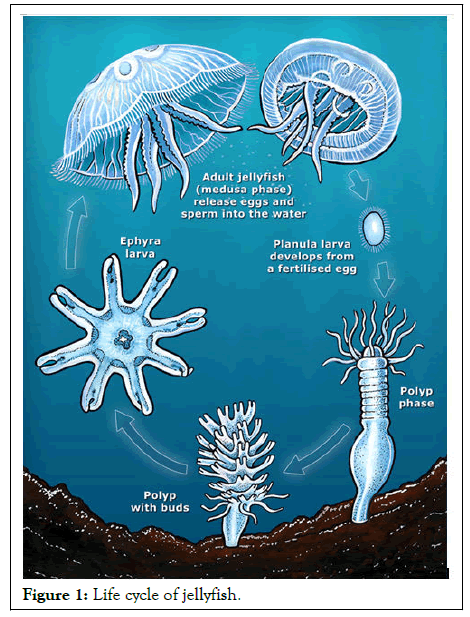
Figure 1: Life cycle of jellyfish.
What are their bodies like?
Their body is in 97% water; usually it is bell-like and semitransparent. Because their body is 95% water, which means they are perfectly camouflaged. The body of a jellyfish is divided into three main parts, the umbrella, the oral arms (around the mouth) and the stinging tentacles.
They are animals with radial symmetry. They have an internal cavity, in which the digestion is carried out, denominated the gastro-vascular cavity and which has a single aperture which carries out the functions of both the mouth and the anus.
Citation: Salimkumar AV, Andrews AA (2022) A Short Note on Jellyfish. Poult Fish Wildl Sci. 10:200.
Received: 19-May-2022, Manuscript No. PFW-22-17568; Editor assigned: 21-May-2022, Pre QC No. PFW-22-17568(PQ); Reviewed: 06-Jun-2022, QC No. PFW-22-17568; Revised: 19-Jul-2022, Manuscript No. PFW-22-17568(R); Published: 25-Jul-2022
Copyright: © 2022 Salimkumar AV, et al. This is an open-access article distributed under the terms of the Creative Commons Attribution License, which permits unrestricted use, distribution, and reproduction in any medium, provided the original author and source are credited.