
Journal of Bone Research
Open Access
ISSN: 2572-4916
ISSN: 2572-4916
Case Report - (2025)Volume 13, Issue 5
Osteoradionecrosis (ORN) following radiation therapy for breast carcinoma is an uncommon but severe late complication that may mimic metastatic disease both radiologically and clinically. Enostosis, also known as a bone island, is a benign intramedullary focus of compact bone that can be incidentally detected during imaging studies and can occasionally simulate a sclerotic metastatic lesion. The coexistence of osteoradionecrosis and enostosis in a single patient with a past history of breast cancer and a recent diagnosis of ovarian malignancy represents a unique diagnostic challenge. This report describes the clinical and radiological findings in a 70-year-old female patient with osteoradionecrosis of the chest wall and enostosis in the lumbar vertebra, with special emphasis on the importance of differentiating benign post-radiation or congenital bone changes from metastatic disease in oncologic patients.
Osteoradionecrosis; Enostosis; Breast cancer; Ovarian cancer
Radiation Therapy (RT) remains a cornerstone treatment modality in the management of breast cancer, significantly improving local control and overall survival. However, the longterm effects of radiation on bone tissue can occasionally lead to deleterious complications such as Osteoradionecrosis (ORN). Osteoradionecrosis is characterized by necrosis of irradiated bone tissue resulting from microvascular damage, decreased cellularity and impaired bone remodeling capacity. The incidence of chest wall ORN is relatively rare compared to mandibular involvement, yet it represents a serious clinical concern due to the risk of secondary infection, chronic pain and structural compromise of the thoracic cage [1].
Radiologically, osteoradionecrosis manifests with a spectrum of findings ranging from cortical irregularity and focal sclerosis to osteolytic destruction depending on the severity and chronicity. Differentiating ORN from local recurrence or radiation-induced metastasis in cancer patients poses a significant diagnostic dilemma. Lesions may appear as sclerotic, lytic or mixed, mirroring the variable patterns observed in metastatic bone disease. Misinterpretation can lead to unnecessary invasive procedures or misdirected therapy [2].
Simultaneously, conditions such as enostosis (bone island) can confound radiologic interpretation. Enostosis refers to a focus of compact cortical bone located within cancellous bone, often discovered incidentally during imaging for unrelated conditions. Though entirely benign and asymptomatic, its dense radiographic appearance can mimic osteoblastic metastasis, especially in those with a known malignant history. The radiologic distinction lies primarily in quantitative assessment features such as Hounsfield Unit (HU) density, margin sharpness and absence of perilesional bone reaction [3].
The present study aims to delineate the diagnostic approach to distinguishing osteoradionecrosis and enostosis from metastatic bone lesions in a patient with dual malignancies. It not only underscores the importance of meticulous radiological evaluation but also emphasizes clinical correlation and imaging pattern recognition to avoid misdiagnosis [4].
A 70-year-old female patient was diagnosed with left breast cancer in 2011 and no significant pathology was detected in the PET CT report taken after left mastectomy at that time. The patient was admitted to us with a new diagnosis of ovarian Ca. Thoracic CT scans performed for staging revealed sclerotic lytic bone lesions in the left 2nd, 3rd and 4th costae, which were not present before. Considering the absence of involvement in Pet CT in a patient with a history of RT and subcutaneous sequelae changes in the same region, sclerotic lesions in the costae were evaluated in favor of osteoradionecrosis and sclerotic bone metastasis was considered in the differential diagnosis with a lower probability (Figures 1 and 2). At the same time, there was a hyperdense, smoothly circumscribed, bone lesion in the left transverse process of the L1 vertebra (Figure 3). The lesion in the L1 vertebra was measured with a mean density of 1009 HU and was evaluated in favor of enostosis due to its characterization [5].
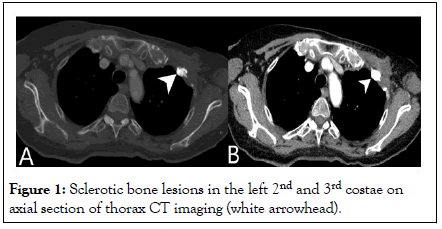
Figure 1: Sclerotic bone lesions in the left 2nd and 3rd costae on axial section of thorax CT imaging (white arrowhead).
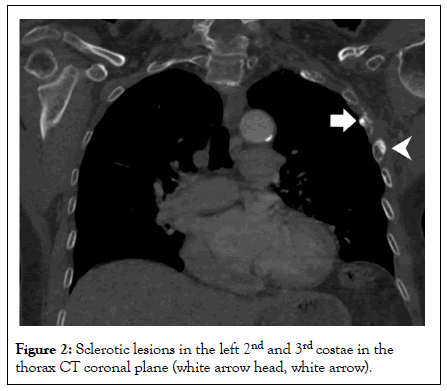
Figure 2: Sclerotic lesions in the left 2nd and 3rd costae in the thorax CT coronal plane (white arrow head, white arrow).
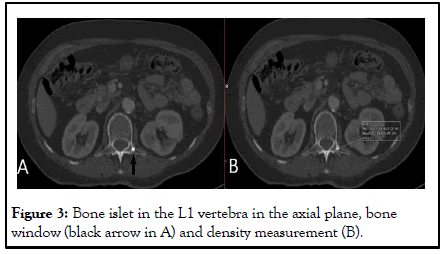
Figure 3: Bone islet in the L1 vertebra in the axial plane, bone window (black arrow in A) and density measurement (B).
Radiological findings
The thoracic CT images demonstrated well-defined mixed lytic and sclerotic lesions with periosteal irregularity and cortical disruption confined to the previously irradiated ribs. The changes were associated with adjacent soft-tissue atrophy and skin thickening findings consistent with post-radiation sequelae. Importantly, a concurrent PET-CT revealed no increased metabolic activity in these rib areas, making metastatic involvement less likely. The absence of Fluorodeoxyglucose (FDG) uptake strongly favored a non-metastatic etiology [6].
Considering the clinical history of prior RT, absence of metabolic activity and the confined distribution of the lesions within the irradiated field, the diagnosis of osteoradionecrosis of the chest wall was made. Sclerotic bone metastases were still considered a differential option but deemed less probable.
Additionally, a well-circumscribed hyperdense lesion was noted in the left transverse process of the L1 vertebra. The lesion was approximately 1.2 cm in diameter, homogeneously dense and without surrounding bone destruction or cortical erosion. Measurement of Hounsfield Unit (HU) attenuation revealed an average density of 1009 HU-a level significantly higher than typical bone metastases. No perilesional sclerosis or reactive bone formation was noted. These features were characteristic of a benign enostosis [7].
Pathophysiology of osteoradionecrosis
Radiation therapy exerts its effects primarily through DNA damage and microvascular endothelial injury. In bone tissues, high-dose radiation disrupts the balance between osteoblastic bone formation and osteoclastic resorption, leading to diminished vascularity, fibrosis and cellular depletion. The resulting hypoxic and hypocellular environment predisposes bone to necrosis and structural breakdown. Over time, osteoradionecrosis manifests as brittle, poorly vascularized bone susceptible to infection and pathologic fracture [8].
The ribs and sternum, though less frequently involved than the mandible, may still undergo osteoradionecrotic transformation in cases where high radiation doses are administered to the thoracic wall. Breast cancer patients receiving chest wall radiation are particularly at risk, especially if they have compromised local circulation or post-surgical tissue damage.
Understanding enostosis
Enostosis (bone island) is an incidental benign focus of compact bone that develops within cancellous regions, typically demonstrating extremely high attenuation values on CT-often exceeding 1000 HU. Common sites include the pelvis, femora, humeri, and vertebrae. Enostoses are round or ovoid, sharply marginated and lack bone destruction or reactive sclerosis. They do not enhance with contrast nor demonstrate metabolic activity on PET-CT scans, making them radiologically distinguishable from sclerotic metastases.
In this patient, the L1 vertebral lesion displayed the classic imaging features of enostosis, with no perilesional edema or contrast enhancement, reaffirming its benignity. Recognition of enostosis is essential in oncologic imaging, as misinterpreting it as a metastatic deposit could alter staging and lead to undue psychological and therapeutic consequences [9].
Clinical relevance of coexisting lesions
This case highlights a complex yet educational diagnostic scenario: The coexistence of post-radiation ORN and an incidental enostosis in a cancer patient under evaluation for a new malignancy. It underscores the necessity for radiologists and oncologists to maintain a broad differential diagnosis and apply a pattern-based approach that incorporates clinical history, radiation fields and imaging modalities.
Relying solely on structural imaging may lead to misinterpretation, while functional imaging such as PET-CT provides additional metabolic insight. Quantitative tools like HU density assessment on CT also prove invaluable, as values greater than 885 HU are highly suggestive of enostosis rather than metastasis.
Osteoradionecrosis of the chest wall, though rare, is an important late complication of radiation therapy for breast cancer. It can present with radiologic features easily mistaken for metastatic disease. Concurrently, benign skeletal entities like enostosis can simulate osteoblastic metastases in imaging studies, especially in patients with a background of malignancy.
In this case, careful radiologic interpretation integrating clinical history, PET-CT findings, HU quantification and anatomical correlation enabled differentiation of benign post-radiation and developmental lesions from metastatic pathology. A multidisciplinary, evidence-based approach thus remains essential in evaluating ambiguous bone lesions in oncologic patients, preventing unnecessary biopsy, misdiagnosis or overtreatment. Diagnostic vigilance and awareness of such benign mimickers are crucial to ensure appropriate management decisions, conserve patient quality of life and optimize oncologic care outcomes.
[Crossref] [Google Scholar] [PubMed]
[Crossref] [Google Scholar] [PubMed]
[Crossref] [Google Scholar] [PubMed]
[Crossref] [Google Scholar] [PubMed]
[Crossref] [Google Scholar] [PubMed]
[Crossref] [Google Scholar] [PubMed]
[Crossref] [Google Scholar] [PubMed]
[Crossref] [Google Scholar] [PubMed]
Citation: Cemile A (2025) Osteoradionecrosis Secondary to Radiotherapy and Incidental Enostosis in the Differential Diagnosis of Osteoblastic Bone Metastasis. J Bone Res. 13:251.
Received: 24-Sep-2024, Manuscript No. BMRJ-25-34256; Editor assigned: 27-Sep-2024, Pre QC No. BMRJ-25-34256 (PQ); Reviewed: 11-Oct-2024, QC No. BMRJ-25-34256; Revised: 09-Feb-2025, Manuscript No. BMRJ-25-34256 (R); Published: 16-Sep-2025 , DOI: 10.35841/2572-4916.25.13.251
Copyright: © 2025 Cemile A. This is an open-access article distributed under the terms of the Creative Commons Attribution License, which permits unrestricted use, distribution, and reproduction in any medium, provided the original author and source are credited.