
Journal of Clinical and Experimental Ophthalmology
Open Access
ISSN: 2155-9570
ISSN: 2155-9570
Case Report - (2025)Volume 16, Issue 6
Iris implants were originally described as an option to treat photophobia and glare associated with aniridia, coloboma, corectopia or any other causes of acquired or congenital iris defects. They are not designed to be used in healthy phakic eyes and not approved by regulatory bodies anywhere in the world for cosmesis. However, widespread publicity and the compulsive need for beautification has popularized the illicit use of these implants. Implantation into phakic eyes causes mechanical irritation of angle structures leading to chronic inflammation, pigment dispersion, prolonged endothelial cell loss and angle closure. The consequences are dire, leading to presentation of such patients with serious complications involving the cornea, angle and lens. Here is a short review of available literature on cosmetic iris implants. It is to be emphasized that implantation of these devices solely for a better cosmetic appearance is a malpractice. In order to treat the complications associated with deficient iris there are safer devices available and approved. There is a need to spread patient awareness regarding the same.
Cosmetic iris; Corneal decompensation; Glaucoma; Cataract; Uveitis
The first artificial iris implant was described by Professor Peter Choyce in 1964 as an Anterior Chamber (AC) prosthetic iris device. Professor Choyce was an early pioneer of intraocular lenses and developed a technique where the transparent Polymethylmethacrylate (PMMA) polymer haptics were thermally fused with ferrous compounds, indocyanine green and cobalt blue to give brown, green and blue colored irides respectively. This was the direct forerunner of modern artificial iris diaphragms used today for traumatic or congenital iris defects [1].
Functional prosthetic iris devices are of 2 types: Iris diaphragm implant and iris-lens diaphragm implant. The former is placed anterior to the iris whereas the latter is placed posterior to the iris, either in capsular bag, ciliary sulcus or fixed to the sclera, depending on the availability of supporting structures. Artificial iris implants have been successfully used in traumatic iris defects, congenital iris colobomas, aniridia, herpetic iris atrophy, surgical iris loss and ocular albinism implants in the AC are known to cause mechanical irritation of angle structures leading to chronic inflammation, pigment dispersion, prolonged endothelial cell loss and compression of the trabecular meshwork. They are neither indicated nor approved by the US Food and Drug Administration (FDA), for implantation into healthy phakic eyes. However, for more than two decades, there have been reports of cosmetic iris implants being illicitly used to change the iris color, often resulting in vision-threatening complications and requiring explanation [2].
The first such cosmetic iris was propagated as New Iris by Kahn and Liakopulos in 2004 (Kahn DA, Liakopulos P. New cosmetic artificial iris diaphragm implant (NewIris): 8-month follow-up. In Joint Meeting of the American Academy of Ophthalmology and the European society of ophthalmology 2004 Oct 23, claiming that 12 patients who underwent this procedure, had a mean endothelial cell loss of just 2.6% with 8 months of follow-up. At another presentation about the same implant in 2 patients with ocular albinism, there were reportedly no complications at 1 year of follow up. The new iris implant is an iris diaphragm composed of silicon with 6 semi-circular peripheral flaps instead of haptics for placement in the AC. It ranges in diameter from 11 mm-13 mm, with a fixed, central opening in the pupil of approximately 3.5 mm and a thickness of 0.16 mm. Being thin and elastic in nature, it can be easily inserted through a 2.8 mm clear corneal incision under topical anesthesia. The device was widely advertised as a means to permanently change eye color “without the limitations, risks and annoyances of contact lenses” and since it was approved for use only in Panama, patients motivated by advertisements often travelled there, seeking this surgical option (Figure 1). Following this, several case reports on complications following bilateral implantation of new iris or new color iris were published [3-5].
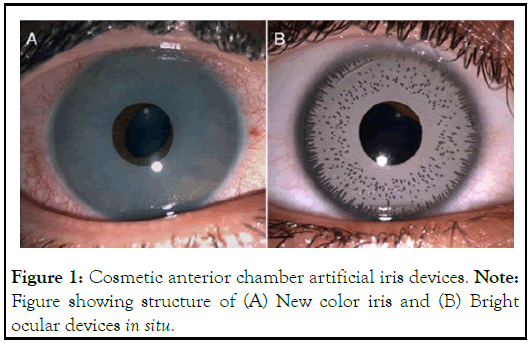
Figure 1: Cosmetic anterior chamber artificial iris devices. Note: Figure showing structure of (A) New color iris and (B) Bright ocular devices in situ.
Cosmetic iris implants are being marketed and advertised by the manufacturers as a safer alternative to cosmetic contact lenses with minimal complications. However, several authors have reported onset of devastating complications from early to late post-operative period with these implants. The first such reports emerged with the fraudulent use of new color iris implants, followed by others like bright ocular implants. Garcia-Pous et al described a case of a 21-year-old woman who presented with acute and progressive diminution of vision, corneal oedema and increased IOP following implantation of new iris artificial lenses. The lenses were explanted but there was a permanent decrease in endothelial cell count and pigment dusting. Anderson et al reported an interventional case series of 2 patients who underwent the same implant and presented with endothelial cell loss, uveitis, pigment dispersion and elevated IOP within 4 weeks of implantation. Both underwent explantation of the implants but one of these patients needed a trabeculectomy later whereas the other had developed bullous keratopathy. Thiagalingam et al. reported a case of a 19-year-old patient who developed uveitis, corneal decompensation and ocular hypertension within 13 days of receiving the implants in both eyes. Even after explantation, early nuclear sclerotic changes were noted in both eyes. A case of Uveitis-Glaucoma- Hyphema (UGH) syndrome was reported by Arthur et al in a 29-year-old patient with new iris implants (Figure 2). The patient developed a permanent corneal haze later on. George et al reported a case of bilateral irreversible vision loss following neovascular glaucoma with central retinal vein occlusions secondary to cosmetic iris implantation. Jonsson, et al. reported the case of a 37-year-old who developed elevated IOPs and progressive optic neuropathy within 5 months of implantation [6,7].
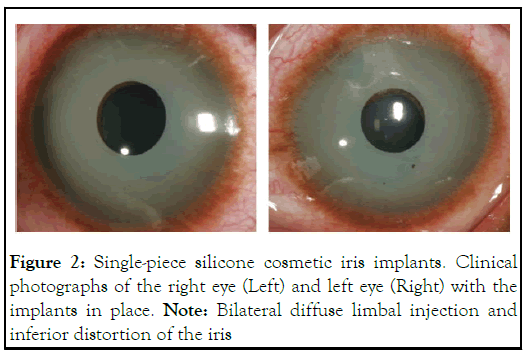
Figure 2: Single-piece silicone cosmetic iris implants. Clinical photographs of the right eye (Left) and left eye (Right) with the implants in place. Note: Bilateral diffuse limbal injection and inferior distortion of the iris
Following concerns raised by ophthalmologists worldwide as well as patients’ self-reported complications on social media platforms, the use of the device gradually declined after nearly >700 procedures by 2010. In 2012, another cosmetic implant viz. bright ocular (Stellar devices, New York, USA) claimed to be made of US-FDA approved material and having better safety profile was introduced and has since been implanted in over 10 countries including Turkey, Tunisia, India, China, Lebanon, Jordan, Syria, Mexico, Costa Rica and Albania. Bright ocular is similar in design to new iris except that it claims to minimize iris trauma with the help of posterior grooves that allegedly enable better flow of aqueous. But just like new iris, complications like chronic anterior segment inflammation, pigment dispersion, glaucoma, endothelial cell loss and permanent visual loss from glaucoma were noted. Mansour et al. even reported permanent iris atrophy and pupillary abnormalities after explantation of the device. Unlike new iris, literature on bright ocular iris devices is limited. Most recently, Ghaffari, et al. reported a series of 12 patients who had received either of these implants and underwent subsequent explantation due to well-known complications. In the largest ever literature review on cosmetic iris devices by Galvis, et al. the mean age of the patients undergoing these implants was 32.6 years (Range 19-65 years). The reported countries where these devices have been implanted (upto March 2016) include Panama, Lebanon, India, Turkey, Tunisia, Jordan, Mexico and France, with most of implants being new iris. The complication rate reported was as high as 91.4% and explanation rate was 68.8%, with a significant 9.3% patients having a final visual acuity <20/200. Common complications included corneal decompensation (33.6%), inflammation (30.5%), glaucoma (46.1%) and cataract (14.8%). Chehab, et al. also reported in their study that majority (93.4%) of the patients who had undergone these implants did not receive any information from their surgeon. Most of the reported literature on cosmetic iris implants includes case reports and short case series thereby making it difficult to predict the exact incidence of complications. Nevertheless, glaucoma, corneal decompensation, uveitis and cataract were consistently seen. From being limited to Panama in the early 2000’s, cosmetic iris implants are now being illicitly sold and marketed in Europe, Africa and Asia, with most of the population being young adults lured by advertisements and unknowingly sustaining permanent visual loss from residual ocular damage. Since these implants are being openly advertised,it is imperative that their complications become widely known to ophthalmic scientific bodies and patients be strongly advised against their use [8].
In patients with iris defects such as aniridia and large colobomas, there is often pronounced photophobia and cosmetic disfigurement. To reconstruct iris in such cases, Dr Hans Reinhard Koch together with Dr. Schmidt Intraocularlinsen GmbH, developed an artificial iris implant that has been commercially available since 2007 under the name of ArtificialIris (Human optics©). This device has a 3-layered silicon structure where the middle most layer is incorporated with medical grade pigments to match the color of the iris. The implant is both flexible and foldable and easily inserted through a 3 mm incision. It measures 12.8 mm in diameter with thickness varying from 0.25 mm to 0.40 mm (Figure 3). The implant can be customized with scissors or a trephine for every individual eye. It can be implanted into ciliary sulcus and suturefixated to sclera or a small portion can be sutured to the remaining iris tissue. These devices have been successfully used in eyes with congenital or acquired iris defects with good functional and aesthetic outcome. Table 1 summarizes the available iris prosthetic devices [9].
| Implant name | Implant type | Indications | Complications* |
| Type 67G Morcher aniridia implant | Rigid diaphragm devices with a peripheral opaque annulus with IOL-style haptics | Aniridia (acquired or congenital), iris coloboma, traumatic iris dehiscence | Elevated IOP, capsular fibrosis, trauma to residual iris, decreased endothelial cell count, corneal decompensation, cystoid macular oedema, device dislocation, device breakage, technically difficult insertion and retinal detachment. |
| Type 50F Morcher capsular tension ring | Small-incision devices incorporating a capsular ring | Sectoral iris coloboma, asymmetric traumatic mydriasis with no capsular support | Elevated IOP, corneal decompensation, cystoid macular oedema, device dislocation, technically difficult insertion, no cosmetic advantage, secondary pupil and disturbed vision |
| Type 96F Morcher segments | Small-incision devices incorporating a capsular ring | Sectoral iris coloboma (congenital or acquired) | Elevated IOP, corneal decompensation, cystoid macular oedema, device dislocation, technically difficult insertion, no cosmetic advantage, secondary pupil and disturbed vision dislocation, technically difficult insertion, no cosmetic advantage, secondary pupil and disturbed vision |
| Human optics custom flex® artificial intelligence | Customized flexible small-incision iris prostheses | Aniridia (acquired or congenital), iris coloboma (acquired or congenital), traumatic iris dehiscence | Elevated IOP, corneal decompensation, recurrent bleeding, iris retraction syndrome and darkening of the residual iris |
| Note: It is important to interpret these complications in the context of the concurrent ocular comorbidities which are often present in eyes requiring an artificial iris; *Complication rates higher with scleral fixated devices and sulcus placed devices. | |||
Table 1: Availability of iris prosthetic devices.
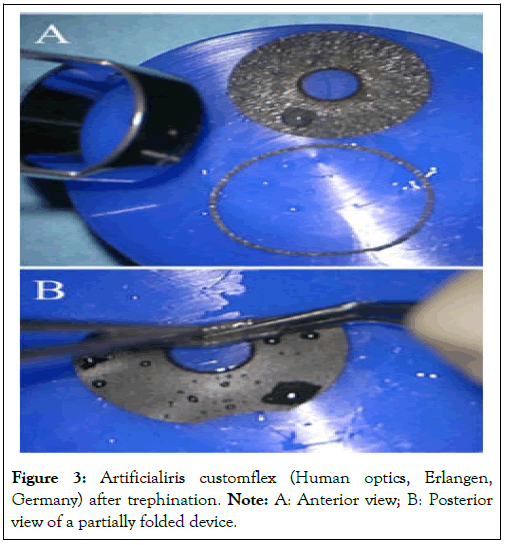
Figure 3: Artificialiris customflex (Human optics, Erlangen, Germany) after trephination. Note: A: Anterior view; B: Posterior view of a partially folded device.
Being sulcus or bag-fixated, these devices are not reported to cause uveitis. The risk of IOP increase and corneal decompensation is higher in those with pre-existing glaucoma and poor endothelial cell density, just like any other intraocular surgery. Though long-term studies on safety and efficacy of these implants are limited, they are approved and recommended for medical reasons and found to have good functional and cosmetic results.
Patients who want to permanently change eye color for beautification can be easily lured by advertisements and resort to surgical implantation of cosmetic iris implants. Sadly, they end up with varying degrees of vision loss from serious complications such as corneal decompensation, angle-closure glaucoma and cataract. These procedures should be vehemently discouraged. Patients need to be educated about the proper indications of iris implants and the availability of safer devices in those with need.
[Crossref] [Google Scholar] [PubMed]
[Crossref] [Google Scholar] [PubMed]
[Crossref] [Google Scholar] [PubMed]
[Crossref] [Google Scholar] [PubMed]
[Crossref] [Google Scholar] [PubMed]
[Crossref] [Google Scholar] [PusbMed]
[Crossref] [Google Scholar] [PubMed]
[Crossref] [Google Scholar] [PubMed]
[Crossref] [Google Scholar] [PubMed]
Citation: Chaturvedi I, Chauhan T (2025) Not All That Glitters Are Gold-Cosmetic Iris Implants. J Clin Exp Ophthalmol. 16:1005.
Received: 07-Oct-2024, Manuscript No. JCEO-24-34503; Editor assigned: 10-Oct-2024, Pre QC No. JCEO-24-34503 (PQ); Reviewed: 24-Oct-2024, QC No. JCEO-24-34503; Revised: 02-Nov-2025, Manuscript No. JCEO-24-34503 (R); Published: 09-Nov-2025 , DOI: 10.35248/2155-9570.25.16.1005
Copyright: © 2025 Chaturvedi I, et al. This is an open-access article distributed under the terms of the Creative Commons Attribution License, which permits unrestricted use, distribution and reproduction in any medium, provided the original author and source are credited.