
Journal of Clinical and Experimental Ophthalmology
Open Access
ISSN: 2155-9570
ISSN: 2155-9570
Research Article - (2025)Volume 16, Issue 6
Objective: To establish an ex vivo porcine eye model for direct observation of Intraocular Lens (IOL) haptic unfolding within the capsular bag under physiologic temperature conditions and to compare unfolding behavior among different hydrophobic acrylic IOL designs.
Methods: Freshly enucleated porcine eyes were used to simulate cataract surgery. A custom aluminum eye holder maintained the ocular surface near body temperature to reproduce physiologic conditions. The iris was removed to allow direct visualization of the capsular bag and equatorial region. Three one-piece hydrophobic acrylic IOLs with different haptic structures were evaluated: CNL0T0 with C-loop and hinged haptics, XY1 SP with C-loop haptics without hinges and PODF GF with double C-loop haptics. Following implantation into the capsular bag, haptic unfolding was observed using vertical and tilted surgical microscope views. Total unfolding time and contact patterns between the haptics and the capsular equator were compared among the IOLs.
Results: Distinct unfolding characteristics were observed among the three IOLs. CNL0T0 gradually unfolded within 136 s with limited capsular contact near the haptic tips. XY1-SP unfolded more slowly, completing at 195 s after manipulation, with partial haptic contact. PODF GF rapidly and simultaneously unfolded within 40 s, showing two capsular contact points associated with its double C-loop design. The present observation system enabled detailed visualization of haptic movement and capsular interaction throughout the unfolding process.
Conclusion: This ex vivo porcine eye model enabled detailed observation of IOL haptic unfolding under conditions approximating the physiologic intraocular environment. Differences in unfolding dynamics and haptic–capsular contact patterns were identified among the evaluated IOLs, suggesting that haptic design may influence early postoperative fixation behavior.
Intraocular Lens (IOL); Haptic unfolding; Capsular bag dynamics; Porcine eye
Cataract surgery is a safe and effective procedure for the restoration of vision impairment using small-incision Intraocular Lenses (IOLs), supported by advances in Phacoemulsification and Aspiration (PEA) technology and improved Ophthalmic Viscosurgical Devices (OVDs). IOLs are inserted in the anterior segment of the eye using injectors designed for each IOL model. After implantation, the IOL haptics unfold and contact the capsular equator to establish the IOL position. Haptic unfolding is influenced by various factors such as the material and design of the haptics, capsule size, and ambient temperature during haptic unfolding [1-3]. However, the presence of the iris on the capsule makes the clinical observation of how a haptic unfolds and contacts the capsule challenging. In ex vivo porcine eye studies, IOLs are at room temperature (20â-25â), whereas the anterior chamber is near body temperature [4]. Understanding the kinetics of haptic unfolding is crucial, especially for investigating axis alignment after implantation of toric IOLs [5]. Thus, a method for observing haptic unfolding under a pseudo anterior chamber condition of living porcine eyes was developed.
Porcine eye preparation
Fresh porcine eyes enucleated within 5h were obtained from a local slaughterhouse (Tokyo Metropolitan Central Wholesale Market, Tokyo, Japan) and fixed in the aluminum eye holder on a temperature-controlled breadboard (PTC1/M, Thorlabs, Newton, NJ, USA) [4]. A temperature-controlled breadboard maintained the holder at body temperature (36â), while the anterior chamber temperature was continuously monitored. To observe the contact between the haptics and the capsular equator, the entire iris of each porcine eye was removed by iridectomy [6,7]. After filling with the OVD (Provisc®, Alcon Vision, Fort Worth, TX), the remaining iris tissue was removed using capsule diathermy (CD-1000, Tagawa Electronic Research Institute, Chiba, Japan).
Cataract surgery and IOL implantation
Three types of IOLs were evaluated: CNL0T0 (Alcon Vision), XY1-SP (Hoya, Tokyo, Japan), and PODF GF (BVI, Waltham, MA). CNL0T0 is a hydrophobic acrylic Clareon® IOL, with a total length of 13.0 mm and an optic diameter of 6.0 mm [8]. Its haptics are designed as modified C loops with flexible hinges. XY1-SP is a hydrophobic acrylic Vivinex® IOL with the same total length and optic size [8]. Its haptics are designed as step-vaulted C-loops without flexible hinges. PODF GF is an IOL made of a novel hydrophobic acrylic material (a cross-linked acrylate/methacrylate copolymer), with a total length of 11.4 mm and optic size of 6.0 mm [9]. Its haptics have a double C-loop configuration. The IOL powers were 16.0 D for CNL0T0 and 20.0 D for XY1-SP and PODF GF. The injectors used were MONARCHIII (Alcon) for CNL0T0 and XY1-SP and ACCUJECT (Medicel AG, Altenrhein, Switzerland) for PODF GF. Each IOL model was evaluated in three independent porcine eyes, and consistent unfolding behavior was reproducibly observed across replicates.
Cataract surgery was performed by a single surgeon (S.Y.). The cataract was removed by phacoemulsification and aspiration (PEA) through a 2.4-mm corneal incision using CENTURION® Vision System (Alcon). After filling with the OVD, IOLs were inserted through a 2.6-mm incision. Cataract surgery was performedImmediately after insertion, unfolding of the entire IOL was observed in the vertical view of a surgical microscope (Lumera 700, Carl-Zeiss, Jena, Germany) and recorded. Contacts between the unfolded haptics and the capsular equator were also observed in a view tilted by 45°.
Figure 1 shows the dynamics of CNL0T0 unfolding (upper, vertical view) and the contact between the haptics and the capsule (lower, tilted view). After inserting IOL CNL0T0 into the capsular bag, the leading and trailing haptics gradually unfolded. The time course after insertion is presented, and the unfolding terminated in 136 s. In the tilted view, the contact between the haptics and the capsule is identified with a red arrow. The haptics were hinged adjacent to the haptic–optic junction, and a short portion near the haptic ends contacted the capsule.
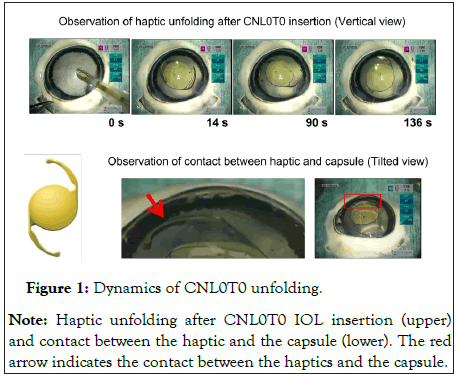
Figure 1: Dynamics of CNL0T0 unfolding.
Note: Haptic unfolding after CNL0T0 IOL insertion (upper) and contact between the haptic and the capsule (lower). The red arrow indicates the contact between the haptics and the capsule.
Figure 2 shows the dynamics of XY1-SP unfolding (upper, vertical view) and contact between the haptics and the capsule (lower, tilted view). After the insertion of IOL XY1-SP into the capsular bag, both haptics slowly unfolded. The IOL was rotated using a hook to facilitate unfolding at 64 and 157 s, and the unfolding terminated at 195 s. In the tilted view, the haptic–capsule contact was different from that of CNL0T0. The haptics lacked hinges, and only half of the haptic contacted the capsule (red arrow).
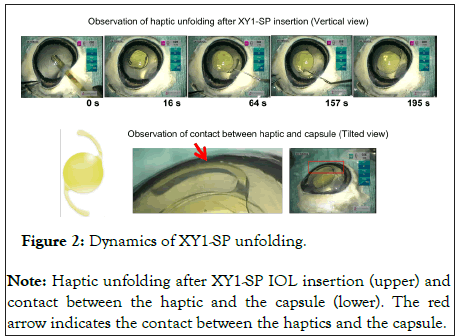
Figure 2: Dynamics of XY1-SP unfolding.
Note: Haptic unfolding after XY1-SP IOL insertion (upper) and contact between the haptic and the capsule (lower). The red arrow indicates the contact between the haptics and the capsule.
Figure 3 shows a PODF GF IOL with a double C-loop haptic. After injection into the capsular bag, the haptics unfolded rapidly and simultaneously, completing unfolding within 40 s. This behavior was ascribed to the unique material, size, and design of the double C-loop. In the tilted view, two points of contact on the capsule can be observed, with approximately half of the haptics in contact.
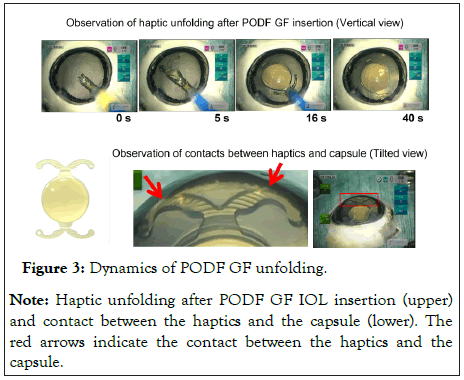
Figure 3: Dynamics of PODF GF unfolding.
Note: Haptic unfolding after PODF GF IOL insertion (upper) and contact between the haptics and the capsule (lower). The red arrows indicate the contact between the haptics and the capsule.
In this study, observations of three types of IOLs using iris-free porcine eyes, an eye holder maintaining physiological temperature, and 45° tilted microscopic views demonstrated how the haptics unfolded within the capsule and involved the capsular equator under pseudo-anterior chamber condition. Although the observed IOLs were limited, to the best of our knowledge, this is the first report of the current observations. Temperature control in the porcine eye simulated the physiological condition of the anterior chamber. In fact, temperature change during cataract surgery was controlled [4]. The tilted microscopic view of iris-free porcine eyes enabled the visualization of the capsular equator. For retrolenticular observation, the Miyake-Apple technique was employed in cataract surgery research. In this technique, the eye globe is bisected at the equator, and the anterior half is placed on a glass slide for posterior visualization of the anterior segment during surgery [10,11]. For studying the dynamics of implanted IOLs, our observation method is deemed beneficial and effective, which allows maintaining the eye at body temperature with minimal interventions.
The duration of haptic unfolding shortens with increased ambient temperatures. In a laboratory experiment, Eom et al., measured the unfolding times of hydrophobic acrylic IOLs [3], which were implanted using warmed OVDs [12]. Clinically, anterior chamber temperature can vary with the injection of cold OVD and balanced salt solution, which can be simulated using a temperature-controlled eye holder [4]. Thus, we consider the current observation method effective for studying haptics dynamics. During toric IOL implantation, rotation after alignment of the toric axis is critical; thus, this observation approach may be also beneficial. However, further evaluations are required.
Complete unfolding took >2 min in IOLs with open-loop haptics (CNL0T0 and XY1-SP), whereas their contact times to the capsules varied. The mechanical properties of IOLs and haptics are ensured according to the ISO 11979-3:2012 [13] for a 10.0 mm diameter or evaluated for diameters ranging from 9.5 mm to 11.0 mm [9]. However, the manner in which an IOL is fixed within the capsular bag has been rarely investigated. Clinically, assessing this is also challenging, as the ends of haptics are typically covered by the iris.
Therefore, we anticipated that the current observation method would be valuable for understanding the haptic contact with the capsule.
This study has some limitations. First, only three IOLs were observed. The dynamics of haptic unfolding vary with the material and design of the haptics, IOL power, ambient temperature, and IOL manipulation. Hence, more types of IOLs with different powers should be assessed. Ideally, observations in vertical and tilted views should be performed simultaneously; however, this could not be performed in this study. Thus, further improvement is necessary. The present study was primarily intended as a qualitative observational investigation, and the sample size was limited. Further quantitative studies with larger sample sizes will be necessary to statistically compare unfolding kinetics among different IOL designs.
In conclusion, the observation method using an iris-free porcine eye at controlled temperature provided an ex vivo platform for understanding the dynamics of haptic unfolding.
[Crossref] [Google Scholar] [PubMed]
[Crossref] [Google Scholar] [PubMed]
[Crossref] [Google Scholar] [PubMed]
[Crossref] [Google Scholar] [PubMed]
[Crossref] [Google Scholar] [PubMed]
[Crossref] [Google Scholar] [PubMed]
[Crossref] [Google Scholar] [PubMed]
[Crossref] [Google Scholar] [PubMed]
[Crossref] [Google Scholar] [PubMed]
[Crossref] [Google Scholar] [PubMed]
[Crossref] [Google Scholar] [PubMed]
[Crossref] [Google Scholar] [PubMed]
Citation: Yaguchi S, Minami K, Bissen-Miyajima H (2026). Ex Vivo Observation of Intraocular Lens Unfolding. Clin Exp Ophthalmol.17:1037.
Received: 15-May-2026, Manuscript No. JCEO-26-41801; Editor assigned: 18-May-2026, Pre QC No. JCEO-26-41801 (PQ); Reviewed: 01-Jun-2026, QC No. JCEO-26-41801; Revised: 08-Jun-2026, Manuscript No. JCEO-26-41801 (R); Published: 16-Jun-2026 , DOI: 10.35248/2155-9570.25.16.1037
Copyright: © 2026 Yaguchi S, et al. This is an open-access article distributed under the terms of the Creative Commons Attribution License, which permits unrestricted use, distribution, and reproduction in any medium, provided the original author and source are credited.