
Translational Medicine
Open Access
ISSN: 2161-1025
ISSN: 2161-1025
Research Article - (2025)Volume 15, Issue 3
Purpose: Shoulder arthroscopy, as a minimally invasive surgical technique for patients who have shoulder injuries, has the advantages of short inpatient period and fast postoperative recovery. However, Patients experienced surgery have a common symptom: Postoperative pain, which can delay rehabilitation and influence the result of treatment. Although there are many managements for pain after shoulder arthroscopy surgery, the adherence rate of interventions remains low and adverse effects often occur. Electroacupuncture is a traditional Chinese medicine treatment which is used to alleviate pain after surgery by inhibiting the functional connection between cerebellum and cortex thalamus in a large number of clinical studies. Therefore, this study aims to explore the effect of electroacupuncture on postoperative pain in patients receiving shoulder arthroscopic.
Materials and methods: This is a single-center, non-inferiority, randomized, single-blind, placebo-controlled trial. This trial aims to evaluate the efficacy and safety of electroacupuncture for analgesia in patients receiving arthroscopic shoulder surgery. 120 patients receiving rotator cuff repair under shoulder arthroscopy will be recruited. They will be randomly divided into an acupuncture analgesia group (patients receive electroacupuncture analgesia and intravenous patient controlled analgesia with 0.9% saline after surgery) and an intravenous analgesia group (patients receive sham electroacupuncture and intravenous patient controlled analgesia with analgesic drugs). The main outcome is postoperative pain score. The secondary outcomes are the patients’ postoperative analgesic requirements, levels of inflammatory factors before and after acupuncture, patient satisfaction, postoperative complications, incidence of delirium, sleep quality and shoulder joint function rehabilitation.
Discussion: This study will be the first time to explore the effect and safety of electroacupuncture on postoperative shoulder pain as a clinical trial. Our finding will provide a new insight to alleviate pain after shoulder surgery.
Acupuncture analgesia; Intravenous analgesia; Postoperative analgesia; Shoulder arthroscopy surgery
Rotator cuff injury is very common among patients who seek medical attention for shoulder pain, far exceeding the so-called "shoulder capsulitis". The most common type of rotator cuff injury is a supraspinatus muscle injury, which typically presents as shoulder pain and restricted shoulder joint movement. Severe rotator cuff injuries may require surgical treatment, often performed using arthroscopy, followed by appropriate rehabilitation to promote the recovery of shoulder joint function. Mild rotator cuff injuries do not require surgical treatment and commonly employ acupuncture, massage, physiotherapy and rehabilitation as clinical treatment methods.
To patients with rotator cuff injuries, arthroscopic incision and reconstruction have the more minimum trauma, rapider recovery and a lower infection rate. Nevertheless, it has 30%-70% of patients may experience moderate to severe pain, especially in 48 hours after the operation, which affects rapid recovery. Overall, reducing postoperative pain is crucial to patients in promoting rehabilitation and improving patient satisfaction and postoperative pain relief has become a key indicator for evaluating the success of surgery.
There are several effective methods to control the pain after shoulder surgery such as Ultrasound guided Interscalene Nerve Blockade (ISB), subacromial/intra-articular injections or infusions, cryotherapy oral medications and intravenous Patient- Controlled Analgesia (PCA). Among them, continuous intermuscular sulcus brachial plexus block is the most effective one in all types of shoulder surgery. ISB is one of the most commonly used analgesic methods, but it can cause serious complications like: Dyspnea, rebound pain, phrenic nerve paralysis, respiratory distress, cardiac arrest, pneumo thorax, central nerve toxicity and Horner syndrome [1].
Intravenous PCA has been utilized for over 40 years to relieve acute pain after surgery. However, the intravenous PCA is invasive modalities and restricts patient mobility. In addition, intravenous PCA using opioids is frequently result in nausea, vomiting, respiratory depression and so on. Which is related to prolonged hospitalizations and hospital readmissions.
Acupuncture is a traditional Chinese medicine treatment method which has more than 2000 years’ history. A quantity of clinical trials has proved that acupuncture has unique advantages to analgesic effects and reduces the postoperative dosage of analgesics by inhibiting the functional connection of cerebellum and cortex thalamus. Previous study has shown that continuous electroacupuncture stimulation for 30 minutes at Hegu, Neiguan, Zusanli and Sanyinjiao could lower postoperative pain and maximum pain scores in patients receiving elective gynecological laparoscopic surgery. In addition, the previous study has shown that electroacupuncture can reduce postoperative analgesic requirements in postoperative patients especially in people who undergoing total knee arthroplasty or total hip arthroplasty. Furthermore, many studies have indicated that electroacupuncture could reduce the incidence of delirium after surgery and improve the shoulder function [2].
Electroacupuncture is also widely used in clinical practice for the treatment of shoulder joint pain. Previous study has shown that, to improve shoulder joint pain and shoulder joint function, electroacupuncture alone is superior to rehabilitation alone. Besides, previous study compared electroacupuncture at the opposite and the same side points on the patients with chronic shoulder pain and showed that the patients in the contralateral acupuncture group have better improvement of shoulder function [3].
This is a randomized controlled and assessor-blinded design trial to evaluate the efficacy and safety of electroacupuncture. The trial was approved by the ethics committee of Shanghai Changhai hspital on January 16, 2023, with an approval number CHEC2023-014 and will be conducted in accordance with the declaration of Helsinki. Explicit informed consent will be obtained from all participants or proxy consent from the next of kin. The reporting of this protocol will be reported based on the SPIRIT (Standard Protocol Items: Recommendations for Interventional Trials) reporting guidelines and STRICTA (Standards for Reporting Interventions in Clinical Trials of Acupuncture). Outcomes will be assessed at baseline, during the treatment and at the end of the follow-up. Outcome assessors, data managers and statisticians will be blinded to the group allocation, while acupuncturists and participants in medication group will not be blinded for obvious reasons. A flow diagram of the study process is shown in Figure 1 and the trial schedule of enrolment, treatments and assessments is showed in Table 1.
| Time point | Enrollment | During the operating room postoperative | |||||||
| Preoperative | Before the surgery | Surgery | PACU | 1 d | 2 d | 1 m | 3 m | 6 m | |
| Enrollment | |||||||||
| Eligibility screening | × | ||||||||
| Informed consent | × | ||||||||
| Allocation | × | ||||||||
| Interventions | |||||||||
| Acupuncture Analgesia group | × | × | × | ||||||
| Intravenous analgesia group | × | × | |||||||
| Assessments | |||||||||
| Baseline variables | × | ||||||||
| Preoperative nocturnal pain | × | ||||||||
| Preoperative sleep status (AIS) | × | ||||||||
| Preoperative blood indicators | × | ||||||||
| Surgical duration | × | ||||||||
| Anesthesia duration | × | ||||||||
| Infusion volume | × | ||||||||
| Cumulative remifentanil | × | ||||||||
| Consumption | |||||||||
| NRS score | × | × | × | ||||||
| Postoperative analgesic demand | × | × | × | ||||||
| Number of times to remedy pain relief | × | × | × | ||||||
| PONV | × | × | |||||||
| Postoperative complications | × | × | × | ||||||
| Delirium (3D-CAM) | × | × | |||||||
| Postoperative nocturnal pain | × | ||||||||
| Patient satisfaction | × | ||||||||
| Postoperative blood indicators | × | ||||||||
| Postoperative sleep status (AIS) | × | × | |||||||
| Postoperative shoulder joint function | × | × | × | ||||||
Table 1: Trial schedule of enrolment, interventions and assessments for effect of clinical study on electroacupuncture intervention for pain in patients after shoulder arthroscopic surgery.
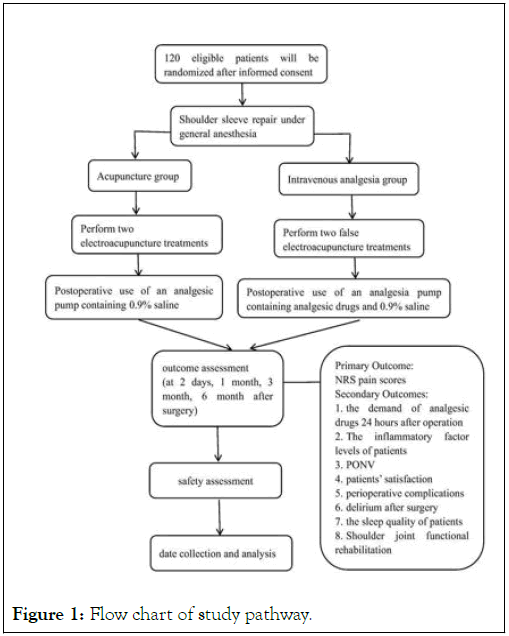
Figure 1: Flow chart of study pathway.
Study population
Patients with rotator cuff injury experience elective shoulder arthroscopic surgery will be screened and recruited for the study in Changhai hospital, naval medical University. The study has been initiated as planned in March 2023. Recruitment is ongoing. The study will be completed in September 2024.
Patients will be fully informed about the objectives, risks and benefits of this study before surgery. Written informed consent will be obtained from patients or their legal representatives. The investigators will complete the Case Report Form (CRF) according to the items listed in the CRF, including age (years), sex (male or female), height, weight and American Society of Anesthesiologists (ASA) classification. If patients do not meet the inclusion criteria, they will be excluded. In addition, enrolled patients have the right to discontinue their participation and withdraw from the trial at any time. They must provide a true medical history and answer the investigator’s questions. Patients’ data will be protected and stored by the investigator in a secure cabinet [4].
Inclusion criteria
• Age 18-65 years.
• Patients undergoing elective shoulder arthroscopic surgery due to rotator cuff injury.
• American Society of Anesthesiologists ASA ≤ III .
• Providing written informed consent.
Exclusion criteria
• Refusing general anesthesia or having a high risk of general anesthesia.|
• Suffering from pain caused by other disease or having a history chronic opioid therapy.
• Unable to cooperate to long-term follow-up investigation or complete questionnaire.
Randomization and blinding
Before the starting of the trial, randomization and allocation concealment to avoid selection bias will be performed by a medical statistician. Patients are randomly assigned in the acupuncture group and the intravenous analgesia group with the 1:1 ratio using a computer-generated random number table conducted by the medical statistician. The information of groups will also be sealed in 120 opaque envelopes, which will keep secret until the enrolment is completed by investigators. The subject information will be written on the envelope. The pharmacist will be notified to prepare the corresponding trial drug and medical equipment on the day of the operation. This protocol ensures that all aspects of the trial-from patient grouping, to acupuncture manipulation and until postoperative follow-up-are handled by trained personnel. Allocations will be unblinded to the anesthesiologists and implementers of electroacupuncture. Neither the patients, nor investigators at postoperative follow-up are aware of allocations [5].
Intervention
Hegu (LI 4) is located on the back of the hand, between the first and second metacarpals and at the midpoint of the radial side of the second metacarpal. Quchi (LI 9) is located at the end of the elbow bend. Yanglingquan (GB 34) is located at the outside of the lower leg, in the pit below the fibular head. Tiaokou (ST 38) is located at the outwards with a transverse finger from front edge of the tibia.
Patients receive electroacupuncture before PACU (Post Anesthesia Care Unit) discharge. The acupuncture group will disinfect after confirmation of positioning. Needles are vertical inserted in Hegu and Quchi on the opposite of the affected limb, while Yanglingquan and Tiaokou are chosen on the same side of the affected limb. Depth of needling is 0.5~0.8 inch. Paired electrodes from the electroacupuncture apparatus are attach transversely to the needle handles at Hegu, Quchi and Yanglingquan, Tiaokou (Figure 2). And it’s considered to be effective for acupuncture when the frequency of electrical stimulation is adjusted to cause pain, numbness, swelling or radiation sensation. The electroacupuncture stimulation lasts for 30 minutes with alternating dilatational wave of 2 Hz/100 Hz. The same acupuncture will be performed again 24 hours after operation. After the surgery, patients use PCA with the selfcontrolled infusion mode of 2 ml/time, locking for 10 minutes and the maximum dose of 10 ml/hour. Parecoxib sodium 40 mg will be administered as rescue treatment for patients whose NRS score is higher than 3. The patients will continue to receive hospital acupuncture treatment twice a week within one month after discharge [6].
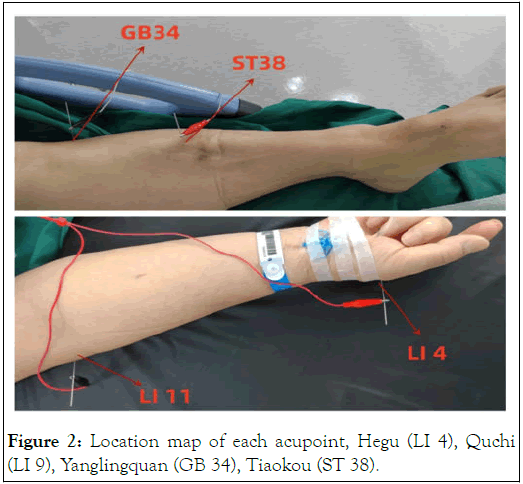
Figure 2: Location map of each acupoint, Hegu (LI 4), Quchi (LI 9), Yanglingquan (GB 34), Tiaokou (ST 38).
The intravenous analgesia group treat with sham acupuncture. A sponge cuboid with a length of 5 cm, a width of 3 cm and a height of 2 cm is pasted and fixed with double-sided foam tape on Hegu and Quchi on the opposite of the affected limb, while Yanglingquan and Tiaokou are on the same side of the affected limb.
Acupuncture sponge reaches corresponding acupoints and when the frequency of electrical stimulation is adjusted to cause pain, numbness, swelling or radiation sensation, it is considered effective for acupuncture and moxibustion and then withdraw the needle in the sponge (the needle does not touch the skin) (Figure 3). The electroacupuncture stimulation lasts for 30 minutes and the alternating expansion wave is 2 Hz/100 Hz. The same acupuncture will be performed again 24 hours after operation. After the surgery, patients use PCA (fentanyl 10 ug/kg, Ketorolac tromethamine 3 mg/kg and add normal saline until 100 ml) with the self-controlled infusion mode of 2 ml/ time, locking for 10 minutes and the maximum dose of 10 ml/ hour. Parecoxib sodium 40 mg will be administered as rescue treatment for patients whose NRS score is higher than 3.
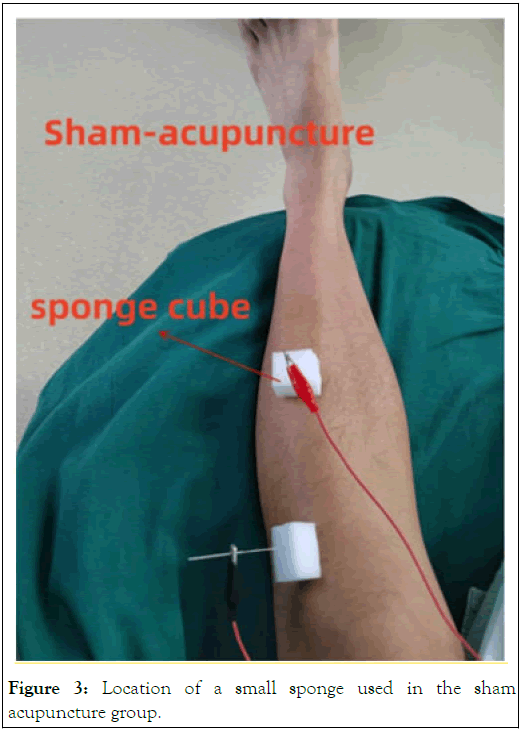
Figure 3: Location of a small sponge used in the sham acupuncture group.
Anesthesia management
Anesthesia management and care process with unified standards will be implemented for all patients.
Induction of anesthesia
Collect the patient's data like: ECG, non-invasive arterial pressure, saturation of pulse oximetry and bispectral index when patients upon admission to the operating room on the day of surgery. A peripheral intravenous access will be established. Preoxygenation with an oxygen flow of 6 L/min and oxygen concentration of 100% before anesthesia will be performed. All patients will be induced with midazolam 0.04 mg/kg, propofol 2.0 mg/kg, sufentanil 0.5 ug/kg and rocuronium 0.6 mg/kg successively. After the patient loses consciousness and achieved adequate muscle relaxation, the same attending anesthesiologist will perform tracheal intubation and connect the anesthesia machine for mechanical ventilation.
Maintenance of anesthesia
The respiratory parameters of patients undergoing mechanical ventilation will be adjusted as follows: oxygen concentration 100%, tidal volume 6 ml/kg-8 ml/kg and respiratory rate 12-14 breaths/min to maintain end expiratory carbon dioxide pressure between 30 and 35 mmHg. Continuous pumping of with remifentanil 10 ug/(kg·h)-40 ug/(kg·h), propofol 4 mg-10 mg/ (kg·h), inhaled Sevoflurane of 1%-2% concentration, will be performed to maintain intraoperative the Bispectral Index (BIS) between 40 and 60. Hemodynamic stability will be maintained. Adjusting the dosis of propofol and remifentanil to maintain hemodynamics and depth of anesthesia or appropriate vasoactive drugs (e.g., ephedrine, phenylephrine and esmolol) will be given, make the fluctuation range of patients’ blood pressure will be controlled within ± 20% of the preoperative basis. No longer add long lasting effect opioid analgesics and muscle relaxants during the operation. After the skin suture is completed, all anesthetic infusion will be finished. If necessary, neostigmine 1 mg and atropine 0.5 mg will be used to antagonize neuromuscular blockade at the end of surgery. To record the consumption of anesthetic drugs, opioids used during the operation are converted to remifentanil, accord to equivalent formula: 0.01 mg sufentanil=0.1 mg remifentanil. After the operation, patients will be transferred to (PACU). When the patients’ NRS score is higher than 3, 40 mg Parecoxib Sodium was injected intravenously for analgesic remedy. Patients will be discharged from the PACU when a modified Aldrete score ≥ 9.
Follow up visits
Patients will receive dedicated follow-up after surgery. The personnel in charge of follow-up will be blinded to grouping and medication use and complete follow-up and data entry of nodal time observation indicators based on the CRF form only.
Baseline data
The patient’s general condition, including gender, age, BMI, history of comorbid diseases will be recorded. The following intraoperative information will be recorded: Intraoperative blood loss; intraoperative fluid volume; urine volume; intraoperative sufentanil and remifentanil doses; the duration of anesthesia and surgery; perioperative complications [7].
Primary outcome
The primary outcomes are NRS pain scores (0=no pain, 10=worst imaginable pain) after surgery 0.5 h, 1 h, 2 h, 4 h, 8 h, 12 h, 24 h, 2 d.
Secondary outcomes
The secondary outcomes are the demand of analgesic drugs 24 hours after operation, inflammatory factor levels in two groups of patients, PCT, CRP, TNF -α, IL-6, IL-8, IL-4 and IL-10 were compared and measured before and after acupuncture, Postoperative Nausea and Vomiting (PONV), patients’ satisfaction; postoperative complications including pharyngeal pain, constipation, dizziness, dry mouth, etc. In addition, delirium after surgery is assessed by scoring in 3D-CAM. Athens insomnia Scale (AIS) is used to evaluate the sleep quality of patients before, at the 1st day and the 2nd day after the surgery. The study uses American Shoulder and Elbow Surgeon (ASEA) to evaluate functional rehabilitation after 1 month, 3 months and 6 months after surgery by telephone interview.
Sample size calculation
The study is a non-inferiority, randomized controlled study, with the trial group being the acupuncture group and the control group being the intravenous analgesia group. Numerical rating scale at rest of less than 1.3 to be considered non-inferior. Therefore, the difference in NRS score Δ assume an average score of 1.3. This sample size calculation was based on a onesided test with α=0.025, using SPSS15 software to calculate the sample size (zα=1.96, zβ=1.28, sd=1.645, Δ=1.3), the minimum number of participants in each group is 54.
Considering that the possible dropout rate is 10%, we decided to include at least 60 patients in each group, the total sample size required for the study protocol is 120.
Data analysis
SPSS 23.0 statistical software (IBM, Chicago, USA) will be used for analysis. Normally distributed continuous data between two groups will be reported as means and standard deviations; skewed continuous data will be reported as medians and quartiles. Comparison of normal continuous outcomes will be performed using Student t-test for unpaired groups. Comparison of non-normal or skewed continuous outcomes will be performed using Mann-Whitney U test. The categorical variable will be represented by percentages.
Comparisons of categorical data among groups will be performed by a χ2 or Fisher’s exact test. The repeated data among two groups will be analyzed with 2-factor repeated measures analysis of variance (Chi-square division). P<0.05 is considered as statistically significant.
Assessment of safety
First, the operating room used in trail is well-supervised where the anesthesiologist will monitor ECG, noninvasive arterial pressure and pulse oximetry. If a patient experiences an adverse reaction because of the test drug, the administration of the drug will be withdrawn immediately and appropriate treatment will be given to maintain the patient’s respiratory and circulatory stability. The serious adverse event will be reported to the chief investigator and relevant expert consultations will be held. This information will be entered into the hospital’s electronic information system [8].
The rotator cuff refers to the collective term for the tendon tissues that cover the subscapularis, supraspinatus, infraspinatus and teres minor muscles located in the front, top and back of the shoulder joint. The main function of the rotator cuff is to assist in shoulder joint stability and movement, protecting the humeral head from being pulled upward by the deltoid muscle, avoiding impingement with the acromion and being a tissue that is susceptible to injury. The rotator cuff injury is a common clinical disease in middle-aged and elderly people and the rotator cuff repair under arthroscopy is one of the most common treatment. However, most patients have moderate and severe pain after surgery, which not only causes strong stress reaction of the body, but also slows down the recovery process.
At present, multi-modal and individualized methods are advocated for managing postoperative pain. Clinical analgesia intervention is mainly carried out on patients through drugs and physical methods at different stages of perioperative period, including: The nerve block before the surgery, long-term local anesthetics or other analgesics injecting into the shoulder joint cavity. But, some recent studies have shown that intraarticular injection of anesthetics may injure the cartilage of patients and cause unexpected damage. Postoperative analgesia clinically commonly includes continuous brachial plexus block analgesia through intubation, intravenous infusion through selfcontrolled analgesia pump which contained non-opioid drugs (paracetamol, non-steroidal anti-inflammatory drugs) and opioid drugs and electrical stimulation therapy.
In a meta-analysis, it was concluded that in the nerve block group, the analgesia effect of Suprascapular Nerve Block +Interscapular Nerve Block (SSNB+INB) was the best at 12 hours after operation and that of INB+Intra-Articular Injection (IAI) was the best at 24 hours and 48 hours after operation. For the non-nerve block group, the analgesic effect of external medication at 12 hours after operation is the best and the analgesic effect of oral medication at 24 hours and 48 hours after operation is significantly better than other intervention measures.
However, there are few studies observed on electro-acupuncture for perioperative analgesic in shoulder arthroscopic surgery. Previous study confirmed that percutaneous electrical stimulation of acupoints (Hegu LI4, Neiguan PC6) during perioperative period can improve postoperative analgesia of patients undergoing arthroscopic shoulder surgery, delay the time of the first use of analgesia pump and reduce the amount of postoperative analgesics and adverse events. According to ancient Chinese medical classics “Lingshu”, Hegu acupuncture is a kind of method to expand the stimulation area, with a wide range of stimulation, which can effectively unblock the local qi and blood, dredge the meridian qi, promote blood circulation and achieve the effect of analgesia, so it was used to cure all kinds of pain.
In this study, we will implement acupuncture at Quchi LI11 and Hegu LI4 at the same time, this is because that these acupoints both belonged to large intestine meridian which circulates through the anterior side of the shoulder joint. So that the simultaneous of these two acupoints can enhance the analgesic effect of acupuncture on the anterior side of the shoulder joint. In addition, we also select Yanglingquan GB34, the “Jinghui” of the eight meridian intersection points which means the influential point of tendons. This acupoint has been an important role for the treatment of soft tissue diseases since ancient times and its affiliated gallbladder meridian which patrols through the side of the shoulder joint. Therefore, acupuncture at this point can not only dredge the muscles of the whole body, but also penetrate the qi and blood of gallbladder meridian, improve the blood circulation on the side of the shoulder joint and speed up the local recovery process [9].
Tiaokou ST38 is a classic point for the treatment of shoulder joint diseases. Ming-Yu Lo conducted an observation on electroacupuncture at Tiaokou ST38 and Yanglingquan GB34 in treating 21 patients with frozen shoulder pain and the result shows this method was very effective. A retrospective metaanalysis discussed effect of acupuncture at Tiaokou ST38 point to improve shoulder joint diseases and believed that Tiaokou ST38 point is special for shoulder joint diseases and that acupuncture at this point has certain anti-inflammatory effect.
Although many previous studies have confirmed that acupuncture has a definite effect on pain control, the research on the timeliness of acupuncture is still lacking, a recent study on the treatment of primary dysmenorrhea with wrist-ankle acupuncture believed that the immediate analgesic effect of acupuncture was accurate, but due to the limitations of the study, no long-term analgesic effect was observed.
Thus, in order to improve the effect of postoperative analgesia and reduce the dosage and adverse reactions of postoperative analgesics, the electroacupuncture of this study was given twice after the operation to observe the analgesic effect and the effect of acupuncture on the inflammatory index and sleep condition of patients will be inspected. A recent research observes the pain relief of patients with unilateral chronic shoulder pain by contralateral or ipsilateral acupuncture and the results showed that the pain degree of patients was reduced, the shoulder function was improved, the patients in contralateral acupuncture group was improved better and the different neural mechanisms of contralateral and ipsilateral acupuncture were revealed by monitoring and observing different brain responses during acupuncture.
In a systematic review of meta-analysis, a large amount of evidence showed that early exercise after arthroscopy improved the range of motion of the shoulder joint after rotator cuff repair, thus shortening the recovery time. Early exercise will undoubtedly aggravate the pain of patients after surgery, while long-term immobilization will affect the process of functional recovery. Therefore, this study asked patients to undergo acupuncture for many times after discharge, in order to solve the problem of pain for patients in the early postoperative period, so as to explore the impact of acupuncture on the long-term recovery of shoulder joint function.
In this study, the anesthesiologist and traditional Chinese medicine practitioners who perform electroacupuncture will be trained to follow the standardized procedure. The investigator staff will be well trained to perform preoperative recruitment, assessment and postoperative follow-up. We will train the whole study team to use the assessment scales normatively in this study. Moreover, the investigator will be blind to the intervention.
[Crossref] [Google Scholar] [PubMed]
[Google Scholar] [PubMed]
[Crossref] [Google Scholar] [PubMed]
[Crossref] [Google Scholar] [PubMed]
[Crossref] [Google Scholar] [PubMed]
[Crossref] [Google Scholar] [PubMed]
[Crossref] [Google Scholar] [PubMed]
[Crossref] [Google Scholar] [PubMed]
[Crossref] [Google Scholar] [PubMed]
Citation: Duan P, Hu J, Yang T, Li Y, Wang X, Chen J, et al. (2025) Effect of Electroacupuncture Intervention on Postoperative Pain in Patients Receiving Shoulder Arthroscopic Surgery: Study Protocol for A Noninferiority Randomized Controlled Trial. Trans Med. 15:329.
Received: 08-Oct-2024, Manuscript No. TMCR-24-34527; Editor assigned: 11-Oct-2024, Pre QC No. TMCR-24-34527 (PQ); Reviewed: 25-Oct-2024, QC No. TMCR-24-34527; Revised: 01-Jun-2025, Manuscript No. TMCR-24-34527 (R); Published: 08-Jun-2025 , DOI: 10.35248/2161-1025.25.15.329
Copyright: © 2025 Duan P, et al. This is an open-access article distributed under the terms of the Creative Commons Attribution License, which permits unrestricted use, distribution and reproduction in any medium, provided the original author and source are credited.