
Journal of Applied Pharmacy
Open Access
ISSN: 1920-4159
ISSN: 1920-4159
Review Article - (2025)Volume 17, Issue 2
Alcoholic Liver Sickness (ALD) results from consistent pointless alcohol use and consolidates a scope of liver mischief, from steatosis to cirrhosis. It is portrayed by disturbance, oxidative strain and fibrosis. Jaundice, stomach pain and liver damage are all clinical side effects. Examination incorporates liver capacity tests, imaging and every so often a biopsy. The fundamental treatment is the limitation of alcohol, which can end disease development. Additional organizations could integrate healthy assistance and pharmacotherapy. Early mediation is significant for chipping away at open minded results. The goal of ongoing research is to improve understanding and treatment of ALD.
Alcoholic liver disease; Steatosis; Hepatitis; Cirrhosis; Alcohol restriction; Liver treatment
There are three distinct types of alcoholic liver disease, all of which can be avoided. Alcoholic liver disease is common. A lot of people who drink a lot end up with three different diseases in their lifetime. Alcoholic liver affliction truly does now never again emerge in every weighty consumer. The possibility of getting liver sickness goes up the more you have been drinking and the more liquor you polish off. It is no longer necessary for you to be under the influence of alcohol for the condition to occur [1]. The disease affects most people between the ages of 40 and 50. Men are bound to have this issue anyway; ladies might foster the infection after less openness to liquor than men.
Types
Stenotic (fatty) liver: The accumulation of excess fat in liver cells is how steatosis, also known as greasy liver, is described. This condition is every now and again connected with strength, diabetes and irrational alcohol use. A greasy liver is typically identified through imaging studies or coincidental findings during routine assessments and it is initially asymptomatic. Whenever left untreated, it can progress to extra serious liver conditions, for instance, Non-alcoholic Steatohepatitis (NASH) or cirrhosis. The board primarily incorporates lifestyle changes, including weight decreases, dietary changes and controlling fundamental conditions. Preventing movement and maintaining liver health require prompt identification and prayer.
Acute hepatitis: Extreme hepatitis is a searing condition of the liver that arises out of the blue and can be achieved by viral sickness, toxic substances or invulnerable framework reactions. Ordinary viral etiologies integrate hepatitis A, B and C. Aftereffects often consolidate jaundice, stomach misery, affliction and raised liver impetuses. Assurance incorporates serological testing, liver capacity tests and, every so often, imaging or biopsy. Treatment focuses on addressing the hidden cause, such as stopping irritating substances or taking antiviral medication to treat viral infections. Most patients recover totally with legitimate organization, but outrageous cases can progress to extreme liver frustration. For best results, early determination and mediation are essential.
Cirrhosis: Cirrhosis is a late-stage liver infection depicted by a long shot that arrives at fibrosis and the improvement of regenerative handles, inciting debilitated liver capacity. It can be brought on by persistent conditions like hepatitis B or C, alcohol abuse or nonalcoholic fatty liver disease [2]. Secondary effects consolidate jaundice, ascites, stomach misery and marks of doorway hypertension. Blood tests, imaging analysis and a liver biopsy are all common methods of finding the executives focus on treating the hidden cause, overseeing the details and maintaining constant consideration, including drug changes and lifestyle adjustments. In state-of-the-art cases, liver transplantation may be required. For further developing anticipation and personal fulfillment, early determination and intercession are crucial.
Causes
Chronic alcohol consumption: Hereditary, mental and social factors frequently combine to lead to persistent alcohol use. The inability to stop drinking alcohol can be caused by a genetic predisposition. Mental factors include psychological health issues like anxiety and discouragement, which may lead people to seek self-cure with alcohol. Social variables, for instance, peer pressure, social principles and basic induction to alcohol similarly expect basic parts. Stressful life-altering events, injuries and alcohol use in the family further contribute. Understanding these essential causes is central for making effective aversion and treatment procedures, including conducting medicines and genuinely steady organizations highlighted diminishing alcohol usage and keeping an eye on its principal drivers [3].
Genetics: Consistent alcohol use and alcohol-related problems are strongly influenced by genetics. A person's reaction to alcohol and their risk of developing dependence can be affected by variations in ambiguous qualities, such as those involved with alcohol digestion (such as ADH1B, ALDH2) and synapse frameworks (such as GABRA2, CHRM2). Hereditary predisposition interacts with natural factors, such as social pressure and influence, to influence alcohol consumption patterns. The family foundation of alcohol use issues similarly basically augments risk, proposing a natural part. Distinguishing individuals who are bound to foster liquor use problems and creating individualized avoidance and treatment plans is made more straightforward with the assistance of a comprehension of hereditary commitments.
Obesity: Heftiness basically impacts alcohol usage plans and the bet on alcohol related clinical issues. Overflowing body weight can change alcohol assimilation, inciting extended blood alcohol obsessions and deferred intoxication. Strength is similarly associated with a higher recurrence of alcohol use issues, as individuals would include alcohol as a strategy for practical adaptation for stress or self-discernment issues. In addition, the risk of developing liver diseases like cirrhosis, steatohepatitis and fatty liver is increased when obesity and alcohol consumption are combined. Keeping an eye on rotundity through lifestyle changes, such as eating routine and exercise, is central for decreasing alcohol related prosperity bets and chipping away at all around success.
Viral infection: Viral illnesses, particularly those achieved by hepatitis contaminations (A, B, C, D and E), are tremendous allies of liver sickness and can interact with progressing alcohol use to strengthen liver mischief. Hepatitis B and C diseases are known to cause progressing liver aggravation, provoking circumstances like hepatitis, cirrhosis and liver threatening development. Co-tainting with these diseases and steady alcohol use fabricates the bet of outrageous liver sickness on account of synergistic effects on liver bothering and fibrosis [4]. A convincing organization incorporates antiviral treatment to control viral replication and alcohol discontinuance to hinder further liver mischief (Figures 1 and 2).
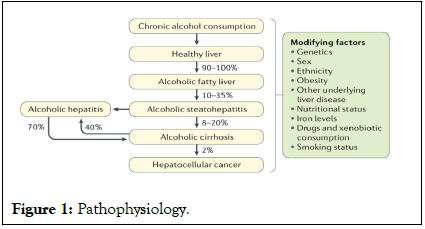
Figure 1: Pathophysiology.
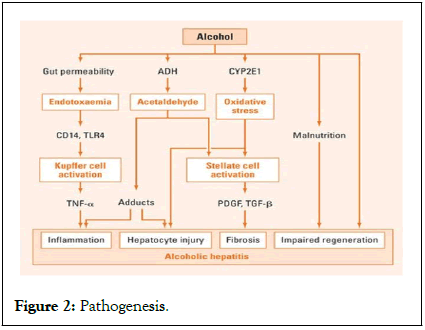
Figure 2: Pathogenesis.
Sign and symptoms
Abdominal pain: Fluid buildup in the abdomen, swelling in ankles.
Digestive issues: Nausea and vomiting, loss of appetite, dark stools, frequent nose bleed.
Skin issues: Jaundice, small red spider like blood vessels on the skin.
Other issues: Weight loss, increase thirst, confusion, mood swing, insomnia.
Diagnosis
Blood test:
• Complete Blood Count (CBC).
• Liver enzymes' determination such as aspartate, alanine, Amino Transferase (ALT).
• Bilirubin determination.
Imaging test:
• Ultrasound.
• CT scan.
• MRI.
Other procedures:
• Liver biopsy, involves removing small tissue sample from liver with a needle during surgery
Treatment
Stem cell therapy for ALD: A treatment with undifferentiated cells has been suggested as a possible elective option for liver transplantation. Undifferentiated creatures are a get-together of pluripotent cells with self-spryness to re-energize, as lacking central microorganisms (ESCs), grown-up Mesenchymal Lacking Cells (MSCs) and impelled Pluripotent Lacking Cells (iPSCs). Foundational microorganism therapy partakes in a couple of high grounds over organ transplantation, for instance, cells can be basic duplicated and cryopreserved; they can be helpfully gotten from the patient for autologous transplantation; and youthful microorganism blend doesn't require major prominent operation. Due to their low moral debate and low teratogenic potential, grown immature microorganisms, such as MSCs and hematopoietic undifferentiated organisms, are the primary contender for undeveloped cell treatment. Grown-up juvenile microorganisms are found in all nonembryonic tissues and are made sure to expect a vital part in staying aware of cell homeostasis and recuperation of hurt organs. MSCs are hypoimmunogenic, suggesting that recipients are not supposed to be formed before transplantation. Nowadays, MSCs have been restricted to many tissues, including lung, liver, umbilical string, spleen, skeletal muscle, dental squash and fat tissue. To standardize treatment, the irrelevant models to portray human MSCs have been proposed by the Worldwide Society for Cell Treatment (ISCT) in 2006: Under standard culture conditions, cells ought to be plastic-disciple should convey CD73, CD105 and CD90 and need enunciation of CD14, CD45, CD34, CD19, CD11b and class II Human Leukocyte Antigen (HLA) surface particles; and ought to isolate into osteoblasts, chondroblasts and adipocytes in vitro. Separation into hepatocytes, recruitment of endogenous hepatocyte multiplication, immunomodulation and inhibition of fibrosis are just a few of the factors that have been found to be associated with liver disease progression following treatment with undifferentiated cells. Basic microorganisms might conceivably isolate into parenchymal cells and this has probably been shown.
Establishment of 3D artificial liver: Liver transplantation is the vitally clinical treatment for state of art ALD, for instance, decompensated alcoholic cirrhosis and alcohol provoked hepatocellular carcinoma. Nevertheless, deficient wellsprings of qualified provider livers and safe excusal genuinely bind the usage of liver transplantation. Using undifferentiated creatures to foster 3D phony livers has raised new assumptions for patients with state of art liver ailments. Totally utilitarian 3D phony livers not only can activate lacking cells to shape hepatocytes and be saved in three viewpoints, yet what's more require vein advancement, limit of supplements, safe authoritative activity and other hepatic abilities. Here, we will summarize the investigation progress that incorporates 3D phony liver development. A significant obstacle to the development of counterfeit livers is the absence of reliable sources for related cell types. Over the course of the past numerous years, phenomenal progress has been made in the control of central microorganism detachment into grown-up significant cells. Different assessments have investigated how to provoke undifferentiated organic entity detachment into hepatocytes, which address the vast majority of cells in the liver. Various detachment shows have been proposed and the ensuing hepatocyte-like cells have most of the components of regular hepatocytes, including outflow of fetoprotein, egg whites and aminotransferases. At this point, hepatocyte detachment from lacking cells is to some degree completely mature and researchers could without a doubt get hepatocyte acknowledgment units from business associations.
Proteasome inhibitor treatment for ALD: The proteasome controls the defilement of cell proteins besides, is solidly entangled in signal transduction, improvement what's more, cell cycle movement antigen taking care of and resistant response and inflammation proteasome obstacle has recently turned out to be a novel and promising framework for the treatment of malignant growth specifically, PS-341 (bortezomib, velcade), a boronic destructive dipeptide with specific development as a proteasome inhibitor, has displayed clinical reasonability in patients with various myeloma and has been upheld by the U.S. food and medication organization. It is presently under evaluation for its activity in different other hematologic and solid malignancies proteasome is seen as a cell support security in the cell in light of its development to kill hurt moreover, oxidized proteins [5]. Different reports have represented that proteasome inhibitors cause a get-together of oxidatively harmed proteins, exhibiting that an immense bigger piece of oxidatively harmed proteins, both in the cytosol and the center of mammalian cells, are taken out by the 20S proteasome. However, it is important to point out that proteasome inhibition is also a protection against oxidative damage because it increases the quality of antioxidative chemicals' articulation. Even though it is well established that ALD is caused by impairment of the ubiquitin proteasome pathway, a growing body of evidence suggests that proteasome inhibitors protect the brain and heart from oxidative stress. Eating ethanol appears to affect different 26S proteasome actions, but it has no significant effects on the 20S proteasome. The 26S proteasome practices are basically decreased in the liver of rodents dealt with ethanol this ethanol-impelled proteasome pathway brokenness isn't equivalent to the proteasome restriction got by using the proteasome inhibitor PS-341. Microarray examination studies have shown that the quality verbalization of antioxidative impetuses were not extended there of psyche. In contrast to rodents given the proteasome inhibitor PS-341, rodents consistently handled ethanol.
Natural compounds that improve lipid metabolism: Curcumin, the essentially unique fixing of turmeric, has been shown to lessen lipid assortment in hepatocytes and bring about steatosis by controlling the NF-E2-related Factor 2 (Nrf2)- Farnesoid X Receptor r (FXR) pathway. A couple of scientists moreover saw that treatment with curcumin could cover oxidative tension in ALD mice by lessening the period of ROS. One of the most well-known dihydroflavonoids is dihydroquercetin, which can be found in milk thorns and onions. Zhang et al. suggested that dihydroquercetin chips away at weighty consumers. liver steatosis by controlling the inception of the SIRT1-AMPK pathway. Dihydroquercetin extended the activity of AMPK, thusly, decreasing the announcement of SREBP1 in ethanol-treated HepG2 cells. Dihydroquercetin has been shown to slow the growth of lipids and protect the liver, suggesting that it could be used as a treatment for ALD.
Natural compounds that reduce oxidative stress: A flavonoid extracted from Silybum marianum known as silymarin has been promoted as a specialist in hepatoprotection. Silymarin essentially fixes hepatic injury by facilitating lipid peroxidation and oxidative tension. It was found that silymarin generally extends the activity of superoxide dismutase (Turf) and Glutathione Peroxidase (GSHPx) and besides, diminishes the level of Malondialdehyde (MDA) in ALD rats, which are immovably associated with the oxidative strain pathway. It was determined that buckwheat contained a lot of isoorientin. In an animal investigate, isoorientin truly fabricates the activities of the disease avoidance specialist Turf and GSH-Px and the statement of alpha-SMA, thusly smothering Alcohol impelled oxidative tension and defending from liver fibrosis. in wistar rodents similarly, the disease counteraction specialist development of isoorientin was diverged from a couple of cell fortifications, counting α-Tocopherol, ascorbic destructive and other plant surmised compounds.
Natural compounds that suppress inflammation: Anthocyanins are a group of colors that come from plants and are typically found in cereals, natural products and flower petals. The prosperity progression effect of anthocyanins has gotten growing thought. anthocyanin medications, the statement of IFN-, TNF-a, TLR-4, VCAM-1 and CXCL-1 on a very basic level reduced in ALD mice, recommending that anthocyanin may cover exacerbation by downregulating proinflammatory cytokines. Baicalin, a working fixing isolated from Scutellaria baicalensis, is by and large used in normal game plans to treat ALD and bothering [6]. Baicalin plays a useful role in a variety of obtrusive poisons, as evidenced by ongoing research. models by limiting explosive reactions. In addition, it was clearly asserted that baicalin could diminish hepatocyte harm by obstructing the TLR4-mediated provocative pathway in ALD rodents.
Natural compounds that regulate programmed cell death: The primary dynamic fixing in banaba leaves is corrosolic corrosive, also known as 2-hydroxyursolic corrosive. Corosolic consumption has attracted critical thought as a result of its diabetic effect, besides being ordered phyto-insulin. As a possible activator of AMPK, corosolic destructive can restore ethanolsmothered autophagy through AMPK activation in vivo and in vitro. Gastrodin is one of the essentially bioactive pieces of Gastrodia elata, an old Chinese restorative plant. Geranium gastrodin generally causes Caspase-3 (CASP3) activation and apoptosis from ethanol-impelled hurtfulness in vivo and in vitro. Ursolic destructive is a pentacyclic terpenoid carboxylic destructive with various prosperity capacities, for instance, against oxidative, relieving, dangerous development and hepatoprotective activities.
Natural compounds that regulate intestinal microbes: Berberine, a quaternary smelling salt compound got from various flavors, has been comprehensively used to treat hepatic injury. Berberine extended the flood of the minuscule creatures, Akkermansia muciniphila and changed the general stomach microbial vegetation in ALD mice, staying aware of metabolic equilibrium and reducing bothering [7,8]. Curiously, berberine also causes lightening liquor-induced hepatic injury in mice by initiating a population of cells that are similar to Granulocytic Myeloid-Determined Silencer Cells (G-MDSC).
Due to its complexity and variety, alcoholic liver disease necessitates an all-encompassing approach to diagnosis and treatment. Improving patient outcomes and stopping the progression of the disease depend heavily on early detection and intervention. For patients with ALD, a multidisciplinary team comprising medical professionals, dietitians and addiction specialists should collaborate to provide specialized treatment and support. Healthcare professionals can assist patients in achieving the best possible outcomes and enhancing their quality of life by treating the underlying causes of ALD and administering the proper treatment.
[Crossref] [Google Scholar] [PubMed]
[Crossref] [Google Scholar] [PubMed]
[Crossref] [Google Scholar] [PubMed]
[Crossref] [Google Scholar] [PubMed]
[Crossref] [Google Scholar] [PubMed]
[Crossref] [Google Scholar] [PubMed]
[Crossref] [Google Scholar] [PubMed]
Citation: Udhayakumar P, Dhinesh A, Lokesh S, Pradeep CS, Vidhyasagar K (2025) A Review of Alcoholic Liver Disease on Etiology, Pathogenesis, Clinical Manifestations, Diagnosis and Treatment. J Appl Pharm. 17:460.
Received: 23-Sep-2024, Manuscript No. JAP-24-34180; Editor assigned: 26-Sep-2024, Pre QC No. JAP-24-34180 (PQ); Reviewed: 10-Sep-2024, QC No. JAP-24-34180; Revised: 02-Apr-2025, Manuscript No. JAP-24-34180 (R); Published: 09-Apr-2025 , DOI: 10.35248/1920-4159.25.17.460
Copyright: © 2025 Udhayakumar P, et al. This is an open-access article distributed under the terms of the Creative Commons Attribution License, which permits unrestricted use, distribution and reproduction in any medium, provided the original author and source are credited.