
HIV: Current Research
Open Access
ISSN: 2572-0805
ISSN: 2572-0805
Research Article - (2026)Volume 11, Issue 2
A rapid decline in new HIV (Human Immunodeficiency Virus) infections has occurred in worldwide regions where extensive efforts were made to combat mosquitoes, but not in regions where no such efforts were made. Two thirds of global HIV infections occur in sub-Saharan Africa, a region with the highest rates of mosquito-borne diseases in the world. Outside sub-Saharan Africa, regions with high abundances of Aedes albopictus mosquitoes consistently have several to more than 10 times higher HIV prevalence than neighboring regions. Sleeping in close proximity allows mosquitoes to transfer fresh blood within minutes through contaminated mouthparts between people. People who sleep in close proximity to each other or are frequently exposed to mosquito bites have high rates of HIV infection. For example, eight high-risk populations for HIV listed in guidelines (e.g., sexual partners, prisoners, homeless people) either sleep in close proximity to each other or are regularly exposed to mosquitoes. A wide range of epidemiological data can be consistently explained by the theory of mosquito transmission, but not sexual transmission. Anyone can easily test this issue using existing global data. Research communities must resolve these issues.
HIV; Transmission mode; Sexual activity; Mosquitoes
Currently, there is no animal research data supporting any transmission mode of HIV. Therefore, to determine the HIV transmission mode, we have to rely only on epidemiological data (age distribution of infection, geographic distribution of infection, high-risk populations, preventive results, and others). Epidemiological data have accumulated. A wide range of data can consistently be explained by the theory of mosquito transmission, but not sexual transmission [1]. However, according to the current dogma, HIV is primarily transmitted through sexual activity. The gap between the two is shocking and must be resolved.
The theory of mosquito transmission
Let’s conduct a simple test on the theory of mosquito transmission using various data. The most striking data in HIV epidemiology has not been explained: Why do two-thirds of global HIV infections occur in Sub-Saharan Africa (SSA)? SSA is a region known for having the highest rate of mosquito-borne diseases in the world. For example, 90% of mosquito-borne malaria cases are in SSA. The second most striking data has also not been explained: why, outside of SSA, do regions with a high abundance of Aedes albopictus mosquitoes consistently have HIV infection rates several to more than 10 times higher compared to neighboring regions? [1] This phenomenon clearly occurs worldwide, but few mention it, maybe because it is unexplainable. Obviously, the theory of mosquito transmission can easily explain these data.
In the theory of mosquito transmission, regular exposure to mosquito bites and sleeping in close proximity to others are the two important factors. Sleeping in close proximity allows mosquitoes to bite two people within an interval of minutes and transmit fresh blood, through contaminated mosquito mouthparts, immediately into the bloodstream of the other person. Therefore, if mosquitoes transmit HIV, people who are regularly exposed to mosquito bites or often sleep in close proximity to others will have high rates of HIV prevalence. Indeed, 8 high-risk populations listed in prevention guidelines are either regularly exposed to mosquitoes or often sleep in close proximity with others. The 3 high-risk populations in sexual relationships (sexual partners, men who have sex with men (MSM), and people with multiple partners) often share beds with each other. Sex workers often sleep with clients. Homeless people are often exposed to mosquitoes. Truck drivers are also often exposed to mosquitoes due to sleeping in simple conditions at night when they are tired. Fishermen are working in humid environments where mosquitoes thrive. Prisoners sleep in close proximity in crowded jails [1].
If mosquitoes transmit HIV, preventing mosquitoes will reduce HIV prevalence. Indeed, according to the UNAIDS (Joint United Nations Programme on HIV/AIDS) 2017 report, a rapid decline in new HIV infections has occurred after 2000 in Eastern/Southern Africa, Western/Central Africa, Asia/the Pacific, Latin America, and the Caribbean (the second figure on pages 25, 49, 77, 113, and 133), but not in the Middle East/North Africa, Eastern Europe/Central Asia, and Western/Central Europe/North America (the second figure on pages 151, 173, and 207) [2]. The former group of regions were all endemic to malaria, and unprecedented efforts were launched to combat mosquitoes after 2000, with some countries starting in the late 1990s [3-5]. Both the spatial and temporal decline in new HIV infections after 2000 align perfectly with the efforts made in combating mosquitoes.
The theory of mosquito transmission can withstand tests from various puzzling phenomena. For example, HIV-infected people are more likely to be infected with the mosquito-borne disease malaria. Obviously, this issue is understandable if mosquitoes also transmit HIV. Some lesbians are infected with HIV, and the actual number has been underestimated. Men are more attractive to mosquitoes than women; therefore, two men together are more attractive to mosquitoes than a man and a woman together, followed by two women together. This suggests that lesbians are less likely to be infected with HIV, but they are still at risk of being infected if they sleep in close proximity. Soldiers in battle sleep in poor conditions, exposing them to mosquitoes. Consistently, the Russia-Ukraine war has seen an explosion in HIV infections. Another puzzling data is that, as indicated in a review study, people who consumer drugs though routes of administration other than injection have a similar prevalence of HIV infection as people who consumer drugs though injection [6]. The reasons for why research communities rarely mention this puzzling issue may be that this issue not only cannot be explained by but also raises questions for the theory of sexual transmission which state sharing injection syringes is a high-risk factor for HIV transmission. In fact, few drug users do not know that sharing syringes is dangerous. Who would risk transmission of HIV and many other pathogens to share syringes given that one-time syringes are cheap and widely available?
The mosquito transmission theory can easily explain why the two group of drug users have a similar rate of HIV prevalence. Many drug users often consume drugs together, regardless of whether they are injection drugs or non-injection drugs. Some of them sleep in the same room after consuming drugs, thus similarly creating opportunities for mosquitoes to spread the disease.
There is rare epidemiological data regarding HIV that cannot be consistently explained by the theory of mosquito transmission. Researchers are encouraged to present any epidemiological observations or phenomena that appear inconsistent with this theory for further evaluation and testing.
The theory of sexual transmission
If a person is infected with an infectious disease, who else will be most easily infected? The person in close proximity. Who are the people in the closest proximity? Sexual partners. They live together, engage in kissing, sleep on the same bed, share utensils, have sex, etc. (sexual workers with clients instead). Therefore, most infectious diseases, if not all, are most rapidly transmitted between sexual partners. High infection rates of an infectious disease among these populations only imply that there are many possibilities for the transmission modes. Studies must be conducted to clarify the disease spread through this route, but not that route. The theory of sexual transmission of HIV was developed based on high rates of HIV infection among populations in sexual relationships. Unfortunately, there is no reported research that has examined whether infected people have been involved only in sex, and not in other factors (e.g., kissing, vectors in their sleeping rooms, sharing utensils, etc.).
There are usually no or mild symptoms similar to a cold in the early stages of HIV infection. This silent infection poses a challenge in determining transmission modes. In the early stages of the epidemic, data on HIV infection were usually reported from clinics on patients. People visiting hospitals due to the disease had usually been in the AIDS (Acquired Immunodeficiency Syndrome) stage, which typically occurs after a long period of HIV incubation (a median period of about 11 years). This long incubation time poses another challenge in determining transmission modes. For example, children infected with HIV at ages 5 to 14 will usually develop AIDS 10 years later. Therefore, although reported rates of infection from clinics were low in the 5-14 age group, actual rates were unknown. The only exception was children before age 5, who mostly developed AIDS and died within this age range. It is surprising that, as a sexual transmission, the global average rate of HIV infection in this age group was very high in the early stage of the epidemic (Fig. 7 of the literature) [7]. Data on babies in each country worldwide can be accessed in the global data set. [8].
The current dogma explains that children usually acquire HIV from their mothers through perinatal exposure. Perinatal exposures (e.g., in utero, during delivery) are similar worldwide. So why were infection rates low among young children in Western developed countries (e.g., Figure. 1A) [8-10], but high or very high among children in Asia, Africa, and many countries in Latin America/Southeastern Europe (e.g., Figure. 1B) [8,11,12]? In fact, the large difference in infection rates among young children between the two groups of countries supports the theory of mosquito transmission of HIV because infection rates of mosquito-borne diseases are usually high among children in Asia, Africa, and many countries in Latin America/Southeastern Europe and low among children in Western developed countries, especially two decades ago [13-19]. Bed-sharing between children and parents is common in the former group of countries, but much less common in Western developed countries [20,21]. This explains the different rates of mosquito-borne diseases among children, including HIV, between the two groups of countries.
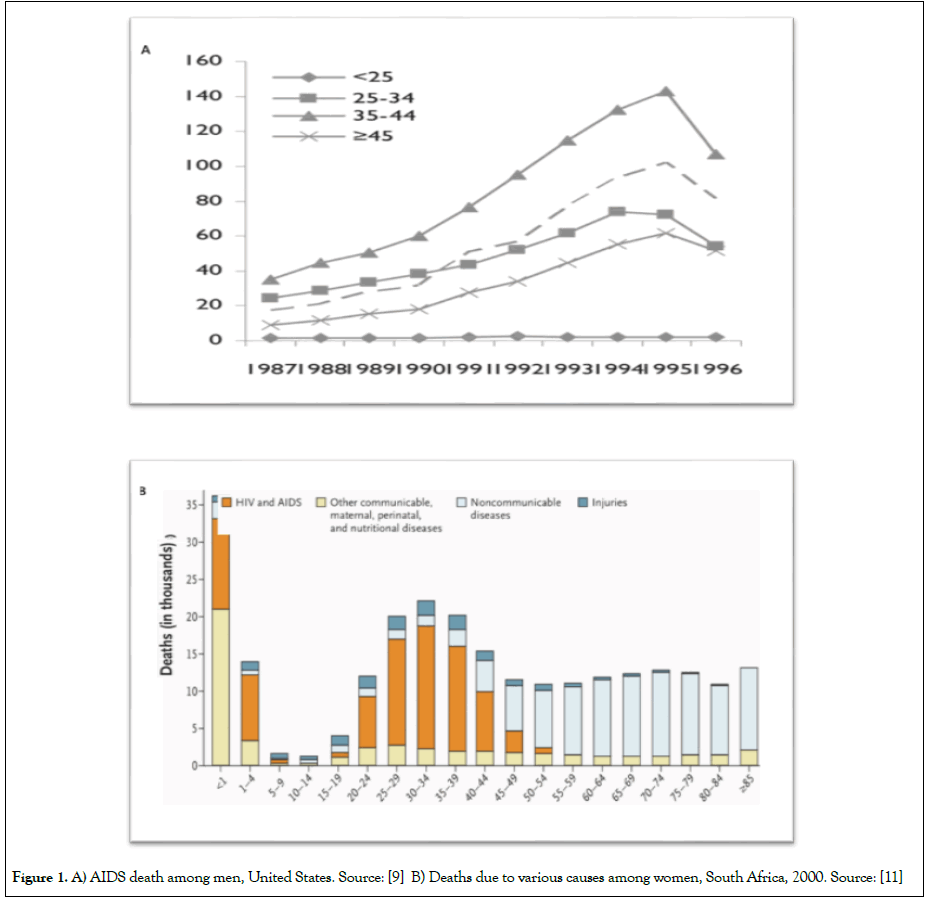
Figure 1: A) AIDS death among men, United States. Source: [9] B) Deaths due to various causes among women, South Africa, 2000. Source: [11]
Efforts to combat mosquitoes are greatly prioritized for children because children account for 90% of malaria deaths. This helps explain why the decline in new HIV infections has been much more significant in children than in adults after 2000.
A valid theory should be able to consistently explain the phenomena in the field. However, it is common that the epidemiological data regarding HIV are either left unexplained, or explanations raise contradictions. For example, before my reports, there was no consistent and convincing explanations for why two-thirds of HIV infections occur in SSA, why global regions with a high abundance of Aedes albopictus mosquitoes consistently have HIV infection rates several to more than 10 times higher compared to neighboring regions, why a rapid decline in new HIV infections has occurred in regions combating mosquitoes but not in regions where no such efforts were made, among others. My recent paper has shown various contradictions in HIV research [1]. Here, let's discuss some of these contradictions in HIV research in the United States, a country playing a leading role in HIV research. According to the United States Centers for Disease Control and Prevention (US CDC), male-male sex is considered the highest risk factor for HIV transmission, accounting for two-thirds of HIV infections in the United States [22]. The distribution of the percentage of male-male sex is roughly similar nationwide (Figure 2A) [23]. The mean number of sexual partners, another important risk factor, is also distributed quite evenly nationwide, except in several states (Figure 2B) [24]. However, HIV prevalence in the Southeast, especially in eastern coastal regions, is several to more than 10 times higher compared with other regions (Figure. 2C) [25]. The much higher HIV prevalence in the Southeast and Eastern coastal regions contradicts the even distribution of the two main risk factors shown in Figure. 2A and Figure. 2B. However, the distribution of HIV prevalence is similar to that of mosquito-borne malaria in the United States (Figure. 2D), and that of Aedes albopictus and Aedes aegypti mosquitoes (Figure. 2E and Figure. 2F) [26,27]. Therefore, the theory of mosquito transmission explains well the highly uneven distribution of HIV in the United States. Men are more attractive to mosquitoes than women. Two men together are more attractive to mosquitoes than a man and a woman together, or two women together. This, together with other reason discussed previously, it can be explaining why MSM usually have the highest rates of HIV prevalence in regions nationwide [1].
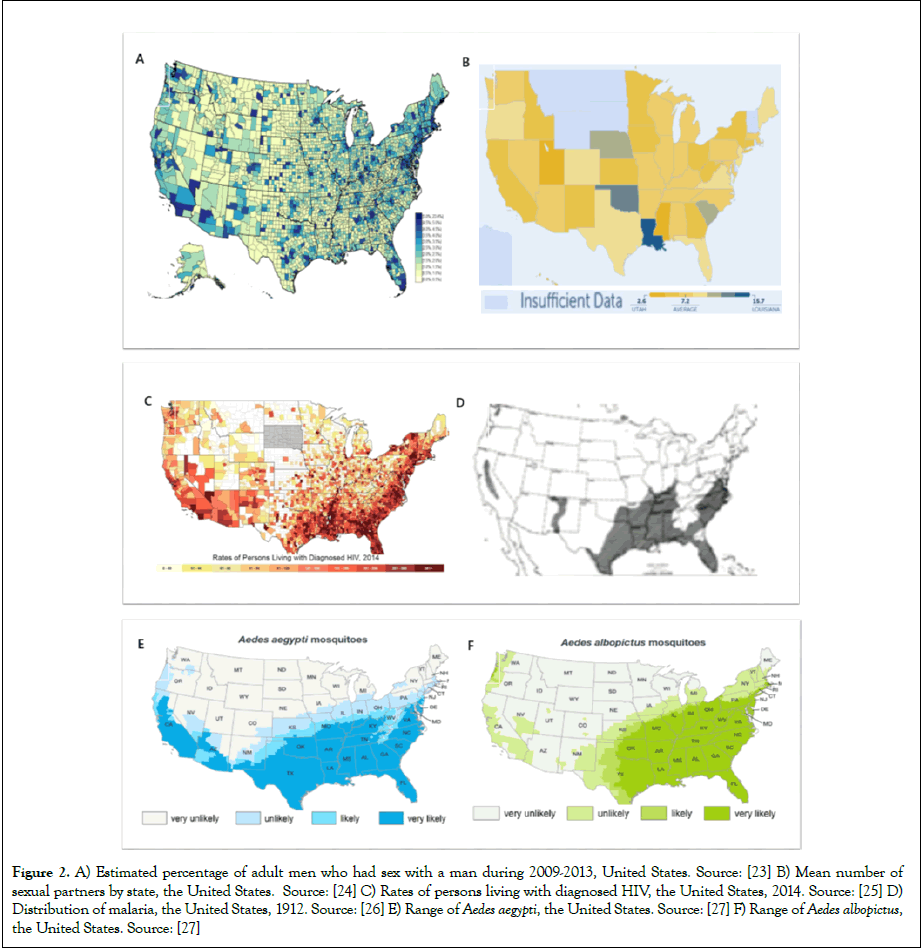
Figure 2: A) Estimated percentage of adult men who had sex with a man during 2009-2013, United States. Source: [23] B) Mean number of sexual partners by state, the United States. Source: [24] C) Rates of persons living with diagnosed HIV, the United States, 2014. Source: [25] D) Distribution of malaria, the United States, 1912. Source: [26] E) Range of Aedes aegypti, the United States. Source: [27] F) Range of Aedes albopictus, the United States. Source: [27]
In the United States, although the Black population engages in better preventive practices (e.g., high rates of condom use and HIV testing) [28,29], they have an HIV prevalence 8 times higher than among Whites [30]. However, the theory of mosquito transmission can explain why Black populations have much higher rates of HIV infections in the United States. The Black population in the United States has much higher rates of bed sharing and homelessness than the White population, thus exposing them to a much higher risk of disease transmission by mosquitoes [31,32].
What should we do?
A wide range of epidemiological data can be consistently explained by the theory of mosquito transmission, but not sexual transmission. This striking issue can easily be tested using existing data. What is research? Research is about identifying problems and solving them, not ignoring or concealing them.
Epidemiological data are indirect data. Mistakes can easily occur when relying on indirect data to determine transmission modes, especially for diseases with no or mild symptoms in the early stages of infection. Therefore, it is important to examine a wide range of data to see if they consistently match certain transmission theories. It is similar to trying to determine the reason for a headache that can occur due to various causes; without direct data (e.g., an image of a tumor), various tests must be taken to determine the cause.
However, the theory of sexual transmission of HIV was developed based on data showing high rates of HIV prevalence among populations in sexual relationships. Other high risk populations and diverse types of data have been neglected. Once a theory is established, new studies are designed based on the theory, data is commonly interpreted data based on the theory, and various mathematical models are derived from the theory. These make it difficult to correct a mistaken theory.
Some researchers have argued that high rates of HIV infection among populations in sexual relationships support sexual transmission. However, many theories can explain a small portion of the data for an infectious disease. Only the theory that incorporates the primary transmission mode can explain most of the data. As it is discussed above, high rates of HIV prevalence among these populations can only imply that there are many possibilities for the transmission modes because they are in the closest physical contact.
In a debate with me, a scientist claimed that lower HIV prevalence among circumcised people than uncircumcised people supports the theory of sexual transmission. In the view of the theory of sexual transmission, this data makes sense. Circumcision is listed as an important preventive method in guidelines. However, Africa has a much higher rate of circumcision than Europe, Asia, Australia, North America, and Latin America; so why do two-thirds of new HIV infections occur in Africa? Why, regardless of whether in Africa or outside of Africa, do regions with high abundances of Aedes albopictus mosquitoes consistently have several to more than 10 times higher HIV prevalence than neighboring regions? Are there any reported papers showing lower rates of circumcision in the former group of regions?
How to design research is a critical factor for the outcome. Data on circumcision are from retrospective studies. There are often problems with this type of study. Why do some males visit hospitals for circumcision while others do not? Clearly, the former males are more cautious about HIV transmission. This difference is significant and means a lot. They may have reduced sexual activity, the number of sexual partners, and other activities. These actions will reduce HIV transmission through various modes. For example, these actions reduce sleeping with sexual partners, thereby reducing the risk of disease transmission through mosquitoes. Moreover, various other factors also affect this data. Researchers who obtain positive results on circumcision study will publish them. In contrast, researchers who obtain negative results usually not. Publishing positive results is easy, while publishing negative results is difficult because journals like to publish positive results. In 2017, an excellent scientific journal retracted 107 commercial papers produced by paper mills within 3 years [33]. There are thousands of biomedical journals. Imagine: what a huge number of commercial papers are published every year! How can paper mills produce a lot of papers within a short time? The current dogma states a>b; paper mills will just show the result of a>b in their papers. Journals like to publish papers that align with the current dogma. Imagine how non-commercial papers? We must read papers with caution because many people publish papers only for applying for jobs or promotion.
Evolution endow life with a powerful ability in digesting food. For example, eagles eat entire small animals and frogs eat entire insects. Humans in some countries also eat fresh meat, including entire animals, without cooking. Different from some pathogens that have evolved specific mechanisms in adapting to the digestive environment, few HIVs remain alive and retain their infectivity after some time in mosquito mouthparts and midguts due to many digestive enzymes. Therefore, animal studies exploring the mechanical transmission of HIV should mimic the scenario where mosquitoes bite two people within minutes to transfer fresh blood. However, no animal studies have reportedly been conducted in that manner. Some papers claim HIV cannot enter saliva glands (biological transmission, a different story), is rapidly degraded in mosquito midguts, cannot replicate inside mosquitoes, and mosquitoes cannot transfer enough viruses. These claims are based on studies in which few HIVs are alive after some time inside mosquitoes. This is similar to a scenario where some blame poor machine quality for an air or car accident but do not mention that the driver actually did not drive correctly. In contrast, although no animal studies have shown that HIV can be transmitted through sex, few papers mention this or that issue. Although epidemiological data either cannot be explained by the theory of sexual transmission, or explanations are full of contradictions, few papers question the problems.
Unlike the public, who need to be informed about current preventive guidelines, research communities must resolve the problems before them. History has repeatedly shown us that challenging a mistaken dogma is difficult. Dr. Ritterman calls for leaders in medicine: “Those in authority must be open to new ideas, even if those ideas challenge paradigms associated with their own success” [34].
Summary
In summary, a wide range of data can be consistently explained by the theory of mosquito transmission, but not sexual transmission. It is easy to test these issues using existing epidemiological data. Our understanding of HIV transmission modes is not yet complete, and further research is urgently required.
The sole author designed, analyzed, interpreted and prepared the manuscript.
The author declares no conflict interests.
The author received no specific funding for this work.
Citation: He J (2026). Why can HIV epidemiology be consistently explained by the theory of mosquito transmission but not sexual transmission? HIV Curr Res.11:458.
Received: 19-May-2026, Manuscript No. HICR-26-41900; Editor assigned: 21-May-2026, Pre QC No. HICR-26-41900 (PQ); Reviewed: 04-Jun-2026, QC No. HICR-26-41900; Revised: 15-Jun-2025, Manuscript No. HICR-26-41900 (R); Published: 25-Jun-2026 , DOI: 10.35248/2572-0805-26.11.458
Copyright: © 2026 He J. This is an open-access article distributed under the terms of the Creative Commons Attribution License, which permits unrestricted use, distribution, and reproduction in any medium, provided the original author and source are credited.