
Journal of Physical Chemistry & Biophysics
Open Access
ISSN: 2161-0398
ISSN: 2161-0398
Research Article - (2025)Volume 15, Issue 6
We present experimental data of speed of sound (u), viscosities (η) and densities (ρ) for the binary liquid mixtures of cyclic diether with 1-alknols at 298.15 K by using ultrasonic interferometer technique. From the experimental values of speed of sound (u), viscosities (η) and densities (ρ) have been used for study of the molecular interaction in the different liquid mixtures using the excess values of parameters such as excess surface tension (SE), excess available & B i o volume (VaE), excess relaxation strength (rE), excess enthalpy (HE) and excess free volume (VfE) variation in the above parameters for the different liquid mixtures is indicative of the nature of molecular interaction between them. For all studied systems, excess surface tension (SE), excess available volume (VaE), excess relaxation strength (rE), excess enthalpy (HE) and excess free volume (VfE) were negative over the entire mole fraction range of 1,3-dioxolane at measured temperatures. The obtained results are interpreted in term of intermolecular interaction in binary liquid mixtures.
Surface tension; Available volume; Excess relaxation strength; Enthalpy; Free volume; Density; Viscosity; Binary mixture
ρ: Densities of liquid; u: Ultrasonic velocity; η: Viscosity; X1: Mole fraction of 1,3-Dioxolane; T: Temperature; S: Surface tension; SE: Excess surface tension: Va: Available volume; Va E: Excess available volume; r: Relaxation strength; χ: Interaction parameter; H: Enthalpy; HE: Excess enthalpy; Vf: Free volume; Vf E: Excess free volume; YE: Thermodynamic excess function
The ultrasonic studies of a binary liquid mixture are very useful for practical and theoretical points of view to understand in many liquid theories. For these reasons future applications of ultrasound in chemical reactions will be in diverse [1]. In the synthesis of pharmaceuticals, ultrasound will improve chemical yields over conventional methods. The data of the properties associated with the liquids and liquid mixtures like speed of sound (u), viscosities (η) and densities (ρ) find extensive application in solution theory and molecular dynamics [2]. The present paper is a part of our ongoing research program in the measurement of thermodynamic and transport properties of liquid and liquid mixtures at 298.15 K. The liquids were chosen in the present study on the basis of their industrial applications [3-7]. Alkanols are used as hydraulic fluids in pharmaceutical and cosmetics, in medications for animals, in manufacturing of perfumes, paint removers, flavors and dyestuffs, as defrosting and as an anesthetic agent. The experimental results have been used to discuss the nature of interaction between unlike molecules in terms of hydrogen bonding [8]. The nature and relative strength of the molecular interaction between the components of the liquid mixtures have been successfully investigated by the ultrasonic methods. Thermodynamic and transport properties of binary liquid mixtures with different organic liquids have been studied by many workers.
Thermodynamic studies of binary liquid mixtures have attracted much attention of scientists. These excess values of surface tension (SE), available volume (Va E), relaxation strength (rE), enthalpy (HE) and free volume (Vf E) in binary liquid mixture are useful in understanding the solute-solvent interactions [9,10]. In recent years ultrasonic study of liquid and liquid mixtures has gained much importance during the last four decades in assessing the nature of molecular interaction and investigating the physiochemical behavior of system. In the present paper we have report the results of study on binary liquid mixture of 1,3- dioxolane over the entire range of composition at 298.15 K. By using the experimental data of sound velocity (u), viscosity (η) and density (ρ), various acoustical parameters like excess surface tension (SE), excess available volume (Va E), excess relaxation strength (rE), excess Enthalpy (HE) and excess free volume (Vf E) have been calculated the mixture. The binary liquid mixtures studied in this paper are as follows:
• 1,3-dioxolane-pentanol
• 1,3-dioxolane-hexanol
• 1,3-dioxolane-heptanol
• 1,3-dioxolane-octanol
• 1,3-dioxolane-nonanol
• 1,3-dioxolane-decanol
Materials
The chemicals used were of analytical grade and 1,3-dioxolane, pentanol, hexanol, heptanol, octanol, nonanol, decanol purchased from CDH New Delhi, India. 1,3-dioxolane (CDH New Delhi, India) was supplied with purity ≥ 99.7%, pentanol (CDH New Delhi, India) with ≥ 99.7%, hexanol (CDH New Delhi India,) with ≥ 99.5%, heptanol (CDH New Delhi, India) with ≥ 99%, octanol (CDH New Delhi India,) with ≥ 99.7%, nonanol (CDH New Delhi, India) with ≥ 99%, decanol (CDH New Delhi, India) with ≥ 99%, respectively. All the liquids were used after double distillation [11]. All chemicals were purified by the method described by Zhao et al. [12] 1,3-dioxolane was dried over K2CO3, filtered and distilled were discarded. The measured density, viscosity and sound velocity of the pure component at 298.15 K with the available literature [13-24] as shown in Table 1. The reported experimental values of density (ρ), sound velocity (u) and viscosity (η) conform closely to their corresponding literature values.
| Compound | ρ (g.cm-3) | u (m.s-1) | η (mPa s) | |||
| Observed | Literature | Observed | Literature | Observed | Literature | |
| 1,3-Dioxolane | 1.0616 | 1.057717 | 1340 | 133817 | 0.5885 | 0.587817 |
| 1.058617 | 133818 | 0.587317 | ||||
| Pentanol | 0.8124 | 0.810813 | 1198 | 119716 | 3.3978 | 3.541113 |
| 0.810713 | 126822 | 3.542413 | ||||
| Hexanol | 0.8176 | 0.818713 | 1306 | 130415 | 4.6091 | 4.592423 |
| 0.815215 | 130315 | 4.593220 | ||||
| Heptanol | 0.8196 | 0.818713 | 1325 | 132715 | 5.9066 | 5.944313 |
| 0.819719 | 132724 | 5.944324 | ||||
| Octanol | 0.8236 | 0.821613 | 1350 | 134814 | 7.1508 | 7.660513 |
| 0.821813 | 134722 | 7.598113 | ||||
| Nonanol | 0.8248 | 0.824415 | 1366 | 136515 | 8.9258 | 9.023021 |
| 0.824215 | 136424 | 9.020024 | ||||
| Decanol | 0.8292 | 0.826715 | 1378 | 138015 | 11.8027 | 11.82515 |
| 0.826419 | 137924 | 11.82915 | ||||
Table 1: Density (ρ), sound velocity (u) and viscosity (η) of pure components at T=98.15 K.
Methods
All the binary liquid mixtures were prepared by weighing appropriate amount of pure liquids on an electronic balance (Citizen Scale (I) Pvt. Ltd. Mumbai, India) with a precision ± 0.1. The experimental uncertainty in mole fractions did not exceed ± 0.0005. All the solutions were prepared by mass ratios and stored in the air-tight stopper measuring flasks. Four-Five samples were prepared for same day and their speed of sound, viscosity and density, were measured on the same day. The density was determined at the experimental temperature using a 25 ml capacity specific gravity bottle immersed in the thermostatic bath. The volume of the bottle at the experimental temperature viz., 298.15 K was ascertained using distilled water. Sound velocity determined by the multi-frequency interferometer (Model F-80D, Mittal Enterprise, New Delhi, India) at 3 MHz and 298.15 K, A fixed frequency generator working at 3 MHz. its resonant frequency, the crystal undergoes rapid mechanical oscillations, generating ultrasonic waves. These waves can propagate through the liquid in the vessel, creating effects like cavitation, acoustic streaming or enhanced mixing. An experimental setup for measuring the viscosity by ostwald viscometer. The viscometer was calibrated using distilled water at 298.15 K and multiple measurements (five repetitions) were taken for each sample to ensure accuracy. The uncertainty in viscosity measurement is given as ± 0.005 × 10⁻³ mPa·s, indicating high precision.
The experimental values of speed of sound (u), viscosities (η) and densities (ρ) of 1,3-dioxolane with 1-alkanol mixtures at 298.15 K are listed in Table 2. From these values, we have computed surface tension (S), available volume (Va), relaxation strength (r), interaction parameter (χ), enthalpy (H) and free volume (Vf) are presented in Table 2 and Figure 1.
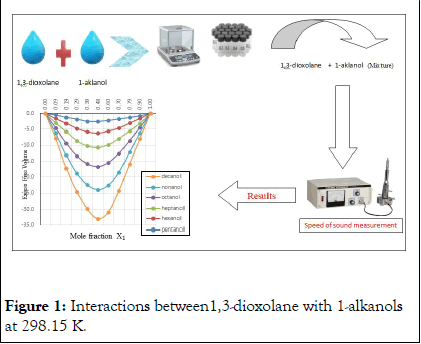
Figure 1: Interactions between1,3-dioxolane with 1-alkanols at 298.15 K.
| Mole fraction 1,3-Dioxolane (x1) | Density (ρ)/g.cm-3 | Viscosity (η)/mPas | Sound velocity (u)/ms-1 | Surface tension (S) × 103/N.m-1 | Available volume (Va) × 10-3/m3mol-1 | Enthalpy (H) × 106 | Free volume (Vf) × 10-7 M3mol-1 | Relaxation Strength (r) |
Interaction parameter (χ) × 10-3 |
| 1,3-Dioxolane+Pentanol | |||||||||
| 0 | 0.8124 | 3.3978 | 1198 | 0.2155 | 0.0272 | 0.3156 | 1.9568 | 0.0631 |
0 |
| 0.0939 | 0.8276 | 2.3973 | 1284 | 0.2436 | 0.0207 | 0.345 | 3.5817 | 0.039 |
0.1236 |
| 0.1942 | 0.8436 | 1.897 | 1290 | 0.2501 | 0.0196 | 0.3468 | 4.9996 | 0.0375 |
0.1079 |
| 0.2941 | 0.864 | 1.4437 | 1296 | 0.2579 | 0.0184 | 0.3384 | 9.9265 | 0.0361 |
0.0928 |
| 0.3942 | 0.8836 | 1.1866 | 1300 | 0.265 | 0.0175 | 0.3341 | 11.0374 | 0.0351 |
0.0748 |
| 0.4787 | 0.9068 | 1.0904 | 1304 | 0.2732 | 0.0165 | 0.33.8 | 10.8499 | 0.0342 |
0.0609 |
| 0.5999 | 0.9316 | 0.9311 | 1310 | 0.2826 | 0.0154 | 0.3262 | 13.4125 | 0.0328 |
0.0422 |
| 0.6972 | 0.9596 | 0.7717 | 1318 | 0.293.8 | 0.0143 | 0.3236 | 17.4788 | 0.031 |
0.0326 |
| 0.7928 | 0.9876 | 0.7171 | 1324 | 0.3045 | 0.0134 | 0.3201 | 17.4788 | 0.0297 |
0.0206 |
| 0.9035 | 1.026 | 0.6489 | 1332 | 0.3192 | 0.0123 | 0.3166 | 19.1422 | 0.028 |
0.0089 |
| 1 | 1.0616 | 0.5885 | 1340 | 0.3332 | 0.0113 | 0.3135 | 21.7624 | 0.0264 |
0 |
| 1,3-Dioxolane+Hexanol | |||||||||
| 0 | 0.8176 | 4.6091 | 1306 | 0.2469 | 0.0229 | 0.4163 | 1.7591 | 0.0337 |
0 |
| 0.0912 | 0.8252 | 3.3826 | 1317 | 0.2524 | 0.0213 | 0.4112 | 2.7275 | 0.0312 |
0.0121 |
| 0.1955 | 0.8432 | 2.3306 | 1320 | 0.2588 | 0.02 | 0.4003 | 4.576 | 0.0306 |
0.0112 |
| 0.2923 | 0.8584 | 1.9839 | 1322 | 0.264 | 0.019 | 0.3899 | 5.5951 | 0.0301 |
0.0092 |
| 0.3982 | 0.8792 | 1.572 | 1325 | 0.2713 | 0.0177 | 0.3787 | 7.5845 | 0.0295 |
0.0083 |
| 0.4942 | 0.8992 | 1.3059 | 1327 | 0.2781 | 0.0167 | 0.3683 | 9.5968 | 0.0291 |
0.0064 |
| 0.6059 | 0.9264 | 1.0343 | 1330 | 0.2875 | 0.0155 | 0.3567 | 12.9396 | 0.0284 |
0.0051 |
| 0.6976 | 0.9508 | 0.9131 | 1332 | 0.2958 | 0.0145 | 0.465 | 14.9307 | 0.028 |
0.0034 |
| 0.8018 | 0.9836 | 0.768 | 1335 | 0.307 | 0.0133 | 0.3352 | 18.398 | 0.0274 |
0.0026 |
| 0.8914 | 1.0168 | 0.7304 | 1337 | 0.3181 | 0.0124 | 0.3254 | 18.9465 | 0.027 |
0.001 |
| 1 | 1.0616 | 0.5885 | 1340 | 0.3332 | 0.0113 | 0.3135 | 24.7413 | 0.0264 |
0 |
| 1,3-Dioxolane+Heptanol | |||||||||
| 0 | 0.8196 | 5.9066 | 1325 | 0.2529 | 0.0243 | 0.4838 | 1.503 | 0.0295 |
0 |
| 0.0928 | 0.8304 | 4.3181 | 1334 | 0.2589 | 0.0224 | 0.4725 | 2.3075 | 0.0276 |
0.0115 |
| 0.1905 | 0.8412 | 3.2577 | 1334 | 0.2623 | 0.0213 | 0.4552 | 3.3296 | 0.0252 |
0.0092 |
| 0.2939 | 0.8592 | 2.5895 | 1335 | 0.2682 | 0.02 | 0.4373 | 4.4224 | 0.0274 |
0.0084 |
| 0.3894 | 0.874 | 1.9926 | 1335 | 0.2728 | 0.0188 | 0.4201 | 6.1746 | 0.0273 |
0.0063 |
| 0.4818 | 0.8916 | 1.5315 | 1336 | 0.2786 | 0.0177 | 0.4042 | 8.6425 | 0.0272 |
0.0056 |
| 0.6021 | 0.9184 | 1.219 | 1337 | 0.2873 | 0.0162 | 0.3835 | 11.2315 | 0.027 |
4.4553 |
| 0.6952 | 0.942 | 1.0959 | 1337 | 0.2947 | 0.0151 | 0.3667 | 12.3322 | 0.0268 |
2.3556 |
| 0.7892 | 0.9756 | 0.9903 | 1338 | 0.3055 | 0.0139 | 0.3505 | 13.4017 | 0.0267 |
1.7391 |
| 0.9006 | 1.0156 | 0.7057 | 1339 | 0.3184 | 0.0125 | 0.3309 | 20.4381 | 0.0266 |
0.7337 |
| 1 | 1.0616 | 0.5885 | 1340 | 0.3332 | 0.0113 | 0.3135 | 24.7413 | 0.0264 |
0 |
| 1,3-Dioxolane+Octanol | |||||||||
| 0 | 0.8296 | 7.1508 | 1350 | 0.2633 | 0.0247 | 0.5619 | 1.3767 | 0.0244 |
0 |
| 0.0885 | 0.8296 | 5.6095 | 1350 | 0.2645 | 0.0235 | 0.5363 | 1.8692 | 0.0243 |
1.3124 |
| 0.1967 | 0.8464 | 3.9321 | 1349 | 0.2683 | 0.022 | 0.51 | 2.9529 | 0.0246 |
1.3133 |
| 0.2998 | 0.856 | 3.2616 | 1348 | 0.2711 | 0.0208 | 0.4845 | 3.6234 | 0.0248 |
1.4823 |
| 0.3902 | 0.8712 | 2.4284 | 1348 | 0.2759 | 0.0195 | 0.4629 | 5.2656 | 0.0247 |
2.8279 |
| 0.4963 | 0.8876 | 1.9058 | 1348 | 0.2811 | 0.0181 | 0.4375 | 6.9577 | 0.0246 |
4.4106 |
| 0.6008 | 0.914 | 1.3631 | 1347 | 0.2891 | 0.0166 | 0.4117 | 10.516 | 0.025 |
4.4812 |
| 0.6925 | 0.934 | 1.1376 | 1348 | 0.2958 | 0.0154 | 0.3905 | 12.718 | 0.0248 |
7.3473 |
| 0.7975 | 0.9676 | 0.9141 | 1348 | 0.3064 | 0.0139 | 0.3652 | 15.9753 | 0.0247 |
8.9242 |
| 0.894 | 1.0104 | 0.7652 | 1348 | 0.32 | 0.0124 | 0.3421 | 18.906 | 0.0246 |
0.0103 |
| 1 | 1.0616 | 0.5885 | 1340 | 0.3332 | 0.0113 | 0.3135 | 24.7413 | 0.0264 |
0 |
| 1,3-Dioxolane+Nonanol | |||||||||
| 0 | 0.8248 | 8.9258 | 1366 | 0.2665 | 0.0255 | 0.6291 | 1.1714 | 0.0213 |
0 |
| 0.0876 | 0.8336 | 6.8601 | 1366 | 0.2693 | 0.0242 | 0.602 | 1.6286 | 0.021 |
3.343 |
| 0.1913 | 0.8404 | 5.8531 | 1363 | 0.2706 | 0.023 | 0.5684 | 1.899 | 0.0219 |
2.9025 |
| 0.2942 | 0.8504 | 4.4022 | 1359 | 0.2726 | 0.0218 | 0.5347 | 2.662 | 0.0226 |
9.5609 |
| 0.3963 | 0.8692 | 3.1558 | 1355 | 0.2774 | 0.0205 | 0.5014 | 3.9924 | 0.0234 |
-1.0268 |
| 0.4959 | 0.8844 | 2.334 | 1352 | 0.2813 | 0.0191 | 0.4697 | 5.7014 | 0.024 |
-1.6349 |
| 0.605 | 0.9092 | 1.7321 | 1349 | 0.2883 | 0.0175 | 0.4354 | 7.9725 | 0.0246 |
-1.8802 |
| 0.6947 | 0.9332 | 1.3334 | 1346 | 0.2949 | 0.0162 | 0.4072 | 10.6902 | 0.0252 |
-2.8731 |
| 0.7993 | 0.9648 | 0.9642 | 1343 | 0.3039 | 0.0146 | 0.3744 | 15.3683 | 0.0258 |
-3.2951 |
| 0.9013 | 1.0084 | 0.8031 | 1340 | 0.3165 | 0.013 | 0.3402 | 17.3683 | 0.0262 |
-3.8191 |
| 1 | 1.0616 | 0.5885 | 1340 | 0.3332 | 0.0113 | 0.3135 | 24.7413 | 0.0264 |
0 |
| 1,3-Dioxolane+Decanol | |||||||||
| 0 | 0.8292 | 11.8027 | 1378 | 0.2714 | 0.0264 | 0.699 | 0.8971 | 0.0192 |
0 |
| 0.0881 | 0.8364 | 8.5615 | 1374 | 0.2726 | 0.0254 | 0.6634 | 1.3454 | 0.0199 |
-0.9486 |
| 0.191 | 0.8396 | 7.8207 | 1370 | 0.2724 | 0.0243 | 0.6226 | 1.404 | 0.0206 |
-1.0823 |
| 0.2921 | 0.856 | 5.534 | 1366 | 0.2765 | 0.0228 | 0.5827 | 2.14 | 0.0213 |
-1.3167 |
| 0.3937 | 0.8672 | 4.2319 | 1362 | 0.2789 | 0.0214 | 0.5429 | 2.8863 | 0.0221 |
-1.5245 |
| 0.4956 | 0.8824 | 3.4173 | 1358 | 0.2826 | 0.0199 | 0.5035 | 3.5598 | 0.0228 |
-1.7167 |
| 0.604 | 0.9076 | 2.537 | 1353 | 0.289 | 0.0182 | 0.4615 | 4.8971 | 0.0238 |
-3.0204 |
| 0.7129 | 0.9308 | 1.5262 | 1348 | 0.2948 | 0.0166 | 0.4198 | 9.1301 | 0.0248 |
-4.3032 |
| 0.7983 | 0.9616 | 1.1637 | 1344 | 0.3032 | 0.0151 | 0.3871 | 12.181 | 0.0256 |
-5.431 |
|
0.8971 |
1.004 |
0.8623 |
1340 |
0.3151 |
0.0133 |
0.3505 |
16.4668 |
0.026 |
-5.8106 |
|
1 |
1.0616 |
0.5885 |
1340 |
0.3332 |
0.0113 |
0.3135 |
24.7413 |
0.0264 |
0 |
Table 2: Experimental values of speed of sound (u), viscosities (η) and densities (ρ) and derived parameter surface tension (S), available volume (Va), relaxation strength (r) and interaction parameter (χ) for the binary mixtures of 1,3-dioxolane(1)+alkanols (2) at 298.15 K.
The excess parameters such as excess surface tension (SE), excess available volume (VaE), excess relaxation strength (rE), excess enthalpy (HE) and excess free volume (Vf E) have been calculated using the following equations.
Surface tension S=6.4 × 10⁻³.ρ.u1/2 (1)
Available volume Va=(M/ρ) [1-(U/U∞] (2)
Where M is the molecular weight of the solution which can be calculated according to the equation [M=M1X1+M2X2] and U∞=1600 m/s
Free volume Vf=(MU/kη)3/2 (3)
Relaxation strength r=1-(U/U∞)2 (4)
Enthalpy H=Vm×Pi (5)
Interaction parameter χ=(uexp2/uidl2)-1 (6)
YE=Yexp-(X1Y1+X2Y2) (7)
YE refer to (SE), (Va E), (rE), (HE) and (Vf E) whereas Yexp is measured property. Y1, Y2, are any acoustic parameter, X1 and X2 are mole fraction of 1,3-Dioxolane and 1-alkanol.
A perusal of Table 2 shows the mole fraction (X1) of 1,3- Dioxolane increases, density and ultrasonic velocity increase, while viscosity decreases. This trend can be explained by molecular interactions in the system [25]. When 1,3-Dioxolane is added, it likely leads to closer packing of molecules due to molecular interactions, such as dipole-induced dipole forces.
The calculated excess surface tension (SE), values for the binary liquid mixture listed in Figure 2. A perusal of curves in Figure 2 indicate the values of excess surface tension (SE), data for binary mixtures of 1,3-Dioxolane with 1-alkanols are negative. The excess surface tension (SE), values are negative over the entire mole fraction range and become more negative with increasing the mole fraction of second component for all binary mixtures. These results can be explained in term of molecular interactions and structured effects. Excess values of surface tension are negative over the entire composition range at 298.15 K, indicating weak interaction between the components of the mixture. In all the cases surface tension increases with increase in mole fraction of 1,3-Dioxolane, which indicate reduction in the intermolecular interactions. For all studied systems, excess surface tension (SE), were negative over the entire mole fraction range of 1,3-Dioxolane at 298.15 K. Among the six systems, 1,3- Dioxolane with 1-alkanols containing system showed more negative.
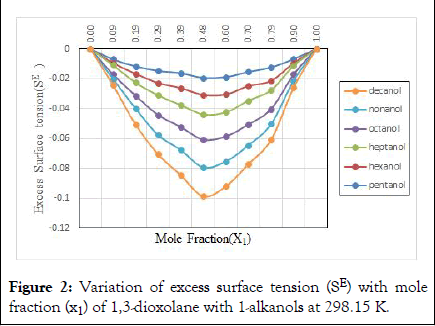
Figure 2: Variation of excess surface tension (SE) with mole fraction (x1) of 1,3-dioxolane with 1-alkanols at 298.15 K.
Figure 3 depicts the variation of the excess available volume (Va) of the chosen system. We clearly see from Figure 3 that the nonlinear variation of excess available volume (Va) with mole fraction of 1,3-dioxolane. The negative deviation of excess available volume (Va) reaching a minimum at 0.48 mole fraction of 1,3-dioxolane shows the molecular interactions between the molecules [26]. It is evident from Figure 3 that the value of excess available volume (Va E) are negative for all binary liquid system at 298.15 K. The value of Va E are plotted against the mole fraction of 1,3-dioxolane and are shown in Figure 3. Similarly results were also obtained by D. Bala Karuna Kumar et al. [27] for binary mixtures of N-methyl-2-pyrrolidone. The depolymerisation of hydrogen bonded alcohols aggregates and decrease in dipolar association of component molecules leads to expansion of volume dominating interstitial accommodation which causes negative value of excess available volume (Va E) but it is compensated by charge transfer complex formation between hydrogen of alcohols and oxygen of 1,3-dioxolane. From the plots of (Va E) vs. X1 (Figure 3) it may seen that excess available volume are negative over the whole mole fraction.
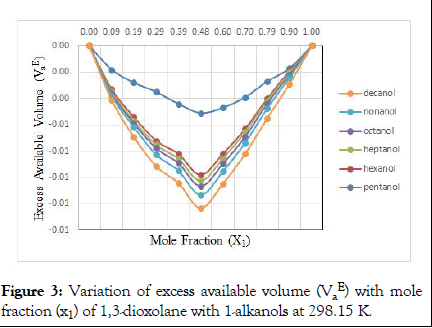
Figure 3: Variation of excess available volume (Va E) with mole fraction (x1) of 1,3-dioxolane with 1-alkanols at 298.15 K.
From Table 2 show that the values of interaction parameter (χ) are positive for the system 1,3-dioxolane+pentanol, 1,3-dioxolane +hexanol, 1,3-dioxolane+heptanol and 1,3-dioxolane+octanol. The positive values of interaction parameter (χ) indicate the existence of strong interactions in the binary liquid mixture. The values of interaction parameter (χ) are negative for the system 1,3-dioxolane+nonanol and 1,3-dioxolane+decanol. This indicating the weak interactions in these binary liquid mixtures [28].
The term relaxation strength (r) is useful in prediction of molecular properties of liquid mixtures. The relaxation strength (r) decreases with increases in concentration of 1,3-dioxolane (X1). Figure 4 shows the variation of excess relaxation strength (rE) with mole fraction of 1,3-dioxolane at the temperature 298.15 K For the binary system 1,3-dioxolane with 1-alkanols, the excess relaxation strength (rE) values are negative and decreasing with the increase in mole fraction of 1,3-dioxolane up to the mole fraction (0.5) and the increase with increase in mole fraction. We clearly see from Figure 4 that the non-linear variation of excess relaxation strength (rE) with mole fraction of 1,3-dioxolane. The negative deviation of excess relaxation strength (rE) reaching a minimum at 0.48 mole fraction of 1,3- dioxolane shows the molecular interactions between the molecules. The structural changes take place due to the variation in relaxation strength (r) of the system. The excess relaxation strength (rE) decrease with increase in the composition of 1,3-dioxolane till 0.48 mole fraction, reaches minimum at 0.48 mole fraction and beyond 0.48 mole fraction, it again increases. The existence of minimum relaxation strength (r) indicates the squeezing of molecules in the system.
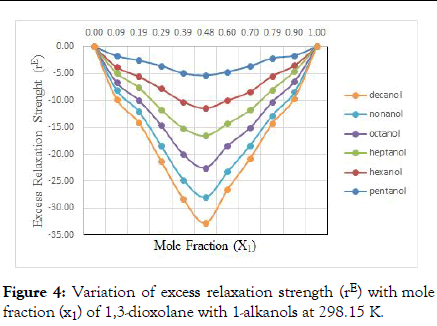
Figure 4: Variation of excess relaxation strength (rE) with mole fraction (x1) of 1,3-dioxolane with 1-alkanols at 298.15 K.
Figure 5 shows the variation of excess enthalpy (HE) with mole fraction of 1,3-dioxolane at the temperature 298.15 K For the binary system 1,3-dioxolane with 1-alkanols, the excess enthalpy (HE) values are negative and decreasing with the increase in mole fraction of 1,3-dioxolane up to the mole fraction (0.5) and the increase with increase in mole fraction. In the present investigation for the six binary systems it is observe that, as the mole fraction of 1,3-dioxolane increase, the excess enthalpy (HE) values decreases. This situation is observed for all six binary system under study and can be viewed from plots Figure 6. This suggests that dipole and dispersive force are operative in these systems, when the 1,3-dioxolane concentration low. When the concentration of 1,3-dioxolane increased, the corresponding decrease in concentration of 1,3-dioxolane leads to specific interactions i.e., the interactions move from weak to strong which supports the above arguments is case of other parameters. As a result, the free dipoles released from the alkanols in association with 1,3-dioxolane molecules forming strong hydrogen bonds, hence stronger molecular association existing between the 1,3-dioxolane with 1-alkanols molecules through hydrogen bonding [29].
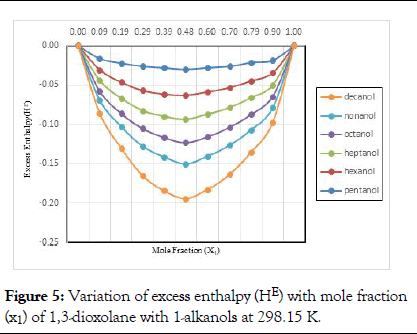
Figure 5: Variation of excess enthalpy (HE) with mole fraction (x1) of 1,3-dioxolane with 1-alkanols at 298.15 K.
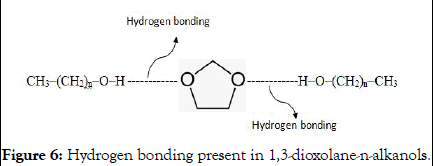
Figure 6: Hydrogen bonding present in 1,3-dioxolane-n-alkanols.
The concept of free volume is an extension of the idea that each molecule is enclosed by its neighbor in a cell. The free volume per molecules may be regarded as the effective volume accessible to the centers of a molecule in a liquid. It is however, evident from the consideration of the liquid state theories that the concept of free volume varies with the specific model chosen for the liquid. A perusal of Figure 7 shows that the value of excess free volume (Vf E), are negative for the all binary liquid system 1,3-dioxolane with 1-alkanols at 298.15 K. In the present investigation the negative excess free volume (Vf E), for binary mixtures of 1,3-dioxolane with 1-alkanols may be attributed to hydrogen bond formation through dipole-dipole interaction between 1-alkanol and 1,3-dioxolane molecule or to structural contributions arising from the geometrical fitting of 1-alkanol into the 1,3-dioxolane due to difference in the free volume between components. The interactions of alcohols with organic liquids are interesting due to its acetic nature. The O-H bond in alcohols is polar and allows the release of hydrogen atom as proton (H+). The order of acidity in alcohols is: 1°-alcohol>2°- alcohol>3°-alcohol. This order is due to +I effect while the interacting ability of alcohols is well established no such opinion is suggested from literature [30,31] with regards to 1,3-dioxolane with 1-alkanols were selected to study their molecular interactions through their acoustical behavior.
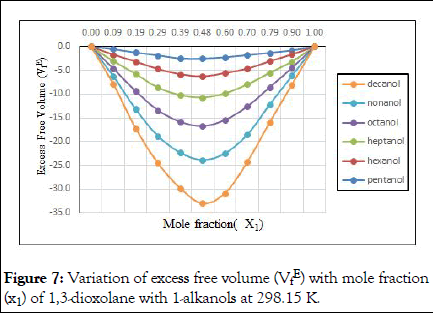
Figure 7: Variation of excess free volume (Vf E) with mole fraction (x1) of 1,3-dioxolane with 1-alkanols at 298.15 K.
The negative values of excess free volume (Vf E), indicate the presence of strong molecular interaction. We may conclude that 1-alkanols, is disrupted. It is also concluded that Suryanarayana approach for estimating free volume thermodynamic considerations is very well applicable in the present case.
This research article report experimental study of sound velocity, viscosity and density and its derived excess parameters. The existence of molecular interactions in solute-solvent is favoured in the system, confirmed from the ultrasonic velocity (u), viscosity (η), density (ρ), surface tension (S), available volume (Va), relaxation strength (r), interaction parameter (χ), enthalpy (H) and free volume (Vf). We are concluded that there exists a molecular interaction between 1,3-dioxolane and 1-alkanols due to hydrogen bonding and degree of complexation.
The authors thanks to Uttar Pradesh Council of Science and Technology, Lucknow (No. CST/CHEM/D-648) for financial support (Project ID: 3409).
Ethical approval is not applicable for the article.
Not applicable.
Not applicable.
The author(s) disclosed receipt of the following financial support for the research, authorship, and/or publication of this article: This project was sponsored by the Uttar Pradesh Council of Science and Technology, Lucknow (No. CST/CHEM/D-648) for financial support (Project ID: 3409).
The author(s) declared no potential conflicts of interest with respect to the research, authorship, and/or publication of this article.
The data for this study are available from the corresponding author on request.
Citation: Sharma DK, Sahu S, Khan A, Agarwal S, Prajapati C, Kumar S(2025) Ultrasonic Studies on Molecular Interaction in Binary Liquid Mixture of Cyclic Diether with 1-Alkanols (C5-C10) at 298.15 K. J Phys Chem Biophys. 15:441.
Received: 23-Sep-2025, Manuscript No. JPCB-25-39440; Editor assigned: 26-Sep-2025, Pre QC No. JPCB-25-39440 (PQ); Reviewed: 10-Oct-2025, QC No. JPCB-25-39440; Revised: 04-Dec-2025, Manuscript No. JPCB-25-39440 (R); Published: 12-Dec-2025 , DOI: 10.35841/2161-0398.25.15.441
Copyright: © 2025 Sharma DK, et al. This is an open-access article distributed under the terms of the Creative Commons Attribution License, which permits unrestricted use, distribution, and reproduction in any medium, provided the original author and source are credited.