
Journal of Chemical Engineering & Process Technology
Open Access
ISSN: 2157-7048
ISSN: 2157-7048
Research Article - (2025)Volume 16, Issue 3
Several previous experiments have shown that salt has a significant effect on the liquid-liquid extraction process, it has been used to enhance the "Salting-out" yield of this process. This is because the presence of salt affects the solubility of the elements present in an aqueous solution, in particular the solute. The addition of a salt to an aqueous solution introduces ionic forces that affect the equilibrium and directly influence the solute's distribution coefficient. We therefore studied the effect of three types of salt, namely Sodium Chloride (NaCl), Ammonium Carbonate ((NH4)2CO3) and Sodium Carbonate (Na2CO3), on the yield of liquid-liquid extraction processes for carboxylic acids (formic acid, acetic acid and propionic acid).
Liquid-liquid extraction; Carboxylic acids; Salting-out; Salting-in
The initial concentration of formic acid, acetic acid and propionic acid (0.2 mol/L; 0.13 mol/L; 0.08 mol/L) respectively, regarding the salt concentrations, we varied from 0 g/L to 8 g/L. To carry out this process, we chose the system (Tributylphosphate (TBP) +Dodecane) as the solvent.
Experiments have shown that increasing the salt concentration in the reactive extraction process has no positive effect on enhancing the extraction yield. At low concentrations of ammonium carbonate and sodium carbonate (below 4 g/L), the yield decreased significantly, which is known as the internal salting-in phenomenon. When the salt concentration exceeded 4 g/L and reached up to 8 g/L, the yield increased significantly, known as the internal salting-out phenomenon, but still remained lower than the initial state before the addition of salt. Form this, we can say that in the reactive extraction process, the primary factor determining the presence of the acid in the organic phase is the chemical reaction, while the physical reaction (diffusion physic) remains insignificant before it, even with the addition of ionic strength (addition of salt) to the solution [1].
The need to separate mixtures is becoming increasingly important in the process industries. With the growing interest in alternative materials and fuels, coupled with the need to combat environmental pollution and recycle products, the diversity of the separation types that needs to be carried out has significantly expanded. Among the separation processes, the most commonly used is solvent extraction [2].
Liquid-liquid extraction has been considered a promising method rather than precipitation among these methods. Phosphorous aliphatic amines, oxygenated amines and high molecular weight aliphatic amines are effective extractants used for the recovery of carboxylic acids. These extractants are more efficient than traditional oxygenated and hydrophobic solvents.
Conventional oxygenated and hydrophobic solvents, such as ketones, alcohols, ethers and aliphatic hydrocarbons, are less effective.
Carboxylic acids are molecules with high added value and unique in their kind. They are found in abundance in nature in the form of fatty acid (liquid). Their physico-chemical properties make them highly reactive, which means they are used extensively in a wide range of industries.
The production of carboxylic acids has a long history, dating back to the 1900’s. However, the recovery of carboxylic acids from fermentation broth or low titer wastewater is a major challenge. Many efforts have been made to develop feasible and economical methods for recovering carboxylic acids [3].
For example, precipitation with calcium hydroxide or calcium oxide, followed by filtration, acidification and crystallization, has been employed as the main recovery method, although it is very difficult and yields low efficiency. Other acid recovery processes are available, including electrodialysis electrodialysis, esterification, chromatography, extractive fermentation and solvent extraction.
Indeed, the addition of a salt to such systems causes a certain dynamic at the molecular level where the ions present in the solution are generally hydrated, thus generating a deficit of water molecules, depriving organic molecules of hydration. Consequently, the latter are encouraged to migrate out of the aqueous medium, giving rise to what is known as the "saltingout" phenomenon. Conversely, by adding a polar solvent, the solvation cages (hydration) can be destroyed, creating a certain availability of water molecules for the organic molecules that become hydrated, giving this time the "salting-in" phenomenon [4].
The main objective of our work is to experimentally study the effect of salt on the liquid-liquid extraction of carboxylic acids (Formic; Acetic; Propionic) by Tributylphosphate (TBP) in the presence of the three salts (Sodium Chloride (NaCl); Ammonium Carbonate ((NH4 )2CO3 ); Sodium Carbonate (Na2CO3 )) at 0 to 8 g/L.
Salting-out
Salting-Out Extraction (SOE or is referred to as aqueous two phase system) is a separation method used to extract a hydrophilic target from an aqueous solution with the aid of an organic solvent as the extractant and salt as a salting out reagent and can be used as a potential alternative approach where separation, concentration and partial purification can be achieved in a single step of extraction process. It offers many merits such as low cost, low viscosity, easy recovery of phaseforming components, short phase separation time, easy scale up and possibility of continuous operation. Recently, the fundamental screening and optimization of SOE systems for target products recovery have been studied and the application of SOE systems have been extended to bio-based chemicals, nature products, protein and enzyme [5].
Chemicals and apparatus
Experimental process: The experiments are conducted in 125 cm3 separating funnels. A volume of 20 cm3 of aqueous solution is introduced into the funnel and an equal volume of the organic phase (extractant+diluent) is mixed, giving a solvent ratio (O/A) of 1.
Firstly, we prepared aqueous solutions of formic acid (0.2 mol/l), acetic acid (0.13 mol/l) and propionic acid (0.08 mol/l) by simple dilution. Then we add different concentrations of a salt to obtain ternary systems (water-acid-salt). We experimented with three different types of salt (((NH4)2CO3 ); (NaCl); (Na2CO3)) at concentrations ranging from (0 to 8 g/L).
The mixture is stirred using a system of Tributylphosphate +Dodecane (TBP+Dodecane) 80% (v/v) TBP-20% (v/v) dodecane by a stirrer at a frequency of 200 rpm for an estimated duration of 20 minutes at an ambient temperature of 20°C [6].
The concentration of carboxylic acids in the aqueous phase was determined by HPLC (High-Performance Liquid Chromatography) method.
The concertation of the acid in the organic phase is obtained through a mass balance C0V0=CV+CV
Where:
•C=The initial concentration of the solid in the aqueous phase
•C=The concentration of the solute at equilibrium in the aqueous phase
•C=The concentration of the solute at equilibrium in the organic phase
•V=The initial volume of the aqueous phase
•V=The volume of the aqueous phase in equilibrium with the organic
•V=The volume of the organic phase in equilibrium with aqueous
Each sample is analyzed three consecutive times under the same operating conditions and the average value is reported.
It is essential to use a parameter characterizing the extraction efficiency.
E (%)=(C0V0 -CV)/(C0V0 ) × 100
Influence of different salt concentrations (NaCl) on the extraction yield of the three acids: The experimental results presented in Figures 1-3 investigate the influence of varying Sodium Chloride (NaCl) concentrations on the extraction yield of formic acid, acetic acid and propionic acid. From these figures, it is evident that NaCl concentration does not significantly affect the extraction yields of any of the three acids. The extraction yields remain relatively stable across the different salt concentrations, indicating that NaCl does not play a major role in enhancing or inhibiting the extraction process for these acids [7].
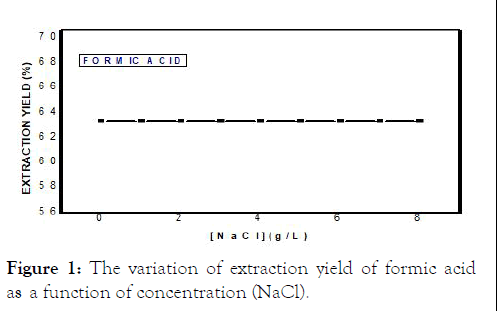
Figure 1: The variation of extraction yield of formic acid as a function of concentration (NaCl).
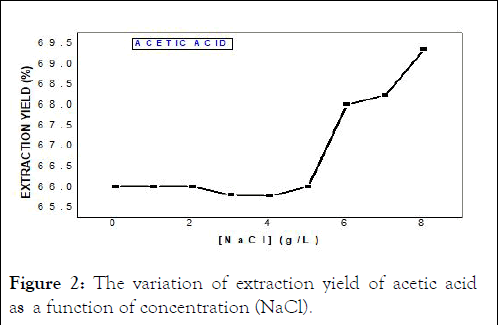
Figure 2: The variation of extraction yield of acetic acid as a function of concentration (NaCl).
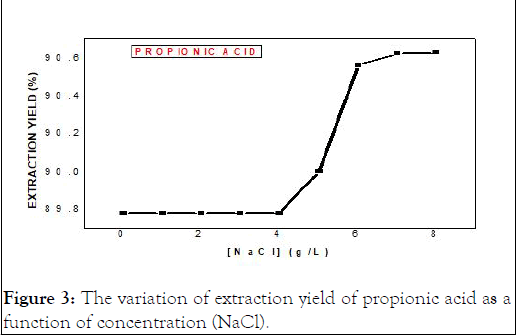
Figure 3: The variation of extraction yield of propionic acid as a function of concentration (NaCl).
According to the experimental results Figures 1-3 sodium chloride salt has no influence on the yield the extraction of the three acids.
Influence of different salt concentrations ((NH4)2CO3) on the extraction yield of the three acids: Figures 4-6 show the effect of ammonium carbonate ((NH4)2CO3) concentration on the extraction yields of the same acids. These results suggest that the concentration of ammonium carbonate has a more pronounced impact on the extraction yields compared to sodium chloride. However, the specific trends in these figures will need to be analyzed further to determine whether the relationship is direct or involves more complex interactions between the salt and the acids during the extraction process [8].
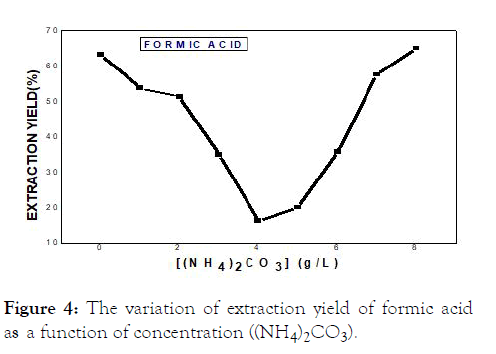
Figure 4: The variation of extraction yield of formic acid as a function of concentration ((NH4)2CO3).
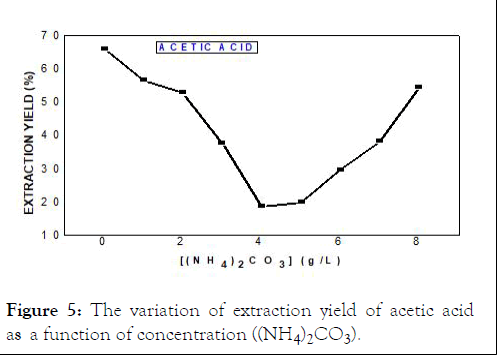
Figure 5: The variation of extraction yield of acetic acid as a function of concentration ((NH4)2CO3).
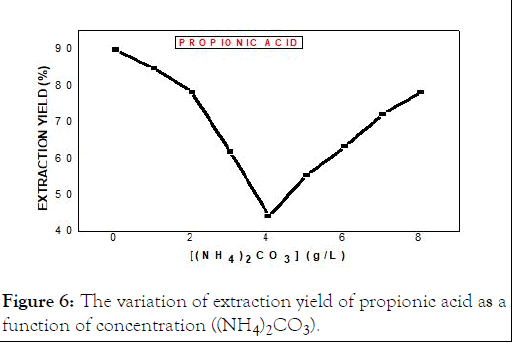
Figure 6: The variation of extraction yield of propionic acid as a function of concentration ((NH4)2CO3).
According to the experimental results Figures 4-6, it is concluded that ammonium carbonate salt has a significant impact on the yield of the extraction process for the three acids.
The extraction yield for all three acids decreases significantly with increasing ammonium carbonate salt concentration [9].
The extraction yield value for the three carboxylic acids reaches its lowest value at a salt concentration of 4 g/L. This is due to the ionic force created by the ammonium carbonate present in the solution (aqueous phase), which increases the solubility of the acid, making the extraction process difficult.
Immediately afterwards, the extraction process yield began to increase as the concentration of ammonium carbonate salt increased.
Due to the high solubility of ammonium carbonate salt in water, when its concentration exceeds 4 g/L, it affects the three acids by reducing their ability to dissolve in water, thereby increasing the extraction process yield.
Influence of different (Na2CO3) salt concentrations on the extraction yield and distribution coefficient of the three acids: Figures 7-9 illustrate the impact of varying Sodium Carbonate (Na2CO3) concentrations on the extraction yield of formic, acetic and propionic acids. The data shows a clear correlation between Na2CO3 concentration and extraction yield for all three acids. As the concentration of Na2CO3 increases, the extraction yield of each acid also rises, indicating that sodium carbonate enhances the extraction efficiency. This trend suggests that Na2CO3 may facilitate the separation process, possibly through changes in acidity or solubility dynamics, making it a promising salt for improving extraction yields of these acids in relevant processes.
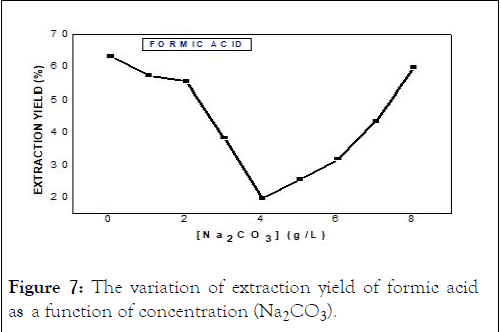
Figure 7: The variation of extraction yield of formic acid as a function of concentration (Na2CO3).
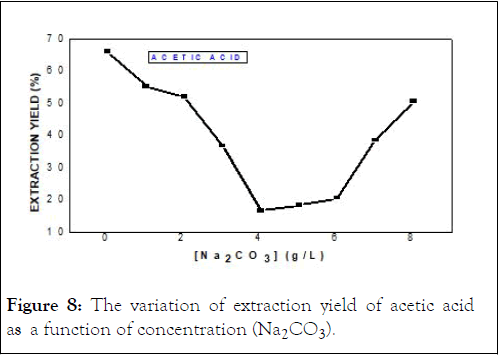
Figure 8: The variation of extraction yield of acetic acid as a function of concentration (Na2CO3).
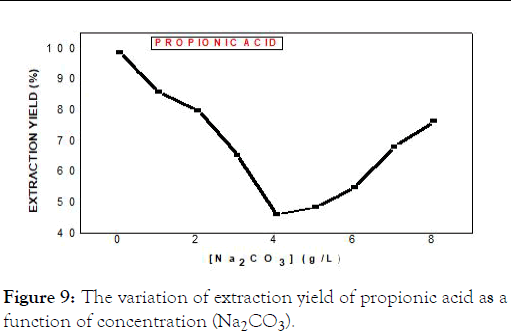
Figure 9: The variation of extraction yield of propionic acid as a function of concentration (Na2CO3).
According to the experimental results Figures 7-9, we conclude that sodium carbonate salt has the same effect as ammonium carbonate salt on extraction yield.
For formic acid Figure 7, acetic acid Figure 8 and propionic acid Figure 9, the yield decreases to 19.65%, 16.560% and 46.275% successively for a sodium carbonate concentration equal to 4 g/L.
When the salt concentration exceeds 4 g/L, the yield begins to increase to 59.850%; 50.60%; and 76.380% for the three formic (Figure 7), acetic (Figure 8) and propionic acids (Figure 9) at a concentration of 8 g/L. This is due to the change in ionic strength within the solution, in addition to the high solubility of the sodium carbonate salt.
The aim of this study is to determine the extent of the effect of salt addition on the extraction process for carboxylic acids such as formic, acetic and propionic acid. Experiments have shown that adding salt has two effects, depending on the amount of salt added. The first effect is known as "salting in": Increasing the salt concentration, significantly contributed to the decrease in the extraction yield, particularly in the case of using Ammonium Carbonate ((NH4)2CO3) and Sodium Carbonate (Na2CO3), when the yield dropped to a low level, reaching 19. 65%; 16.560%; and 46.275% for the three acids (AF; AA; AP) respectively at a sodium carbonate concentration of 4 g/L and 16.5%; 18.692%; 44.125% for the three acids (AF; AA; AP) respectively at an ammonium carbonate concentration of 4 g/L.
However, the yield remained constant when sodium chloride is used. As for the second effect, it occurs when the salt concentration exceeds 4 g/L, the yield increases significantly for both ammonium carbonate and sodium carbonate. This phenomenon is known as salting out.
But this increase in yield does not even reach the initial state before the addition of salt. Consequently, we can conclude that adding salt has no effect on increasing the yield of the reactive extraction process.
[Crossref] [Google Scholar] [PubMed]
[Crossref] [Google Scholar] [PubMed]
[Crossref] [Google Scholar] [PubMed]
[Crossref] [Google Scholar] [PubMed]
Citation: Abdelfetah B, Bourayou EN (2025) Study of the Effect of Salt on the L-L Extraction of Carboxylic Acids (Formic; Acetic; Propionic) by Tributylphosphate (TBP). J Chem Eng Process Technol. 16:544.
Received: 18-Nov-2024, Manuscript No. JCEPT-25-35262; Editor assigned: 21-Nov-2024, Pre QC No. JCEPT-25-35262 (PQ); Reviewed: 05-Dec-2024, QC No. JCEPT-25-35262; Revised: 03-Sep-2025, Manuscript No. JCEPT-25-35262 (R); Published: 10-Sep-2025 , DOI: 10.35248/2157-7048.25.16.544
Copyright: © 2025 Abdelfetah B, et al. This is an open-access article distributed under the terms of the Creative Commons Attribution License, which permits unrestricted use, distribution, and reproduction in any medium, provided the original author and source are credited.