
Forest Research: Open Access
Open Access
ISSN: 2168-9776
ISSN: 2168-9776
Research Article - (2025)Volume 14, Issue 4
Results are reported from an inventory carried out in a forest stand of Pinus caribaea var. hondurensis in Kifu forest. Growth variables; diameter at breast height (dbh), height (h) and Base Area (BA) were used to classify yield potential of Pinus caribaea var. hondurensis in Kifu forest so as to enable the prediction of the potential growth performance in the area. Findings indicate that for 9-12 years old Pinus caribaea var. hondurensis in Kifu forest, height tends to increase exponentially as the age increases. The results also show that mean form factor for over bark volume is 0.42 with an R2 of 100% and linear regression with a forced intercept of zero. The relationship between dbh and stem height shows a positive linear relationship, typical of tropical plantation forests. Additionally, all the selected trees in this study exhibit similar tapering from bottom to the top.
Pinus caribaea; Data; Height; Diameter at breast height; Tree growth performance; Kifu forest
Tree growth is a complex biological phenomenon resulting from the activity of buds (primary growth or axis elongation) and the cambium (secondary growth or axis thickening). Tree growth is eminently variable as dependent upon the individual’s genetic heritage, its environment (soil, atmosphere), its developmental stage (tissue aging) and the actions of man (changes in the environment or in the tree itself through trimming or pruning). Estimating tree volume is important for forest management. This is due to its effectiveness in the assessment of growing stock, timber valuation, spatial arrangement of area allocation for harvesting and decision making process involving the use and management of the forest. The primary intention of this study was to provide information about Pinus caribaea var. hondurensis stand for broad-based management decisions and long term planning. P. caribaea var. hondurensis has proved to be very adaptable to a number of sites and soils in Uganda and is generally well suited to growing in the plantation situation and has hence become a major plantation species in the country. On good sites, P. caribaea var. hondurensis can grow very fast (e.g. mean annual increments exceeding 30 m3/ha/yr in Uganda). In addition, P. caribaea var. hondurensis as most pines produces a very versatile, general purpose timber, which is now widely accepted by timber buyers and the Ugandan public [1].
This study was conducted in Kifu forest reserve to evaluate the growth performance and assess the productivity of forest stands using the data generated. Growth performance data on diameter breast height (dbh) and tree height was collected for a twelveyear- old Pinus caribaea var. hondurensis stand to derive summary results that describe and analyze tree and stand growth patterns that indicate potential yields. These estimates of volume and growth help in planning for appropriate silvicultural treatments in addition to determining when to harvest. The main purpose of the study was to obtain data that can bring forth growth performance information from height-diameter relations for Pinus caribaea var. hondurensis. Furthermore, for future development of height-diameter models for potential prediction in the study area and possible comparison to other regions. Following different important levels of forest inventory, that is National Forest Inventory (NFI) and Non Industrial Forest Owners (NIFO), the study based on NIFO which takes place at forest holding level or forest stands. This therefore would encourage small nonindustrial forest.
Study area
Kifu forest reserve is located in Mukono district, Central Region, Uganda (Figure 1) where the study on Pinus caribaea var. hondurensis stand was conducted. It is located at an elevation of 1,172 meters above sea level. Its coordinates are 0°25'60" N and 32°43'60" E in DMS (Degrees Minutes Seconds) with a tropical rain forest climate [2].
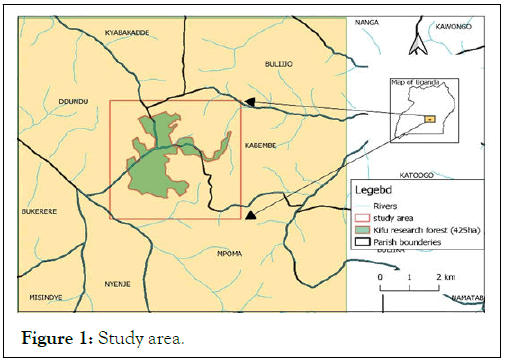
Figure 1: Study area.
Experimental design, materials and methods
Trees sample selection and data collection: Felling of trees in the determination of tree volume was not essential in this study. The trees sampled were selected taking care of the variations in the site and considering all the tree stand. Since quality seedlings were used in the establishment of the well managed stand, there were no incidences of disease and deformations in tree form. Clinometer and measuring tape were used for measuring tree height in meters and pair of calipers for tree dbh in centimeters.
Data processing: Tree basal area was calculated from diameter assuming circular cross section in square meters. While stand basal area from sum of cross-sectional areas based on diameters of individual trees in square meters. Stand volume was sum of individual tree stem volumes based on correlation with tree diameters in cubic meters. The collected raw data and site location was used to generate yield potential of the stands [3].
Data summary is presented in Table 1.
| Growth variable | H (m) | DBH (cm) | BA m2 | Volume m3 |
| Standard deviation | 2.9 | 4.31 | 0.02 | 0.24 |
| Max | 31.6 | 38.7 | 0.12 | 1.38 |
| Min | 17 | 18 | 0.03 | 0.21 |
| Mean | 25.21 | 27.52 | 0.06 | 0.65 |
| Note: DBH: Diameter Breast Height; H: Height, BA: Basal Area | ||||
Table 1: P. caribaea over bark data for 100 stand.
Volume estimation using a form factor
Form factor was considered as an index of tree form and is rather theoretical because direct measurements of form on a standing tree is not possible and with tree form as a third variable, the precision of estimate increased significantly.
The form factor in this study was defined as the relation between the measured volume of a reference tree and the volume of the same reference tree, Oluwagbemiga et al., calculated using height and diameter data (cylinder volume).
Ratio of tree volume to the volume of a cylinder were compared using correlation graph (Figure 1). From Figure 2, mean form factor for over bark volume is 0.42 with an R2 of 100%. The line shown on the graph is linear regression with a forced intercept of zero. Whose form factor therefore corresponds to the slope. The points represent individual sample trees [4,5].
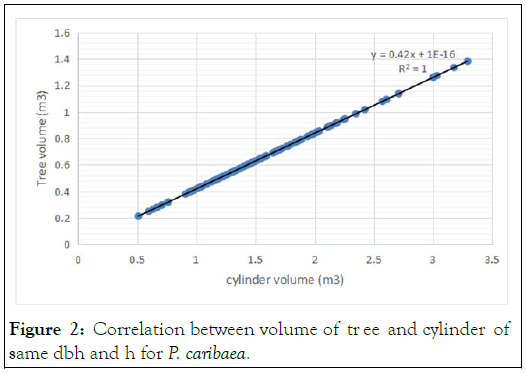
Figure 2: Correlation between volume of tree and cylinder of same dbh and h for P. caribaea.
Pinus caribaea volume-dbh relationship estimate for volume of individual trees shown in Figure 3.
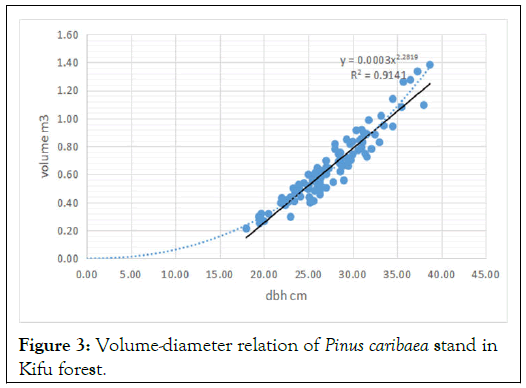
Figure 3: Volume-diameter relation of Pinus caribaea stand in Kifu forest.
Hypsometric relation
The dbh-height function determined the unknown height of the selected tree knowing its dbh from a Pinus caribaea tree population. The relationship between dbh and tree height (Figure 4) shows a positive linear relationship, typical of tropical plantation forests. Additionally, all the selected trees in this study exhibit similar tapering from bottom to the top (Figure 2), confirming the biological validity of the data set [6].
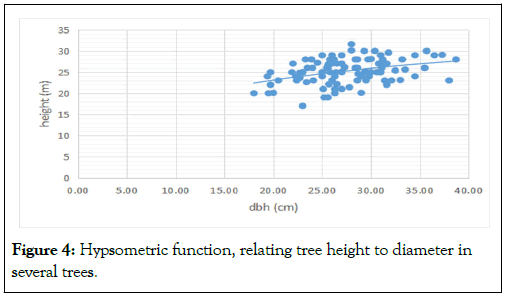
Figure 4: Hypsometric function, relating tree height to diameter in several trees.
Curves for height-age relation for 9-12 years old Pinus caribaea var. hondurensis in Kifu forest indicate that height tends to increase exponentially as the age increases, Figure 5. A comparison was also made with general growth curves in Uganda and other countries as shown in Figure 6 [7,8].
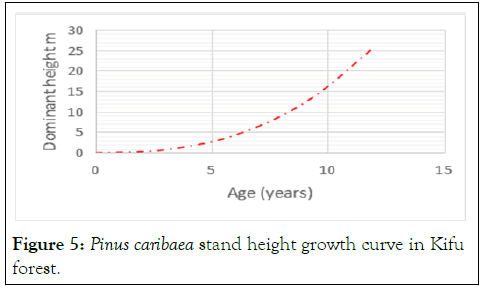
Figure 5: Pinus caribaea stand height growth curve in Kifu forest.
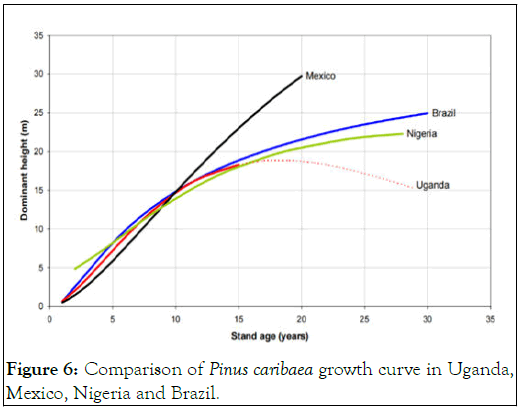
Figure 6: Comparison of Pinus caribaea growth curve in Uganda, Mexico, Nigeria and Brazil.
Individual tree heights and diameters are essential measurements in forest inventories and were used in estimating timber volume. They are also good estimate for site index and other important variables related to forest growth and yield, succession and carbon budget models. The form factor of Pinus caribaea var. hondurensis in Kifu was 0,42 with R2 of 100%. The volume ranged from 0.21 to 1.38 m3 for DBH range of 18 to 38.7 cm. The limitations of the current data-set require allinclusive datasets country wide. To improve the accuracy of the results and contribute to site-species matching in Uganda, future studies on species performance or yield data should be collected from well-established and managed trials in all the Agro- Ecological Zones (AEZs) in the country.
We gratefully acknowledge the financial support from the National Agricultural Research Organisation (NARO). The authors are also grateful to Forest Management and Conservation Programme of the National Forestry Resources Research Institute (NaFORRI) for organizing the inventories in Kifu (research) forest. We are also grateful to the research technicians in the programme that participated in the inventory.
Citation: Ongerep SV, Mujuni DB (2025) Potential Growth Performance of Pinus caribaea var. hondurensis in Kifu Forest, Uganda. J For Res. 14:572.
Received: 27-Oct-2024, Manuscript No. JFOR-24-34835; Editor assigned: 30-Oct-2024, Pre QC No. JFOR-24-34835 (PQ); Reviewed: 14-Nov-2024, QC No. JFOR-24-34835; Revised: 13-Aug-2025, Manuscript No. JFOR-24-34835 (R); Published: 20-Aug-2025 , DOI: 10.35248/2168-9776.25.14.572
Copyright: © 2025 Ongerep SV, et al. This is an open-access article distributed under the terms of the Creative Commons Attribution License, which permits unrestricted use, distribution and reproduction in any medium, provided the original author and source are credited.