
Current Synthetic and Systems Biology
Open Access
ISSN: 2332-0737
ISSN: 2332-0737
Research Article - (2025)Volume 13, Issue 4
Tripeptides are recognized for their high bioavailability and their potential to improve skin structure, hydration and barrier function. This study evaluated the efficacy of MAXI collagen, a tripeptide-based formulation, through combined in vitro and clinical assessments. In cell models, MAXI collagen enhanced collagen production in CCD 966SK fibroblasts, suppressed melanogenesis-related gene expression (TYR, TYRP1, MITF) in A375 melanoma cells and increased SMPD1 along with key anti-aging and antioxidant markers (SIRT1, NADSYN, SOD3, Parkin) in HPEK keratinocytes, indicating broad skin-enhancing activity across multiple pathways. To validate these effects in vivo, a randomized, double-blind, placebo-controlled clinical trial was conducted in 75 adult participants aged 35-65 years. Participants were assigned to MAXI collagen, normal collagen, or placebo (n=25 per group) and consumed one 50 mL bottle daily for 28 days. Skin collagen density, hydration and Transepidermal Water Loss (TEWL) were evaluated at baseline, day 7 and day 28. MAXI collagen increased collagen density by 7.6% at day 7 and 14.0% at day 28 relative to baseline. Skin hydration improved by 12.9% at Day 28, exceeding normal collagen and placebo, while TEWL decreased by 18.0%, indicating improved barrier integrity and moisture retention. Overall, the integrated cellular and clinical findings demonstrate that MAXI collagen provides comprehensive skin benefits by promoting collagen synthesis, improving hydration and strengthening the epidermal barrier. These results support the value of tripeptide supplementation as an effective strategy for enhancing skin health.
MAXI collagen; Tripeptide collagen; Skin hydration; Collagen synthesis
In recent years, consumer demand for skin health has been steadily increasing, driving the rapid growth of the global health food market [1]. According to market research data, the beauty and health supplement industry is expected to continue expanding in the coming years. Key driving factors include population aging, increased lifestyle-related stress, and the impact of environmental pollution on the skin [2]. Compared to traditional skincare products, oral supplements have gained popularity due to their ability to improve skin condition “from the inside out”. Among these, functional ingredients such as collagen, peptides and hyaluronic acid have emerged as market highlights [3]. Numerous studies have demonstrated that these compounds not only enhance skin elasticity but also reduce wrinkles, improve hydration and promote a brighter complexion [4].
Peptides are small protein molecules composed of amino acids such as Gly-Pro-Hyp, exhibiting high biological activity and the ability to regulate various physiological functions [5]. In particular, tripeptides, which consist of three amino acids, have superior absorption and bioavailability. Compared to conventional collagen, tripeptides possess a smaller molecular size and higher permeability, allowing for rapid absorption and direct involvement in collagen synthesis [6]. Furthermore, tripeptides can inhibit Matrix Metalloproteinases (MMPs), reducing collagen degradation and slowing down skin aging [7]. Beyond collagen synthesis, tripeptides also promote the production of hyaluronic acid, a natural moisturizing factor that can retain large amounts of water, thus increasing skin hydration and minimizing dryness and fine lines [8]. Furthermore, tripeptides can reinforce the skin barrier, mitigating the effects of external environmental stressors and contributing to overall skin stability and health [9].
In this study, we performed cellular assays and a clinical trial to evaluate the effects of MAXI collagen on collagen synthesis, skin hydration, and barrier function. In vitro experiments were conducted using multiple skin-related cell types to assess its actions on collagen production, melanogenesis pathways, and barrierassociated gene expression. In the clinical trial, 75 adult subjects were randomized into placebo (n=25), MAXI collagen (n=25), and normal collagen (n=25) groups and consumed one 50 mL bottle daily for 28 days. Skin parameters were assessed at Day 0, Day 7 and Day 28 to determine the time-dependent effects of MAXI collagen.
Cell culture
CCD-966SK human dermal fibroblasts, A375 human melanoma cells, and HPEK primary human epidermal keratinocytes were cultured under standard conditions. CCD-966SK and A375 cells were maintained in Dulbecco’s Modified Eagle Medium (DMEM; Gibco) supplemented with 10% fetal bovine serum (FBS; Gibco) and 1% penicillin-streptomycin. HPEK cells were cultured in dermal cell basal medium supplemented with a keratinocyte growth kit (Lonza). All cells were incubated at 37°C in a humidified atmosphere containing 5% CO2.
Quantitative PCR analysis of key skin-related genes
qPCR was conducted to assess collagen-related, melanogenesisrelated, barrier-associated and aging-associated gene expression following MAXI collagen treatment. CCD-966SK fibroblasts, A375 melanoma cells and HPEK keratinocytes were treated with MAXI collagen or normal collagen for 24 hrs under serum-free culture conditions, while control cells received serum-free medium alone. Total RNA was extracted using the geneaid total RNA mini kit (Geneaid, Taiwan), and 1-2 μg of RNA was reverse-transcribed into cDNA using superscript® III reverse transcriptase (Invitrogen, USA). qPCR was performed using KAPA SYBR® FAST qPCR Master Mix (KAPA Biosystems, USA) on an applied biosystems step one plus real-time PCR system. Target genes included COL1A1, SIRT1, NADSYN, SOD3 and Parkin in CCD-966SK fibroblasts; TYR, TYRP1, and MITF in A375 melanoma cells; and SMPD1 in HPEK keratinocytes. GAPDH served as the internal reference gene. Primer sequences for all targets were designed using NCBI Primer- BLAST, synthesized by Genomics (New Taipei City, Taiwan), and are listed in Table 1. Relative gene expression levels were calculated using the 2-ΔΔCt method.
| Gene | Forward primer | Reverse primer |
|---|---|---|
| TYR | CTCAAAGCAGCATGCACAAT | GCCCAGATCTTTGGATGAAA |
| TYRP1 | GACACGCCTCCTTTTTATTCCA | ATGGGTTTGTCCCCCTGTTC |
| MITF | GCCTCCAAGCCTCCGATAAG | GCACTCTCTGTTGCATGAACT |
| SMPD1 | CCAGGTTACATCGCATAGTGC | TGATGGCGGTGAATAGACCTTT |
| SIRT1 | TAGCCTTGTCAGATAAGGAAGGA | ACAGCTTCACAGTCAACTTTGT |
| NADSYN1 | GCAAAATGTGCAGGCTCGAA | GCACTGGAGCAGTCGTACTT |
| SOD3 | AGCTGGAAAGGTGCCCGA | CTTGGCGTACATGTCTCGGAT |
| Parkin | GCAGAGACCGTGGAGAAAAG | CTTTTCTCCACGGTCTCTGC |
Abbreviations: MITF (Microphthalmia-Associated Transcription Factor); NADSYN1, (Nicotinamide Adenine Dinucleotide Synthetase 1); Parkin, parkin RBR E3 ubiquitin protein ligase; SIRT1 (Sirtuin 1); SMPD1 (Sphingomyelin Phosphodiesterase 1); SOD3 (Superoxide Dismutase 3); TYR, (Tyrosinase); TYRP1 (Tyrosinase-Related Protein 1).
Table 1: Primer sequences used for qPCR analysis
Clinical trial design
The study was registered in clinicaltrials.gov (No. NCT06194487), was performed under a protocol approved by the antai medical care cooperation antai-tian-sheng memorial hospital institutional review board (Approval Number: 23-073-A), and was conducted according to the code of ethics on human experimentation established by the declaration of Helsinki (1964) and its amendments. Written informed consent was obtained from all participants after a full explanation of the study. A double-blinded, placebo-controlled, randomized study was conducted from September 2023 to September 2024. The subjects were randomly assigned to three groups, with 25 subjects in each group. The subjects were informed to consume one bottle every day for 28 days. Before measurements, subjects were instructed to wash and wipe their face and acclimatize for at least 30 min to the standardized laboratory conditions (room temperature 25°C, RH 55 ± 5%). The inclusion criteria for this study require indoor workers aged between 35 and 65 years, regardless of gender. The exclusion criteria include individuals with skin surface damage exceeding the size of a 50-dollar coin, those who have experienced diet-induced skin allergies or undergone cosmetic surgery or medical aesthetic treatments within the past six months. Additionally, individuals who follow a strict vegan diet or have allergies to seafood, alcohol, or any listed product ingredients will be excluded. Furthermore, direct employees of the commissioned research institution, students enrolled in courses taught by the principal investigator and students with an advisory or thesis supervision relationship with the investigator are also ineligible for participation.
Supplement formulation
MAXI collagen sample: Containing MAXI collagen 5g, sucralose, citric acid, flavor liquid, malic acid, water.
Normal collagen sample: Containing fish collagen 5 g, sucralose, citric acid, flavor liquid, malic acid, water.
Placebo sample: Containing sucralose, citric acid, flavor liquid, malic acid, water. Three types of samples, each in a single-dose 50 mL format, were administered once daily in the morning.
The three samples had identical appearances and were distinguished only by a labeled sticker indicating the group for identification by the research personnel. On the study initiation day, subjects received the assigned sample on-site and consumed one bottle immediately. They remained under observation for 15 minutes to ensure no adverse reactions occurred before being allowed to leave with the remaining samples. Samples were distributed on three occasions during the study period: Day 0, Day 7 and Day 28, coinciding with return visits for testing. Subjects were instructed to store the samples in a cool, indoor environment away from direct sunlight throughout the study period.
Clinical skin efficacy assessment
Skin hydration was assessed using the corneometer® CM825 (Courage+khazaka electronic GmbH) on designated test areas such as the forearm or face to evaluate stratum corneum moisture levels. Measurements were conducted at baseline (day 0), day 7, and day 28, with each test performed three times, and the average value was recorded for analysis. Transepidermal Water Loss (TEWL) was measured using the tewameter® TM300 (Courage+khazaka electronic GmbH) to assess skin barrier function, with measurements performed on designated skin areas under controlled environmental conditions (Temperature: 22 ± 1°C, Relative humidity: 50 ± 5%) to ensure data accuracy and consistency. Ultrasound-based collagen density analysis was conducted using the dermalab® combo (cortex technology) to measure dermal thickness and collagen density changes, comparing data from baseline and subsequent time points to evaluate variations in collagen structure and density over the study period.
Statistical analysis
The comparison of measurement results for skin parameters among groups and between groups was analyzed by paired t-test or one-way ANOVA followed by graphpad prism, as p<0.05 was considered statistical significance.
MAXI collagen exhibited skin-enhancing effects in vitro
To evaluate the multifaceted biological activities of MAXI collagen across different skin-related cell types, a series of in vitro assays were conducted following 24 hours of treatment. MAXI collagen demonstrated robust activity across multiple cutaneous pathways. In CCD-966SK fibroblasts, MAXI collagen markedly increased collagen immunofluorescence intensity, outperforming normal collagen and indicating an enhanced capacity to promote collagen production (Figure 1A). In A375 melanoma cells, MAXI collagen significantly downregulated key melanogenesis-related genes, including TYR, TYRP1, and MITF (p<0.01), suggesting a strong inhibitory effect on melanogenic processes (Figure 1B). In HPEK keratinocytes, MAXI collagen substantially induced SMPD1 gene expression, with increases exceeding those observed in the normal collagen group (p<0.01, ##p<0.01), implying activation of lipidrelated barrier metabolic pathways (Figure 1C). Additionally, in CCD-966SK fibroblasts, MAXI collagen upregulated several antiaging and antioxidant genes, including SIRT1, NADSYN, SOD3, and Parkin, indicating enhanced cellular energy metabolism, antioxidant defense, and reparative capacity. Collectively, these findings showed that MAXI collagen exerted comprehensive regulatory effects across collagen biosynthesis, pigmentation pathways, barrier-related metabolism and anti-aging mechanisms.
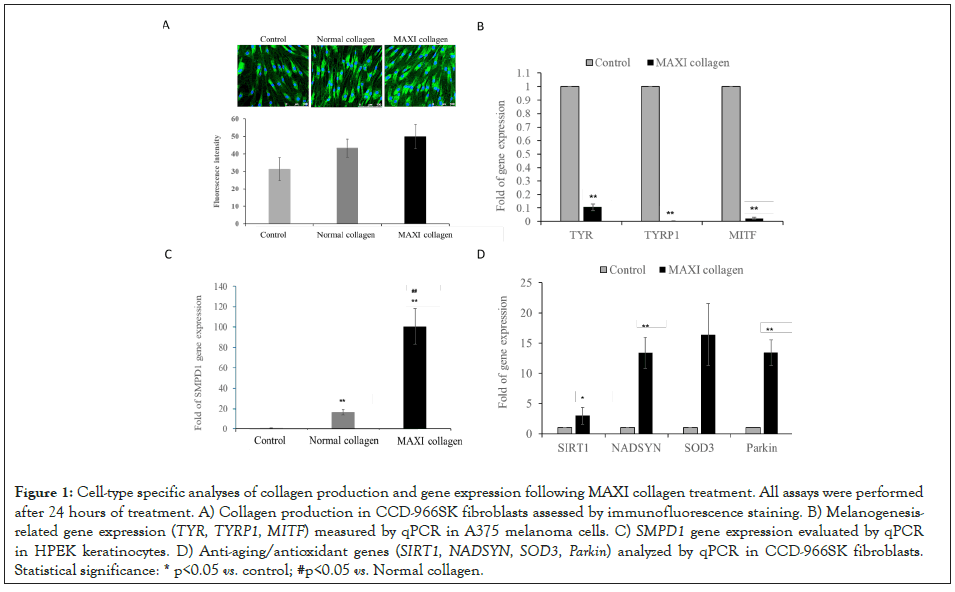
Figure 1: Cell-type specific analyses of collagen production and gene expression following MAXI collagen treatment. All assays were performed after 24 hours of treatment. A) Collagen production in CCD-966SK fibroblasts assessed by immunofluorescence staining. B) Melanogenesisrelatedgene expression (TYR, TYRP1, MITF) measured by qPCR in A375 melanoma cells. C) SMPD1 gene expression evaluated by qPCR in HPEK keratinocytes. D) Anti-aging/antioxidant genes (SIRT1, NADSYN, SOD3, Parkin) analyzed by qPCR in CCD-966SK fibroblasts. Statistical significance: * p<0.05 vs. control; #p<0.05 vs. Normal collagen.
MAXI collagen enhanced collagen production within 7 days
Building upon the cellular findings demonstrating the collagen enhancing activity of MAXI collagen, the same clinical trial was further analyzed to evaluate its efficacy across different participant subgroups. In the subgroup of 75 subjects aged 35-65 years (Figure 2A), MAXI collagen supplementation resulted in an increase in skin collagen density by day 7 and produced a statistically significant improvement at day 28 compared with baseline (p<0.05). The collagen density at day 28 was also significantly higher than that of the placebo group (p<0.05). In the second subgroup derived from the same clinical trial, consisting of 48 subjects aged 35-50 years (Figure 2B), MAXI collagen similarly produced significant improvements at both day 7 (p<0.01) and day 28 (p<0.01) relative to baseline, with the day-28 values being significantly higher than those of the placebo group (p<0.01). Consistent with these quantitative findings, the collagen-density heatmap (Figure 2C) showed visibly higher intensity and denser collagen signals at day 28 in the MAXI collagen group.
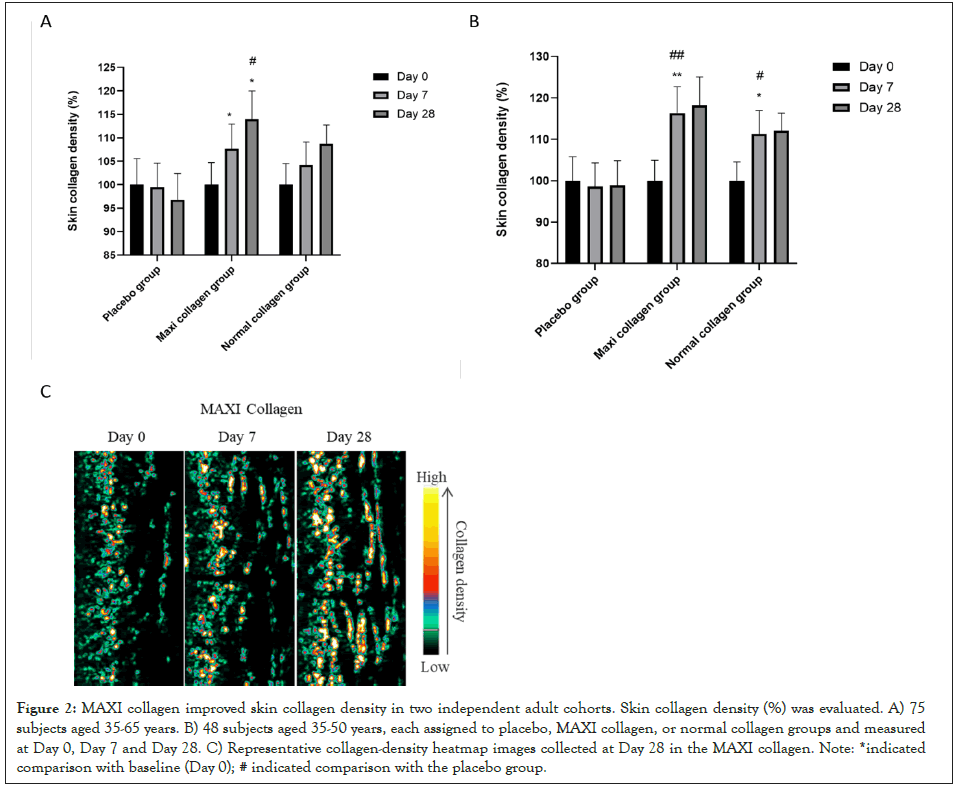
Figure 2: MAXI collagen improved skin collagen density in two independent adult cohorts. Skin collagen density (%) was evaluated. A) 75 subjects aged 35-65 years. B) 48 subjects aged 35-50 years, each assigned to placebo, MAXI collagen, or normal collagen groups and measured at Day 0, Day 7 and Day 28. C) Representative collagen-density heatmap images collected at Day 28 in the MAXI collagen. Note: *indicated comparison with baseline (Day 0); # indicated comparison with the placebo group.
MAXI collagen enhanced skin hydration
On day 28, skin hydration in the MAXI collagen group had increased by 12.9%, which was significantly higher than that observed in the normal collagen and placebo groups, demonstrating its superior moisturizing capability (Figure 3A). Meanwhile, TEWL in the MAXI collagen group had decreased by 18.0%, whereas the normal collagen group showed a smaller improvement, confirming that MAXI collagen had a greater water-retention effect (Figure 3B). Overall, MAXI collagen effectively strengthened the skin barrier, improved hydration levels and reduced water loss.
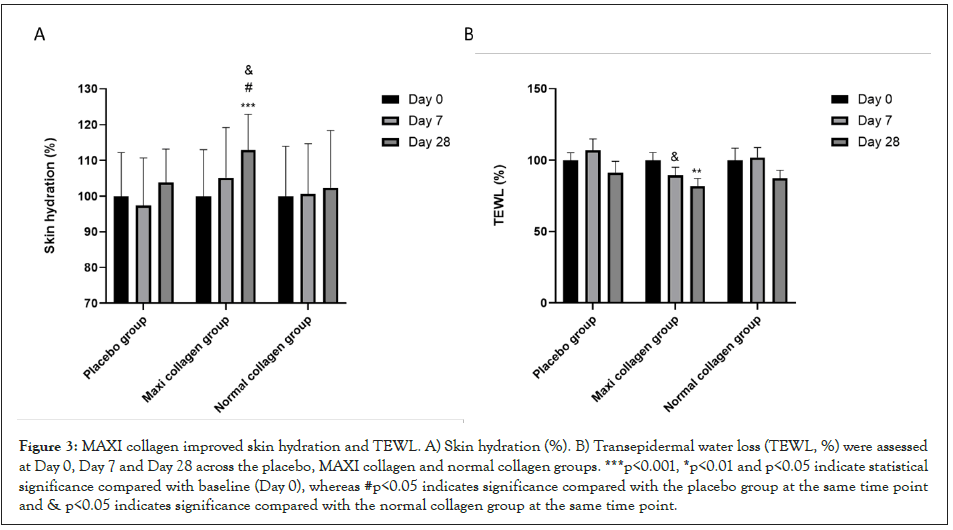
Figure 3: MAXI collagen improved skin hydration and TEWL. A) Skin hydration (%). B) Transepidermal water loss (TEWL, %) were assessed at Day 0, Day 7 and Day 28 across the placebo, MAXI collagen and normal collagen groups. ***p<0.001, *p<0.01 and p<0.05 indicate statistical significance compared with baseline (Day 0), whereas #p<0.05 indicates significance compared with the placebo group at the same time point and & p<0.05 indicates significance compared with the normal collagen group at the same time point.
This study was the first to demonstrate that daily consumption of tripeptides (MAXI collagen) significantly enhanced collagen production within only 7 days. Consistent with these clinical findings, the cellular experiments revealed that MAXI collagen directly stimulated collagen synthesis in fibroblasts and activated multiple skin-beneficial pathways, including the upregulation of anti-aging and antioxidant genes (SIRT1, NADSYN, SOD3, Parkin) and the enhancement of SMPD1 expression related to barrier lipid metabolism. An unexpected outcome was that the improvement in collagen density was even more pronounced in the younger 35-50 age group, suggesting that tripeptide absorption or skin responsiveness may be more efficient at a younger biological stage. In addition, prolonged supplementation produced a timedependent increase in skin hydration, further aligning with the in vitro evidence that MAXI collagen modulates genes involved in skin moisture regulation and cellular resilience. Together, these cellular and clinical findings provide converging evidence that MAXI collagen exerts rapid and multi-pathway skin benefits.
Collagen synthesis was a complex biological process regulated by fibroblasts, gene expression, cellular signaling pathways, and enzymatic reactions [10]. Research showed that tripeptides, as short-chain collagen peptides, were directly absorbed in the small intestine, entered the circulatory system, and subsequently stimulated collagen production in both skin and cartilage tissues [11]. Tripeptides activated the TGF-β (transforming growth factor-β) and Wnt/β-catenin signaling pathways, promoted the expression of COL1A1 and COL3A1, which encoded type I and type III collagen, respectively, and played a crucial role in maintaining skin structure [12]. Additionally, tripeptides inhibited collagen-degrading enzymes, such as Matrix Metalloproteinase-1 (MMP-1), thereby reducing collagen breakdown and enhancing skin elasticity and firmness [13]. Several clinical studies supported the efficacy of tripeptides in improving skin health. A randomized, double-blind, placebo-controlled study demonstrated that daily supplementation with 2.5 g of tripeptides for 8 weeks significantly increased collagen density by 12-15%, reduced wrinkle depth, and improved skin elasticity [14]. Furthermore, another study in middle-aged women found that tripeptide supplementation significantly reduced skin roughness and improved dermal structural integrity [15]. These findings confirmed that tripeptides effectively promoted collagen synthesis, contributing to skin health improvement, particularly for individuals experiencing collagen loss due to aging or environmental factors.
Compared to hydrolyzed collagen peptides, tripeptides had a lower molecular weight (<500 Da), enabling faster absorption through intestinal epithelial cells and direct action on skin fibroblasts [8]. Recent studies indicated that tripeptides reached peak plasma concentration within 1-2 hours after ingestion, bound to integrin receptors on fibroblasts, and activated the MAPK/ERK signaling pathway, thereby accelerating collagen and hyaluronic acid synthesis [16]. This mechanism may have explained the rapid increase in collagen density within 7 days, as was observed in this study. Compared to traditional collagen products on the market, such as hydrolyzed collagen peptides (3,000-5,000 Da), dipeptides, and collagen peptide powders, tripeptides exhibited higher bioavailability and activated collagen production pathways more quickly [8,17]. Additionally, certain marine collagen and plant-derived collagen precursors typically required 4-8 weeks to show noticeable effects [18]. However, this study demonstrated that tripeptides significantly increased collagen density by 7.6% within just 7 days, outperforming most competing products. Moreover, in the 35-50 age group, the collagen synthesis-promoting effect of tripeptides was even more pronounced, potentially due to the age-related decline in collagen metabolism, which made this demographic more responsive to external peptide supplementation. Given its rapid efficacy and high absorption efficiency, tripeptides held a significant competitive advantage in the collagen supplement market, particularly in fast-acting, high-performance skincare formulations.
Skin hydration was primarily influenced by Natural Moisturizing Factors (NMFs), hyaluronic acid, and skin barrier integrity [19]. Tripeptide supplementation had been demonstrated to enhance skin moisture levels through multiple biological mechanisms [20]. First, tripeptides promoted the synthesis of hyaluronic acid and Glycosaminoglycans (GAGs), both of which played crucial roles in water retention and maintaining skin hydration [21]. Studies showed that tripeptides upregulated HAS-2 (Hyaluronic Acid Synthase-2) gene expression, thereby increasing hyaluronic acid production and improving skin moisture content [22]. Furthermore, tripeptides enhanced stratum corneum barrier function, reduced Transepidermal Water Loss (TEWL), and improved long-term skin hydration [23]. Clinical evidence supported these findings. A double-blind, placebo-controlled study found that daily supplementation with 2.5 g of tripeptides for 12 weeks led to a 15.2% increase in skin hydration and an 18.0% reduction in TEWL, demonstrating significant improvement in skin barrier function and water retention [24]. Compared to conventional collagen supplements, tripeptides exhibited faster absorption and produced more immediate effects, making them particularly beneficial for improving skin hydration within a shorter timeframe [25]. This study further confirmed these observations, showing that tripeptide supplementation led to a notable increase in skin moisture and a decrease in TEWL within 28 days. These results reinforced the role of tripeptides in skincare applications, highlighting their ability to enhance collagen synthesis, improve skin hydration and strengthen the skin barrier, positioning them as a premium functional ingredient in the beauty and health supplement market.
The authors declare no conflict of interest.
[Crossref] [Google Scholar] [PubMed]
[Crossref] [Google Scholar] [PubMed]
[Crossref] [Google Scholar] [PubMed]
[Crossref] [Google Scholar] [PubMed]
[Crossref] [Google Scholar] [PubMed]
[Crossref] [Google Scholar] [PubMed]
[Crossref] [Google Scholar] [PubMed]
[Crossref] [Google Scholar] [PubMed]
[Crossref] [Google Scholar] [PubMed]
[Crossref] [Google Scholar] [PubMed]
[Crossref] [Google Scholar] [PubMed]
[Crossref] [Google Scholar] [PubMed]
[Crossref] [Google Scholar] [PubMed]
[Crossref] [Google Scholar] [PubMed]
[Crossref] [Google Scholar] [PubMed]
[Crossref] [Google Scholar] [PubMed]
[Crossref] [Google Scholar] [PubMed]
[Crossref] [Google Scholar] [PubMed]
[Crossref] [Google Scholar] [PubMed]
[Crossref] [Google Scholar] [PubMed]
[Crossref] [Google Scholar] [PubMed]
[Crossref] [Google Scholar] [PubMed]
Citation: Hsu T, Sung H, Yeh M, Lin Y, Lin Y, Hattori S, Chan S, Mao Y, Chiang C (2025). Oral Supplementation of Tripeptides (MAXI Collagen) Rapidly Enhances Collagen in Human Skin Within 7 Days: A Double-Blind, Placebo-Controlled Study. J Curr Synth Syst Bio. 13:122.
Received: 13-Nov-2025, Manuscript No. CSSB-25-39169; Editor assigned: 17-Nov-2025, Pre QC No. CSSB-25-39169 (PQ); Reviewed: 01-Dec-2025, QC No. CSSB-25-39169; Revised: 08-Dec-2025, Manuscript No. CSSB-25-39169 (R); Published: 15-Dec-2025 , DOI: 10.35248/2332-0737.25.13.122
Copyright: © 2025 Chiang C, et al. This is an open-access article distributed under the terms of the Creative Commons Attribution License, which permits unrestricted use, distribution, and reproduction in any medium, provided the original author and source are credited.