
Journal of Hepatology and Gastrointestinal disorders
Open Access
ISSN: 2475-3181
ISSN: 2475-3181
Research Article - (2025)Volume 11, Issue 3
Pancreatitis and Pancreatic Cancer (PC) are the two most lethal disease branches among severe pancreatic diseases. PC may be diagnosed with pancreatitis of similar the pathological features, which may interfere with the appropriate assessment of early PC and postpone the time of diagnosis and Acute Pancreatitis (AP) is also an important risk factor for the development of PC. The spatial metabolomics based on mass spectrometry imaging is a powerful method for revealing disease-related metabolic pathways and classifying biomarkers in complex biological samples. However, there is no spatial metabolomics research report on AP and PC at the same time. This study reports the simultaneous spatial metabolomics analysis of AP and PC based on AFADESI-MSI combined with machine learning and screened metabolites such as amino acids and phospholipids related to the disease, visualized differential metabolic pathways, explored metabolic translation relationship between PC stage and AP. The discovered metabolites could effectively distinguish stages pancreatic cancer from pancreatitis, it offers a fresh analytical perspective and molecular foundation for further research on the relationship between AP and PC.
Pancreatic cancer; Acute pancreatitis; Mass spectrometry imaging; Spatial metabolomics
Severe pancreatic disease mainly consists of Severe Acute Pancreatitis (SAP) and PC. SAP develops in about 25% of patients with Acute Pancreatitis (AP) which is a persistent organ failure that quickly spreads from the pancreas' localized inflammation to other organs all over the body, with a mortality rate as high as 19-52%. PC is one of the common malignant tumors of the digestive tract. The five-year survival rate after diagnosis is 10%. About 90% of PC originated from Pancreatic Ductal Adenocarcinoma (PDAC), which is highly occult and has a high mortality rate. According to numerous studies, the AP is a significant risk factor for PC and AP may be one of the early pathological manifestations of PC, many PC patients may be misdiagnosed as pancreatitis and miss the best opportunity for treatment. At present, little is currently known about the pathological relationship between AP and PC. Still, the existence of a continuous pathological relationship between AP and PC and the difference between AP and PC's unknown molecular phenotype is crucial to the precise classification and assessment of severe pancreatic diseases [1].
In the last few years, Mass Spectrometry Imaging (MSI) has emerged as a powerful diagnostic technique for visualization of tissue molecules. MSI has considerable applications in the study of tumor pathological mechanisms, the discovery of diseasespecific biomarkers and the prediction of tumor molecular typing. MSI can obtain the content and in situ data of thousands of molecules using in situ imaging only on single tissue segment. MSI-based spatial metabolomics strategy can further screen reliable in situ markers directly related to lesions, locate abnormal metabolic pathways and observe tissue molecular changes from a deeper perspective. Therefore, MSI technology is more suitable for association studies of complex biological samples and more conducive to the characterization and comparison of molecular phenotypes between cancer and inflammation in severe pancreatic diseases.
Most studies only focused on MSI analysis of PC separately. Livia S et al. obtained pancreatic cancer-related differential metabolites through DESI-MSI, combined with the lasso algorithm to evaluate the molecular information of pancreatic tissue samples, which is helpful for the determination of tumor molecular margins in pancreatic cancer surgery. Florian et al. performed spatial metabolomics on 18 pancreatic cancer patients based on MSI and screened the spatial peptide markers related to the prognosis type. The findings served as a foundation for the molecular prognosis prediction of pancreatic cancer. AP lacks MSI research and its spatial and molecular characteristics are unclear. The pathological and spatial molecular metabolic relationship between pancreatitis and pancreatic cancer needs to be characterized urgently. In order to characterize the molecular dialogue relationship between AP and PC, obtain specific and reliable metabolic biomarkers of AP and PC and characterize the spatial metabolomics features of AP and PC, it is critical to use MSI technology to simultaneously investigate AP and PC. This will provide a more reliable molecular basis for understanding the pathological relationship between severe pancreatic diseases and the underlying pathogenic mechanism.
In this study, we present a spatial metabolomics analysis using AFADESI-MSI of 15 PC and 4 AP patient tissues. Metabolites associated with the course and pathology of severe pancreatic disorders were screened with machine learning to successfully identify pancreatitis and various stages of pancreatic cancer. Localization and visualization of the differential metabolic pathways of AP and PC by in situ imaging analysis of differential metabolites provides basic information on the transition of molecular pathological mechanisms between AP and PC. The screened differential metabolites have good clinical diagnostic value and are expected to become a potential biomarker group for distinguishing AP and different stages of pancreatic cancer, providing a molecular basis for the precise treatment of severe pancreatic diseases.
Chemicals and reagents
The spray solvent for AFADESI-MSI consists of MS-grade acetonitrile and water. The Acetonitrile (ACN) was purchased from Merck (Darmstadt, Germany) [2]. The pure water was bought from the Wahaha Group Co., Ltd (Hangzhou, China). Surgipath Cryo-Gel was used for embedding tissue, which was obtained from Leica Biosystems (USA Buffalo Grove, IL, USA).
Clinical tissue samples collection
The AP tissue samples from 4 patients were diagnosed with severe acute pancreatitis performed pancreatectomy. The PC tissue samples from 15 patients with pancreatic cancer performed pancreatic oduodenectomy, the NT (adjacent noncancerous tissue) tissue was considered as control, from the pancreas of 15 PC patients. All the tissues were collected from pancreas center west China Hospital of Sichuan University (Chengdu, China). The pathological staging of pancreatic cancer patients based on the eighth edition AJCC cancer staging manual, the hospital provided ethics approval and obtained all written informed consents from individual patients. The clinic detail characteristics shown in Table 1.
| Characteristics | PC group | AP group | NT group |
| No. of subjects | 15 | 4 | 15 |
| Age, mean (SD) | 65.5 (12.8) | 38.4 (10.7) | 65.5 (12.8) |
| Gender males, n (%) | 8 (53) | 3 (75) | 8 (53) |
| BMI | 21.5 | 25.01 | 21.5 |
| TNM stages* | |||
| Stage I | 4 | -- | -- |
| Stage II | 10 | -- | -- |
| Stage III | 1 | -- | -- |
Table 1: Baseline and histopathologic characteristics of participant subjects.
Sample preparation and AFADESI-MSI measurement
Before MSI experiment, all clinic pancreatic tissue samples were stored at -80°C properly. The pancreatic tissues were sectioned at a 10 μm thickness at a -20°C Cryostat Microtome (CM 1950, Leica Microsystems, Wetzlar, Germany) and thaw-mounted on Superfrost Plusmicroscope slides (Thermo Scientific, USA). All tissue sections were stored at -80°C until MSI analysis and one of the consecutive tissue sections was used for a H and E stain analysis, When MSI analysis was performed, the tissue sections dried in a vacuum desiccator for 3 h to analyze.
MSI experiments were performed using an AFADESI-MSI platform coupled with a Q-Orbitrap mass spectrometer (Q Exactive Plus, Thermo Scientific, Bremen, Germany). The spray solvent consists of ACN: H2O (8/2, v/v) at a flow rate of 5 μL/min with the aid of 0.7 MPa nitrogen as the spraying gas. The MSI analysis was performed on a 3D electrical moving stage by continuously scanning the tissue surface of 0.2 mm/sec in the x-direction, separated by a 0.2 mm vertical step in ydirection. The extracting gas flow rate was set to 45 L/min. The spray voltage was set at 7.0 kV. AFADESI-MSI analysis was carried out using full MS scan in positive and negative ion mode. The parameters of mass spectrometer were set as follows: Capillary temperature, 350°C; S lens voltage, 55 V; maximum inject time, 200 ms; AGC target, 3 × 10⁶; resolution, 70000; m/z range, 70-1000. Mass data acquired by using Xcalibur software (Version 2.2, Thermo Scientific) [3].
Data processing and analysis
The original raw file data was converted to. cdf data file by using Xcalibur fileconvert function then input. cdf data into Massimager Pro (Version 1.0, Beijing, China) for tissue ion image reconstruction, after background ions subtraction, 3 ROIs regions on each tissue through a standard 5 × 5 pixel rectangle were selected, each region generated an independent mass profile containing m/z and intensity information as .txt format file. The respective data matrixes were then imported into the Markerview™ software 1.2.1 (AB SCIEX, Toronto, Ontario, Canada) for peak alignment and isotope peak removal. After then an in-house Matalab code was carried out to remove lowintensity noise signal (NL<2000) and missing value imputation. The Multivariate analyses were performed by MetaboAnalyst 5.0 and the machine learning method of random forest is used for the screening of feature MS variables. One linear dimensionality reduction methods of Principal Component Analysis (PCA) and two nonlinear dimensionality reduction methods t-Distributed Stochastic Neighbor embedding (t-SNE), Uniform Manifold Approximation and Projection (UMAP) were used to evaluate the discriminating effect of screened differential metabolites. The MS features were annotated by MS library (self-built library, Lipidmaps database, HMDB database) and Mummichog through an in-house python code on Pycharm platform (Python 3.1.0) with a mass error of less than 5 ppm. Pathway enrichment and functional analysis were performed by Mummichog, other comparative analysis carried out by Rstudio platform (R 4.2.1).
Spatial metabolomics profiling of NT/AP/PC and disease-specific metabolites pathway enrichment analysis
The AFADESI-MSI-based spatial metabolomics was used to study the NT/AP/PC metabolomic profiles. After MSI data normalization, the PCA method was used to reduce dimensionality MSI Data MSI data (Figure 1A and 1B). Both PCA scores plots show significant differences among the NT/ AP/PC three groups, PLS-DA score plots helped us identify patterns in metabolic phenotypes among the NT/AP/PC more clearly (Figure 1C and 1D). As shown in Figure 1E, most of the samples were accurately clustered by heatmap (Euclidean distance). This evidence implied us significant metabolites changes have occurred in AP/PC patients. Screening of pairwise differential metabolites among the three groups by the FC>2 (FC: Fold change) and P<0.05 rules (Figure 1). The upset plots show the screening of specific and conventional metabolites in the NT/AP/PC tissue in the positive and negative ion modes (Figure 2B and 2C). Furthermore, the KEGG pathway enrichment analysis was carried out to reveal the relevant function of these different metabolites. As shown in Figure 2A, the spermidine and spermine biosynthesis pathway, arginine and proline metabolism pathway, urea cycle, glycolysis pathway was significantly altered in both AP and PC tissues. These may be manifestations of common pathometabolic pathways of severe pancreatic disease. The glycerol phosphate shuttle taurine and hypotaurine metabolism was obviously changed in PC, the phosphatidylcholine biosynthesis and phenylacetate metabolism was extremely abnormal in AP. These abnormal metabolic pathways that independently present in AP or PC may reflect the specific molecular characteristics of each disease. Besides, the Warburg effect reaction was exclusively discovered in PC, which highlights the unique pathogenic metabolism of pancreatic cancer cells [4].
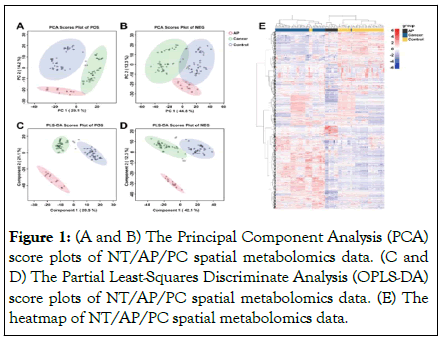
Figure 1: (A and B) The Principal Component Analysis (PCA) score plots of NT/AP/PC spatial metabolomics data. (C and D) The Partial Least-Squares Discriminate Analysis (OPLS-DA) score plots of NT/AP/PC spatial metabolomics data. (E) The heatmap of NT/AP/PC spatial metabolomics data.
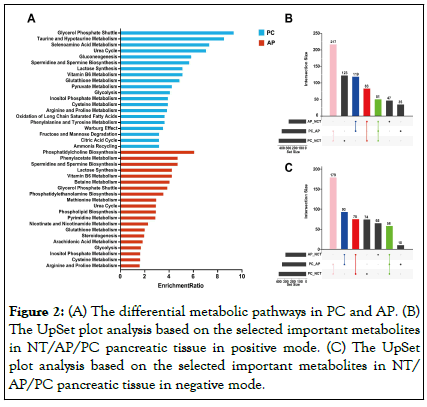
Figure 2: (A) The differential metabolic pathways in PC and AP. (B) The UpSet plot analysis based on the selected important metabolites in NT/AP/PC pancreatic tissue in positive mode. (C) The UpSet plot analysis based on the selected important metabolites in NT/ AP/PC pancreatic tissue in negative mode.
Specific metabolite screening and pathway visualization analysis based on machine learning drived-MSI
Conventional statistical strategies have obvious limitations when trying to completely explore the differential metabolites associated to severe pancreatic diseases. Therefore, the machine learningbased screening method (random forest) is used to filter the top 60 primary feature differential metabolites in NT/AP/PC by the MDA (mean decrease accuracy) values. As shown in Figure 3A, all the samples were accurately clustered by heatmap (Euclidean distance). The results through using UMAP to evaluate the screened metabolites' discriminative ability showed that they had a good group recognition function (Figure 3B), suggesting that they could serve as potential biomarker candidates for trying to distinguish severe pancreatic disease types. The AP and NT groups showed more relevant associations, it demonstrated that the NT tissues of PC patients express more AP-related metabolites, indicating that AP is accompanied by PC patients and that these surviving tissues are probably going to develop into PC tissues at a later stage, affecting the outlook for patients following surgery. The Figure 3C displayed the in situ MSI differences of some representative metabolites in the three groups. Multiple abnormal metabolic pathways were located in NT/AP/PC following Mummichog metabolite pathway enrichment and network analysis. As shown in Figure 4, fatty acid biosynthesis, primary bile acid biosynthesis, pyrimidine metabolism was extremely unusual in NT/AP/PC, which has been confirmed by many studies [5,6]. The pancreas, one of the most important digestive organs in the human body, has an impact on major metabolic pathways related to digestion and the metabolic disorder of bile acid metabolites in severe pancreatic diseases has further supported the conception that the pathological changes in the pancreas occur simultaneously. Benefit from the combination of metabolic network analysis and in situ visualization with mass spectrometry imaging, the details of disease-related metabolic pathways can be study more clearly. Two of the differential metabolic pathways was imaged, the arginine and proline metabolism pathways: Arginine as an upstream metabolite is highly expressed in NT and its downstream metabolites spermidine, spermine is still up-regulated, the same metabolic expression patten can also be clearly seen in AP and PC. The glutamine and glutamate metabolism pathway: LGlutamine as an upstream metabolite is highly expressed in NT and its downstream metabolites aspartic acid, L-alanin, L-glutamic acid is still up-regulated, the same metabolic expression patten can also be clearly seen in AP and PC. Therefore, to better understand the pathogenic metabolic pathways in severe pancreatic disorders, in situ MSI visualization strategy based on metabolic network analysis offered a clear observation perspective for the dynamic molecular changes in pancreatic diseases.
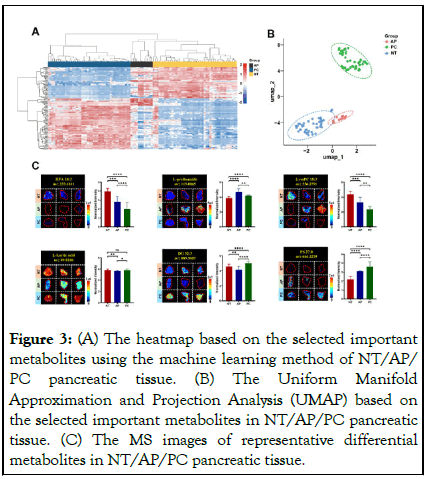
Figure 3: (A) The heatmap based on the selected important metabolites using the machine learning method of NT/AP/ PC pancreatic tissue. (B) The Uniform Manifold Approximation and Projection Analysis (UMAP) based on the selected important metabolites in NT/AP/PC pancreatic tissue. (C) The MS images of representative differential metabolites in NT/AP/PC pancreatic tissue.
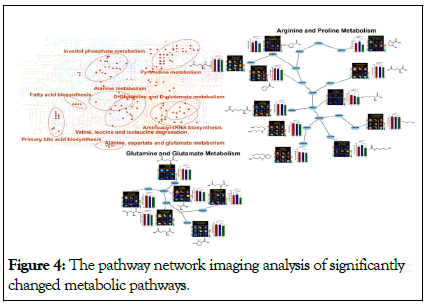
Figure 4: The pathway network imaging analysis of significantly changed metabolic pathways.
Spatial metabolomics profiling of NT and tumor stage-defined PC
To explore for tumor stage-related spatial metabolic signatures, we compared NT samples with pancreatic cancer-related stages samples. The PCA scores plots in Figure 5A and 5B indicated that NT samples are significantly different from T1 and T2 stage samples in both positive and negative ion modes. Screen TOP 60 metabolites for UMAP analysis employing machine learning method here too. As shown in Figure 5C, although the screened metabolites have the ability to significantly identify T1 and T2 stage samples from NTs, the spatial metabolomics characteristics of T1 and T2 stages are still very similar. The in situ MSI results of some representative screened metabolites showed that most of them in the T1 and T2 stages have no significant changes (Figure 5D). The metabolic phenotypes of the T1 and T2 stages are quite indistinguishable and cannot be effectively separated by PCA, as shown by our independent comparison of the T1 and T2 stages samples in Figures 6A and 6B. After that, UMAP analysis coupled machine learning with screening to examine the top 60 metabolites. The screened metabolites could only partially distinguish between the T1 and T2 stages of pancreatic cancer, as shown in Figure 6C. There are two reasonable explanations for this: The first is that the number of tumor stage samples is limited and the second is that some T1 stage samples have partially progressed to T2 stage, bringing their metabolic phenotypes closer to the T2 stage samples. This theory was further supported by the in situ MSI results of a few typical screened metabolites (Figure 6D) and some T1 stage samples are more related to the T2 stage samples in UMAP analysis (Figure 6C).
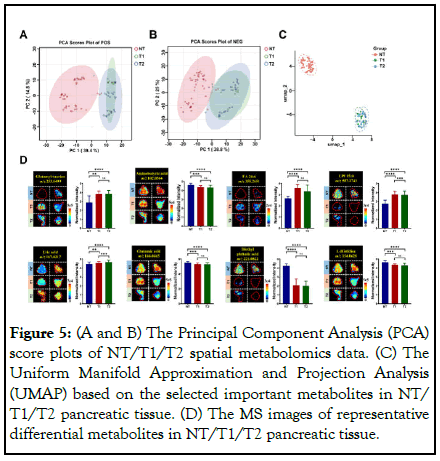
Figure 5: (A and B) The Principal Component Analysis (PCA) score plots of NT/T1/T2 spatial metabolomics data. (C) The Uniform Manifold Approximation and Projection Analysis (UMAP) based on the selected important metabolites in NT/ T1/T2 pancreatic tissue. (D) The MS images of representative differential metabolites in NT/T1/T2 pancreatic tissue.
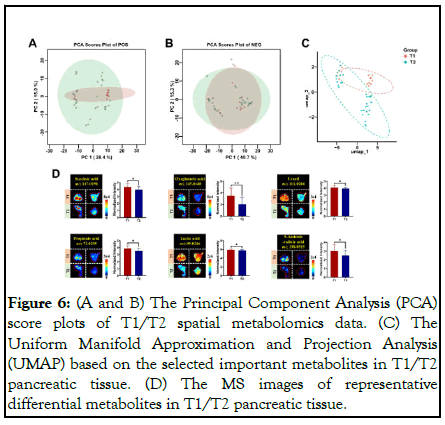
Figure 6: (A and B) The Principal Component Analysis (PCA) score plots of T1/T2 spatial metabolomics data. (C) The Uniform Manifold Approximation and Projection Analysis (UMAP) based on the selected important metabolites in T1/T2 pancreatic tissue. (D) The MS images of representative differential metabolites in T1/T2 pancreatic tissue.
Potential metabolic biomarkers screening in AP/T1/T2 samples
In order to screen for spatial biomarkers that may distinguish AP/T1/T2 and explain the spatiotemporal developmental relationship between AP/T1/T2 and NT tissue. The AP/T1/T2 samples were compared with NT tissue separately, according to FC>2 and P<0.05 to screen the differential metabolites of the respective samples. It is UpSet analysis of the screened differential metabolites of the AP/T1/T2 with NT tissue samples, as illustrated in Figures 7A and 7B. In situ imaging analysis of metabolites that have been screened together with a brief discussion of the potential pathophysiological involvement of various types of metabolites. The unique metabolites that AP/ T1/T2 share were shown in Figure 7D. These metabolites may be the result of metabolic pathways being interfered by cancer lesions or inflamed pancreatic tissue [7]. These examined metabolites may be physiologically significant for determining the state of the pancreas. The m/z 148.0037 Taurine and m/z 810.5369 PS 38:4 are distinct tumor-stage differential metabolites that can be used to assess the course of pancreatic carcinogenesis and are more closely related to the pathogenic mechanism of cancer (Figure 7E). As shown in Figure 7F, m/z 222.0289 PC and m/z 321.2078 ST 19:1O4 are representative common metabolites of AP and T2, possibly attempting to point out the pathological correlation between the development of AP and T2 stage of pancreatic cancer. As the Figure 7G illustrated the representative metabolites of AP and T1. This is a part of common differential metabolites with AP/T1 and AP/T2, indicating that the pathological evolution of PC may have been accompanied by the emergence of AP. Importantly, in order to accurately and independently distinguish these sub-pathological states of the pancreas, screen the metabolite groups that can predict and evaluate each sub-pathological state. The UMAP analysis was performed (Figure 7C), the results showed that this class of metabolites can effectively distinguish between AP/T1/ T2/NT. Then, three potential biomarkers with clinical diagnostic significance were selected using ROC and in situ imaging analysis of these metabolites. As shown in Figure 8A and 8B, the AUC values of Glycerol phosphate, HMDB0304007 and Inosine between 0.87-0.97 can be used as spatial markers to distinguish AP from NT. The AUC values of FA 24:6, PC O-38:7 and NAT 16:0 between 0.98-0.99 can be used as spatial markers to distinguish T1 from NT. The AUC values of PI 42:8, PC 20:4 and LPA 19:1 between 0.9-0.97 can be used as spatial markers to distinguish T2 from NT. The results also provide a novel molecular foundation for predicting different pancreatic subpathological states and exploring pathogenic mechanisms [8].
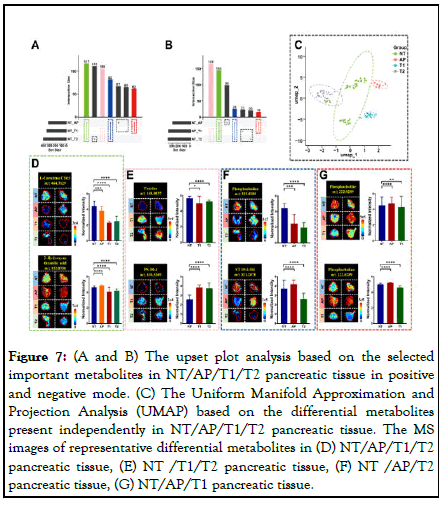
Figure 7: (A and B) The upset plot analysis based on the selected important metabolites in NT/AP/T1/T2 pancreatic tissue in positive and negative mode. (C) The Uniform Manifold Approximation and Projection Analysis (UMAP) based on the differential metabolites present independently in NT/AP/T1/T2 pancreatic tissue. The MS images of representative differential metabolites in (D) NT/AP/T1/T2 pancreatic tissue, (E) NT /T1/T2 pancreatic tissue, (F) NT /AP/T2 pancreatic tissue, (G) NT/AP/T1 pancreatic tissue.
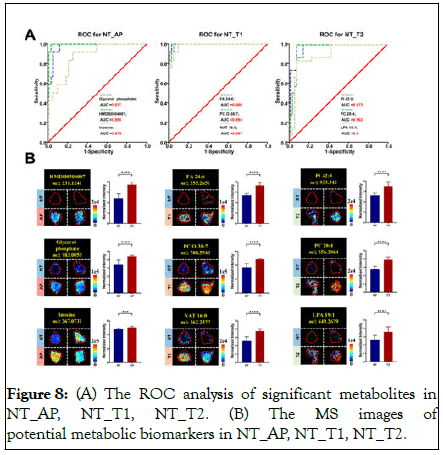
Figure 8: (A) The ROC analysis of significant metabolites in NT_AP, NT_T1, NT_T2. (B) The MS images of potential metabolic biomarkers in NT_AP, NT_T1, NT_T2.
Herein, we developed a mass spectrometry imaging combined with the machine learning method to profile the spatial metabolomics of severe pancreatic illnesses (AP and PC). It is the first study to conduct the simultaneous comparison of AP and PC, which screened disease-related metabolites in pancreatic tissue and localized aberrant metabolic pathways. Machine learning-screened metabolites can effectively distinguish between NT/AP/PC. The network analysis of metabolic pathways was combined with in situ analysis of mass spectrometry imaging was further performed, revealing differential expression relationship of metabolic pathways among NT/AP/PC. Additionally, we examined more thorough tumor stage-defined PC and AP/NT and we identified metabolites that may have the clinical diagnostic value that can be used for future fine prediction and detection of severe pancreatic disorders. These newly discovered metabolites and unique metabolic pathways that relate to AP and PC may offer a strong molecular and theoretical foundation for the research of the development of AP into PC and the accurately determine the type of pancreatic surgery.
Shan Yang and Xia Li contributed equally. The manuscript was written through contributions of all authors. All authors have given approval to the final version of the manuscript.
The authors declare no competing financial interest.
The authors are grateful to Yi Zhang and Wanli Zhang for the help of serial frozen section.
This work was supported by the national natural science foundation of China (82170905, China) and program of science and technology department of Sichuan province (23ZDYF2368 and 23NSFSC3028) well as the west China nursing discipline development special fund project, Sichuan University (HXHL21060, China).
The authors have declared no conflicts of interest.
[Crossref] [Google Scholar] [PubMed]
[Crossref] [Google Scholar] [PubMed]
[Google Scholar] [PubMed]
[Crossref] [Google Scholar] [PubMed]
[Crossref] [Google Scholar] [PubMed]
[Crossref] [Google Scholar] [PubMed]
[Google Scholar] [PubMed]
[Crossref] [Google Scholar] [PubMed]
Citation: Yang S, Li X, Wang M, Du D, Pu Q, Jiang N, et al. (2025) Integrated Spatial Metabolomics Profiling of Acute Pancreatitis and Pancreatic Cancer. J Hepatol Gastroint Dis. 11:356.
Received: 04-Sep-2024, Manuscript No. JHGD-24-33825; Editor assigned: 09-Sep-2024, Pre QC No. JHGD-24-33825 (PQ); Reviewed: 23-Sep-2024, QC No. JHGD-24-33825; Revised: 18-Jun-2025, Manuscript No. JHGD-24-33825 (R); Published: 25-Jun-2025 , DOI: 10.35248/2475-3181.25.11.356
Copyright: © 2025 Yang S, et al. This is an open-access article distributed under the terms of the Creative Commons Attribution License, which permits unrestricted use, distribution and reproduction in any medium, provided the original author and source are credited.