
Journal of Information Technology & Software Engineering
Open Access
ISSN: 2165- 7866
ISSN: 2165- 7866
Research Article - (2025)Volume 15, Issue 1
Introduction: Health tourism is a continuously developing business unit of tourism that includes the services of medicine and health for tourists. This article looks at the conceptual design of a cataract treatment health tourism system aimed at improving the patient experience, increasing access to quality healthcare and reducing treatment costs.
Methods: The methodologies used included related scientific literature review, interviews with experts in the subject matter and the analysis of successful models used in similar systems. Initially, a flowchart of the system was developed and then conceptual model development was carried out using the unified modeling language. Following this, the model was subjected to expert consultation for its evaluation.
Findings: In regard to the result of research, a successful health tourism system has to include features like online booking and consultation, databases of healthcare centers and specialist doctors, a patient information management system and post-treatment support facility. On the other hand, in requirements analysis, main critical factors for patients' satisfaction can be referred to: Quality of healthcare service, accessibility and continuous support.
Conclusion: The cataract health tourism system can be a satisfying experience for the patients and economically viable by using modern technologies along with optimum resource management. These resultant benefits from this system can help increase the attractiveness of health tourism destinations and can improve the quality of healthcare services.
Conceptual model; Health tourism; Cataract
In recent years, health tourism has been among the fastestgrowing industries within the tourism sector and has received much attention from researchers, investors and managers. This industry provides medical and health services for those people who travel to other countries for such services. Some of the factors contributing to an increase in health tourism are high costs of healthcare, waiting lists for medical services in their home countries and the need to seek more advanced technologies and expertise abroad.
Among the most prevalent indications for travel to receive medical care are cataracts. Cataracts are among the major causes of blindness in the world and require special surgery and advanced equipment in their handling. With advancing age and increased prevalence of cataract conditions, there is an emerging need to develop mechanisms within systems that will be able to provide the related healthcare services in an efficient and effective manner [1].
The concept design for a cataract treatment health tourism information system has been postulated to increase patient experience, improve access to high-quality health care provision and reduce the costs of treatments. In turn, the system will be comprised of comprehensive health centers and specialist information, booking and consultation online, management of patient data and follow-up after treatment. It is worth mentioning that this system has to address the many-faceted demand of patients, either individually or in groups, about medical, accommodation and transport needs in an integrated and coordinated manner.
A system like this can help to develop better health care, increasing the satisfaction of patients and encouraging medical tourism, helping thereby the economic development of host countries. Thus, the design and implementation of this system can be one of the important steps toward the development of health tourism and providing higher medical services at lower costs.
A holistic approach was considered in the conceptual design of the cataract health tourism system by taking into consideration all the stages comprehensively. The following section describes the various stages of research and the instruments and questionnaires used for designing and assessing the system [2].
Literature review: This was the first step, which entailed the review of scientific literature regarding health tourism and health information systems. Searches reviewed the literature for academic articles, reports from health organizations and case studies of similar systems. This sought to identify best practices in designing and implementing health tourism systems, technologies used and common challenges.
Expert interviews: The second level is the semi-structured interviews with experts from health tourism, ophthalmology and information technology. These expert interviews have been conducted with the aim of grasping practical knowledge and experiences of the experts in managing cataract treatment and health systems. From these interviews, information obtained gave useful inputs for the requirements analysis and initial system design.
Requirements analysis: During this stage, the needs of users regarding system requirements were analyzed, whether patients, doctors or healthcare managers. In this respect, techniques used include data flow diagrams, conceptual models and identification of user needs. In such a way, it was possible to better understand what was expected from the performance of the system and to define its main components [3].
The result of the requirements analysis was used to design the conceptual model. It included various components: An online platform for booking and consultation, a database of healthcare centers and specialist doctors, a patient information management system and post-treatment support facilities. Each component had been elaborated in this model and their roles within the system were defined. User interface interactions and component-component interactions were also modeled using UML diagrams.
Simulation and performance evaluation: The efficiency of the conceptual model designed was done by software simulations. The system's performance under various conditions has been tested using different simulation tools. Scenarios ranging from numbers of users, volumes of data, to critical conditions have been simulated and their results analyzed. Such evaluations helped in strengthening the model and optimizing it, as the strengths and weaknesses were highlighted.
Feedback and improvement: Results obtained after initial simulations and evaluations were presented to experts and potential users. Their responses were analyzed and necessary changes were applied to the conceptual model. This stage contributed to continuous improvement and raised the accuracy and efficiency of the system [4].
Findings
Among the key findings of the present research, the following stand out: Those related to the conceptual design of a health tourism system focused on cataract problems. These are useful for the identification of the main needs that users will have in order to provide optimum solutions for the design and implementation of the system.
User requirements: The analysis found that the needs of the system's users, such as patients, doctors and healthcare managers, rely on the following aspects:
Health care services: Over 85% of interviewed patients mentioned that the quality of health care services and the expertise of doctors are the key features that patients look for in a treatment destination.
Accessibility of information: Users 75% wished to get complete information about healthcare centers, specialist doctors and treatment costs without inconvenience and as quickly as possible.
Continuity of care: The need to be supported even after discharge was expressed by 65% of the patients, through consultations and follow-up on their status in health.
Appointment booking and consultation through online platforms are thus one of the major components of the system. Advanced searching, online booking systems, video conferencing for consultation and automated reminder systems from the results that should be derived through data analysis, that it should comprise. By reducing waiting times, associated with booking appointments by about 40%, the simulations thus showed that leveraging such a platform will lead to.
Database of healthcare centers and specialist doctors: The second most important part of the system involves developing an elaborative database on healthcare centers and specialist doctors. In this database, explicit information about doctors, including the area of specialisation, equipment availability, years of work experience, patient feedback, among others, is added. Resultant analysis showed that 80% of the respondents required access to this information in order to make informed decisions on which healthcare facility to attend.
Patient's treatment information system: A patient information management system helps in enhancing the various processes of treatment and providing the best services. This needs to include electronic patient records, the history of treatment and the test results. It has been obtained from simulation results that the medical error may be reduced up to 30% using this system.
Treatment support: The other crucial part of this system is the post-treatment support system. The section incorporates consultations for patients after surgery, monitoring their state of health and offering all necessary guidance for quick recovery. Information collected on the same noted that 70% of the patients indicated this section as very useful for improvement in the treatment perspective.
To develop the conceptual model, first, a flowchart of the data was prepared and then use-case diagrams were designed. Figures 1-5 shows the flowchart of registration in the system [5].
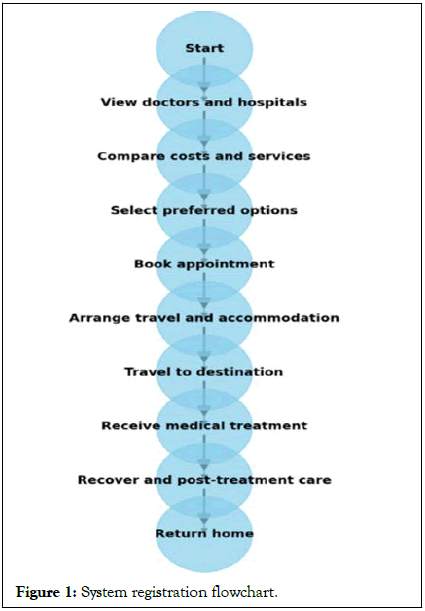
Figure 1: System registration flowchart.
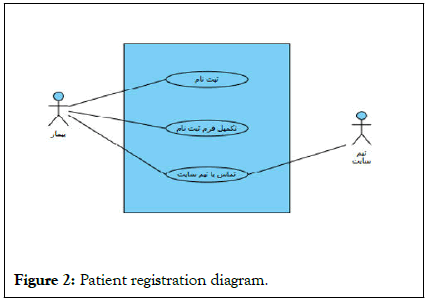
Figure 2: Patient registration diagram.
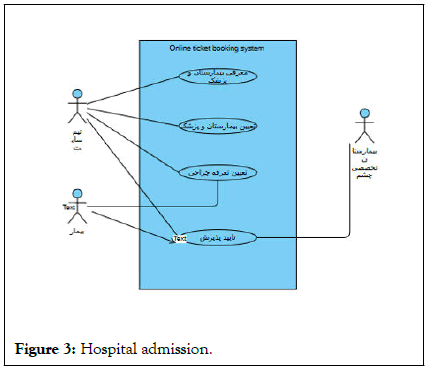
Figure 3: Hospital admission.
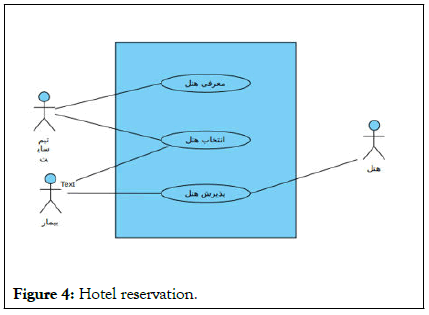
Figure 4: Hotel reservation.
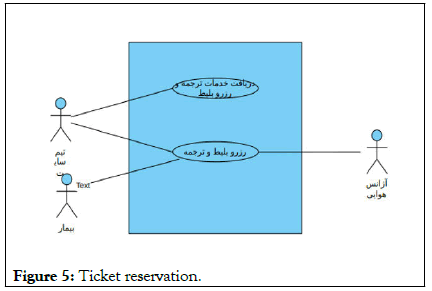
Figure 5: Ticket reservation.
The conceptual design of a health tourism system oriented to cataracts may contribute to raising the quality of the healthcare provided and increasing the level of patient satisfaction. In this respect, comprehensive and integrated facilities both for patients and specialists are believed to provide quality healthcare at more affordable treatment costs. The sections below will present and analyze the importance of the system under review, its main components and challenges ahead [6].
Significance of a cataract-focused health tourism system health tourism is globally emerging as an industry in the delivery of medical and health services to patients who travel to other countries for such services. It is also worth noting that this form of tourism improves not only individual health but also largely contributes to economic growth in the host country. Some of the conditions usually travelled for by patients include cataracts. This condition, which generally appears among the elderly, requires special surgery and advanced equipment.
With the aging population and an increased prevalence rate of cataracts across the world, there is a need to develop comprehensive and efficient systems offering related healthcare services. A health tourism system for cataract patients enables visits to the best healthcare centers and specialists to receive quality services.
The key features or parts that make up a successful health tourism system, are supposed to include the following: An online booking and consultation platform, which should be able to allow patients to book an appointment with specialist doctors online and have pre-travel consultations.
Therefore, it reduces the waiting times for the patients and enhances the treatment planning and coordination [7].
Database of healthcare centers and specialist doctors: This should be an updated database of all the accredited centers and specialist doctors so that accessing the information is not an issue for the patients.
Management of patient information system: This shall manage patient information on medical and treatment data and shall ensure security and privacy of such sensitive information.
Facilities of follow-up and after-treatment care: The system should be designed to provide follow-up and after-care facilities to the patients after the treatment for their recovery.
Challenges ahead: In designing and implementing a health tourism system with focus on cataracts, several challenges have to be addressed:
Security and privacy of patient data: Handling such sensitive medical information is directly related to appropriate security systems with corresponding protective protocols to avoid data breach.
International coordination: The system has to manage the coordination between patients and doctors and healthcare centers internationally with collaboration and interaction.
Health regulations: The system must be in compliance with health regulations in various countries so that it does not fall under any legal complications.
Reliability and stability: The system should be stable and reliable enough to provide quality services without breaks.
In a word, a cataract-based health tourism system, with the help of modern technologies and optimal resource management, can be economically viable and satisfying for patients. It can increase the attractiveness of health tourism destinations by upgrading the quality of health services. While challenges persist, mileage in every minute detail and the needs of users both in design and implementation could very well be important milestones in effectively enhancing patient health and satisfaction.
Ethical issues in designing health tourism system for cataract the design and implementation of a cataract health tourism system do come with ethical issues that need to be addressed. Some of these are as follows:
Privacy and confidentiality: Advanced levels of security shall be used to ensure that the patients' medical information and personal data are secure from unauthorized access.
Informed consent: The details regarding treatment and risks associated should be explained to the patients before treatment and their consent regarding the same shall be obtained on their full free will.
Equity and equal access: It shall provide quality services, making no discrimination against all patients based on their financial or geographical status.
Cost and treatment transparency: Each and every patient who travels for treatment should have complete knowledge of the cost and services provided in advance.
Respect to cultural beliefs: The system has to respect the patients for their various cultures and beliefs and provide services accordingly.
[Crossref] [Google Scholar] [PubMed]
[Crossref] [Google Scholar] [PubMed]
[Crossref] [Google Scholar] [PubMed]
[Crossref] [Google Scholar] [PubMed]
[Google Scholar] [PubMed]
Citation: Gheibi N, Rahmatizade S, Emami H, Moghaddasi H (2025) Conceptual Model Design of Cataract focused Health Tourism System. J Inform Tech Softw Eng. 15:436.
Received: 21-Sep-2024, Manuscript No. jitse-24-34158; Editor assigned: 26-Sep-2024, Pre QC No. jitse-24-34158 (PQ); Reviewed: 10-Oct-2024, QC No. jitse-24-34158; Revised: 12-Feb-2025, Manuscript No. jitse-24-34158 (R); Published: 19-Feb-2025 , DOI: 10.35248/2165-7866.25.15.436
Copyright: © 2025 Gheibi N, et al. This is an open-access article distributed under the terms of the Creative Commons Attribution License, which permits unrestricted use, distribution and reproduction in any medium, provided the original author and source are credited.