
Journal of Pollution Effects & Control
Open Access
ISSN: 2375-4397
ISSN: 2375-4397
Research Article - (2025)Volume 13, Issue 3
Childhood is a time of increased susceptibility to air pollution because the immature body is developing rapidly with dividing cells which are vulnerable to toxins. Children spend frequent time out of doors and therefore have higher risk of exposure to poor air quality. Further, a correlation between areas of high deprivation and poor air quality exists for both adults and children, worsening pre-existing health inequalities.
This Tayside Pollution Research Programme (TPRP) study investigated the effects of poor air quality on hospital admissions with a Gastrointestinal (GI) complaint, in children <16 y of age in Dundee city, Scotland (with a population of 148,270), over a period of 18 years.
Childhood hospital admissions were evaluated by record linkage at Perth royal infirmary, Perth and Ninewells hospital, Dundee, UK and including a pre-determined sub-group analyses for GI disorders. The data analysed were between 1st of January 2000, to 31st December 2017.
25.1% in Dundee and 28.2% in Perth were because of GI disorders and 26.5% of Dundee admissions and 25.9% of Perth admissions were respiratory in nature. At the time of high pollution admissions increased by 35.8% on days of high particulate matter <10 μm and 81.2% for days when the total nitrogen gas levels were high (NOx).
Our results show an increase in child hospital admissions on days of higher pollution. Whilst some of this can be explained by respiratory admissions over a quarter of admissions were due to GI disorders. This documents further novel effects of poor air quality on our children.
Children; Air pollution; Hospital admissions
Scotland has one of the cleanest air quality regulations globally and the most stringent air in Europe with the aim to reduce annual average levels of Nitrogen Dioxide (NO2) to under 40 μg/ m3, particulate matter 10 (PM10, with a diameter of <10 μm) to 18 μg/m3 and PM2.5 (diameter of <2.5 μm) to 10 μg/m3.
Achieving these targets by reducing air pollution is important in maximizing health gains. Significant air pollution derived from transport still exists in our city streets. We also know that deleterious effects of poor air quality occur below the Scottish target levels and the world health organisation has thus recommended more stringent air quality guidelines [1].
Children spend frequent time outdoors and therefore are at higher risk of exposure to poor air quality. During gestation, in infancy and in early childhood they are vulnerable as the child’s body is rapidly developing and has immature immune systems. Children spend a higher proportion of time outdoors and are therefore at greater risk of exposure to ambient air pollutants. A correlation exists between poor air quality and areas of high deprivation in both adults and children worsening pre-existing health inequalities.
Schools are often placed near main roads and road junctions and air quality is worsened by idling engines and the ‘school run’. On days where air pollution was above the regulation level, hospital Schools are often placed near main roads and road junctions and air quality is worsened by idling engines and the ‘school run’. On days where air pollution was above the regulation level, hospital admissions rose significantly in Tayside, Scotland, with circa 1000 excess admissions on high pollution days/year. In children, we know that the brain lung heart immunity and hormone systems are all harmed by air pollution.
Aim of the Study: This Tayside Pollution Research Programme (TPRP) study investigated air pollution effects on children’s hospital admissions for Gastrointestinal (GI) disorders (≤ 16 years of age), over an 18 year period, in two Scottish cities, Dundee (population around 148,270) and Perth (47,350). This was a predetermined sub study looking at GI disorders within the larger population [2].
Patient population and patient data linkage
All childhood hospital admissions at Ninewells hospital, Dundee and Perth royal infirmary, Perth, UK were linked to air pollution levels, including a pre-determined sub-group analyses for GI disorders. Linkage included data from 1st January 2000-31st December 2017.
Ethics statement
The Tayside Caldicott guardian consent gave consent for the study. Patient consent was not required as the data linkage did not include patient participation. All data were pseudoanonymised before analysis.
Data management
Community Health Index (CHI), a personal identifier for all patients in Scotland, was used to extract electronic medical records from an administrative database covering the whole of Tayside. Data was stored and analysed within the Safe Haven provided by the Tayside Health Informatics Centre (HIC). HIC provide data on hospital admissions and all-cause mortality which was linked to daily pollution levels across this region [3].
Child hospital admission definition
Child hospital admissions of interest were agreed a priori and were defined by ICD10 code (2016 addition) with a subgroup of digestive disorders (K00-99).
Exposure data
Daily PM10, NOx (total nitrogen gases), Nitric Oxide (NO2) and Nitrous Oxide (NO) concentrations were measured during the study period at the Perth and Dundee city background sites, (part of UK's Automatic Urban and Rural Network (AURN)). Days with missing air pollution data were excluded. As climate is a known confounder of air pollution and health, data on mean relative humidity and air temperature were obtained from the UK meteorological office. For temperature, data from the measuring stations Mylnefield and Dalwhinnie was used, for the postcode areas of Perth and Dundee, respectively. Humidity from Dalwhinnie and Leucheurs was also used for Perth and Dundee.
Statistical analysis
To investigate any association between pollution exposure and hospital admissions up to 14 days prior to the hospital admission (lag zero to 14), we combined the case-crossover design with distributed lag (non-linear) models (DL(N)M) using separate models for each air pollutant.
DL(N)Ms provide an estimate of the overall effect of exposure, incorporating both potential delayed and harvesting effects. The model is defined through a “cross-basis” function, which describes the shape of the relationship of the predictor (exposure-response function) and its distributed lag effects (lagresponse function). In this study a linear exposure-response function for the association between air pollution exposure and hospital admissions was used. The number of days included in the cross-basis was selected based on visual inspection of the 3D exposure-lag-response surfaces. The lag structure was modelled with a natural cubic spline with 3 Degrees of Freedom (df), placing knots at equally spaced values on the log scale to allow for more flexible lag effects at shorter delays. We included DLNM cross-bases (max lag 14 days, 3 df) for mean temperature and humidity to account for the potentially delayed effects of meteorological factors on admissions [4].
Risk Ratios (RR) were calculated for a 10 μg m-3 increase in air pollutant concentrations. Reported estimates, computed as the risk at day 0 (day of exposure) and the cumulative risk over the total lag period, are presented with 95% Confidence Intervals (CI). All the analyses were caried out with the statistical software R (R foundation for statistical computing, Vienna, Austria) using the “dlnm” package (https://cran.r-project.org/web/packages/ dlnm/index.html).
Potential reduction in admissions over the study was calculated using the RR estimates and P5-P95 pollution levels. Risk estimates were converted into percentage increase in admissions per 10 μg m-3. P5 and P95 were used as the range of pollution for this calculation. Risk percentage was then calculated for P5-25 and P25-95 and then subtracted from each other producing a total percentage of excess admissions.
Patient and public involvement statement: The results from this study have been discussed with Government representatives including MSPs and MPs.
Table 1 shows the number and type (percent) of childhood admission diagnoses over the study period into both Ninewells hospital, Dundee and Perth royal infirmary. As can be seen a large proportion of the admissions were respiratory in nature (26.5% in Dundee and 25.9% in Perth) and gastrointestinal disorders (25.1% in Dundee and 28.2% in Perth) (Table 2).
| Admission diagnosis |
Average admissions/year over study period Dundee | Dundee-% | Average admissions/year over study period Perth | Perth-% |
| Circulation/heart | 37 | 1.2 | 14 | 1.2 |
| Infectious/parasitic disease | 449 | 14.8 | 133 | 11.8 |
| Neoplasms | 185 | 6.1 | 69 | 6.1 |
| Blood | 65 | 2.1 | 14 | 1.2 |
| Metabolic | 57 | 1.9 | 22 | 2 |
| Nervous system | 112 | 3.7 | 44 | 3.9 |
| Eye | 52 | 1.7 | 21 | 1.9 |
| Ear | 113 | 3.7 | 37 | 3.3 |
| Respiratory | 808 | 26.5 | 292 | 25.9 |
| Gastrointestinal | 766 | 25.2 | 318 | 28.2 |
| Skin/subcutaneous tissue | 101 | 3.3 | 35 | 3.1 |
| Musculoskeletal | 114 | 3.85 | 42 | 3.7 |
| Genitourinary | 169 | 5.6 | 82 | 7.3 |
| Other | 16 | <0.01 | 5 | <0.01 |
| All admissions | 3044 | 1128 |
Table 1: Numbers and percent of all child hospital admission types in Dundee.
| ICD code | Dundee | Perth | ||
| Admissions/year | % | Admissions/year | % | |
| K00-14: Diseases of oral cavity, salivary glands | 502.9 | 62.2 | 227.8 | 67.9 |
| K20-31: Diseases of oesophagus, stomach and duodenum | 62.1 | 7.7 | 16.4 | 4.9 |
| K35-38: Diseases of appendix | 34.4 | 4.3 | 18.4 | 5.5 |
| K40-46: Hernia | 35.4 | 4.4 | 16.7 | 5 |
| K50-52: Non-infective enteritis and colitis | 64.2 | 7.9 | 22.9 | 6.8 |
| K55-64: Other diseases of intestines | 85.1 | 10.5 | 25 | 7.5 |
| K65-67: Diseases of peritoneum | <5 | 0.2 | <5 | 0.2 |
| K70-77: Diseases of liver | <5 | 0.1 | <5 | 0.1 |
| K80-87: Disorders of gallbladder, biliary tract and pancreas | <5 | 0.1 | <5 | 0.2 |
| K90-93: Other diseases of the digestive system | 20.2 | 2.5 | 6.3 | 1.9 |
Table 2: Shows the type of GI disorder precipitating admission. Diseases affecting the mouth to the large bowel constituted 82.1% in the Dundee admissions and 85.1% in Perth.
The values for quartile pollution ranges in μg/m3 during the study period for Dundee are shown in Table 3. The ranges in both Dundee and Perth are very similar [5]. As can be seen Q1 equates almost exactly to the levels legislated in Scotland (i.e., 40 μg/m3 for NO2 and NO, 100 μg/m3 for NOx and 18 μg/m3 for PM10).
| Measure | NOx | NO2 | NO | PM10 |
| P5 | 61.3 | 26 | 21.6 | 5.6 |
| P25 | 123 | 39.8 | 44.1 | 9.2 |
| P75 | 212 | 60.2 | 84.2 | 19.5 |
| P95 | 313.3 | 76.1 | 138.7 | 34 |
Table 3: Descriptive statistics of air pollution concentrations (μg/m3) measured in Dundee from 2004-2017.
The respiratory results have been explored and published elsewhere and this paper deals with the gastrointestinal disorders only. Table 4 gives the number of admissions per year for GI disorders split for level of pollution. It also shows the percent increase in these admissions when Q1 (low) is compared to Q4 (high) levels of pollution.
| GI child admins | Mean admins/year | ||||
| Q1 (Low) | Q2 | Q3 | Q4 (High) | % Increase | |
| Dundee | |||||
| NO2 | 136.8 | 201 | 211.6 | 207.6 | 51.8 |
| NO | 110.7 | 194.5 | 210 | 210 | 89.7 |
| NOx | 112.8 | 195.4 | 210.6 | 208.6 | 85 |
| PM10 | 176.7 | 184.5 | 193.3 | 206.7 | 17 |
| Perth | |||||
| NO2 | 48.5 | 79.8 | 86.1 | 83.8 | 72.8 |
| NO | 50.6 | 78.2 | 82.3 | 87.2 | 72.2 |
| NOx | 49.6 | 78.9 | 84.3 | 85.5 | 72.5 |
| PM10 | 67.9 | 75.5 | 82.5 | 92.2 | 35.8 |
| Both | |||||
| NO2 | 185.3 | 280.8 | 297.7 | 291.5 | 57.3 |
| NO | 161.4 | 272.7 | 292.3 | 297.3 | 84.2 |
| NOx | 162.3 | 274.3 | 294.9 | 294.1 | 81.2 |
| PM10 | 244.6 | 260 | 275.8 | 299 | 22.2 |
Table 4: Mean GI disorder child admissions per year. Split for Dundee, Perth and combined.
Table 5 shows these GI disorder admissions’ Relative Risk (RR) with 95% Confidence Intervals (CI) for Dundee and Perth relative to pollution levels.
| Exposure | Dundee | Perth | ||
| Mod P75 | High P95 | Mod P75 | High 95 | |
| Lag 0 | ||||
| PM10 | 1.26 (1.06-1.51) | 1.27 (1.06-1.51) | 1.32 (0.98-1.78) | 1.32 (0.98-1.78) |
| NOX | 3.40 (2.69-4.31) | 3.73 (2.94-4.74) | 4.22 (2.90-6.16) | 4.94 (3.36-7.24) |
| NO2 | 2.98 (2.25-3.94) | 3.29 (2.46-4.40) | 3.67 (2.34-5.74) | 4.06 (2.55-6.46) |
| NO | 3.14 (2.56-3.86) | 3.45 (2.80-4.26) | 3.83 (2.75-5.32) | 4.46 (3.19-6.23) |
Table 5: GI disorder admissions 16 yrs and under. RR and 95% CI results for P75 (moderate exposure) and P95 (high exposure) vs. P0, for Dundee and Perth.
Table 6 shows the average numbers of children admitted per year, for all diagnoses, split by pollution quartile and the potential reductions in all admissions if pollution was reduced to Q1 values, for both Dundee, Perth and combined. This would result in an average of 872 admissions saved if NO2 was always in the lowest quartile and 336 if PM10 were normalized.
| All child admins | Mean admins/year | |||
| Q1 (Low) | Q2 | Q3 | Q4 (High) | |
| Dundee | ||||
| NO2 | 641.3 | 800.6 | 920.3 | 860.4 |
| NO | 577.5 | 771.4 | 825.8 | 907.8 |
| NOX | 579.8 | 771.9 | 829.8 | 911.4 |
| PM10 | 694.2 | 744.4 | 769.3 | 803.7 |
| Perth | ||||
| NO2 | 230.5 | 283.9 | 303.5 | 318.6 |
| NO | 226.1 | 288.4 | 331.1 | 323.1 |
| NOX | 227 | 284.8 | 301.7 | 323.1 |
| PM10 | 251.9 | 268.8 | 281.2 | 307.1 |
| Both | ||||
| NO2 | 871.8 | 1084.5 | 1223.8 | 1179 |
| NO | 803.6 | 1059.7 | 1156.9 | 1230.9 |
| NOX | 806.8 | 1056.7 | 1131.6 | 1234.4 |
| PM10 | 946.1 | 1013.2 | 1050.6 | 1110.7 |
Table 6: Mean child admissions per year. Split for Dundee only, Perth only and combined.
Table 7 show the admission data for childhood admissions for GI disorders, that is the potential number of admissions that could be avoided if pollution were within legal limits.
| GI admins | Mean admins/year | Excess admins in Qs per year | Total excess admins/year | ||
| Low | Q2 | Q3 | High | ||
| Dundee | |||||
| NO2 | 136.8 | 64.2 | 74.9 | 70.8 | 209.9 |
| NO | 110.7 | 83.7 | 99.2 | 99.3 | 282.3 |
| NOX | 112.8 | 82.7 | 97.8 | 95.9 | 276.3 |
| PM10 | 176.7 | 7.8 | 16.6 | 30.1 | 54.6 |
| Perth | |||||
| NO2 | 48.5 | 31.3 | 37.6 | 35.3 | 104.2 |
| NO | 50.6 | 27.6 | 31.7 | 36.6 | 95.9 |
| NOX | 49.6 | 29.3 | 34.7 | 36 | 99.9 |
| PM10 | 67.9 | 7.6 | 14.6 | 24.3 | 46.5 |
| Both | |||||
| NO2 | 185.3 | 95.5 | 112.4 | 106.2 | 314.1 |
| NO | 161.4 | 111.3 | 130.9 | 135.9 | 378.2 |
| NOX | 162.3 | 112 | 132.5 | 131.8 | 376.3 |
| PM10 | 244.6 | 15.4 | 31.2 | 54.4 | 101 |
Table 7: A modelled calculation showing potential reductions in GI childhood admissions, if air quality levels were always within legal limits.
Figure 1 shows the cyclical nature of pollution levels across the 18-year study period, for NO2. As expected, there is a seasonal variation with worsening air quality during the colder months. With the legal limit of NO2 in Scotland being 40 μg/m3, exceedances occur during many colder months of the year in both Perth and Dundee [6].
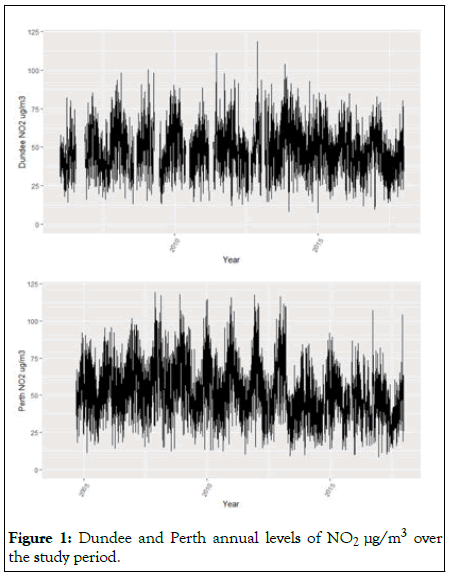
Figure 1: Dundee and Perth annual levels of NO2 μg/m3 over the study period.
Our results show that hospital admissions for children under the age of 16 increased on days of higher pollution. Whilst some of this can be explained by respiratory admissions over a quarter of admissions into both hospitals were due to GI disorders.
The nitrogen gases can adversely affect the gut both directly and indirectly. These gases are irritant, causing inflammation in the mouth and gut when swallowed in saliva, triggering inflammatory cytokine release from the epithelium and from macrophages. They can also adversely affect the gut microbiome. Indirectly they can increase susceptibility to viral infections by alterations in the human immune response. This could explain the high prevalence of mouth conditions, as well as lower GI disturbances.
Particulate matter, in this case PM10, also increased hospital admissions for GI disorders. GI disorders have previously been reported as a consequence of high PM levels PMs can be ingested through contaminated water and food, but also, as is likely in this case, indirect inhalation and contamination of swallowed saliva. PMs have been shown to increase gut permeability which can lead to diarrheal disease and alteration in the gut microbiota. PM can also affect intestinal mucosa indirectly by induction of generalized inflammation and this has been reported in areas of poor air quality. A relationship between respiratory and GI conditions is reported as the lunggut axis and noted during the COVID-19 pandemic when GI disorders were also associated with respiratory symptoms.
By showing increased GI admissions on days of high pollution, the concern is that these events could be setting the child up for later bowel inflammatory disease. Further there is an increased cost, not only the suffering of the ill health, but also on the child’s education when school is missed. Our modelling shows that by keeping air quality within legal limits 872 admissions could be saved if NO2 was always in the lowest quartile and 336 if PM10 were normalized. This is also a significant cost in terms of NHS Bed usage [7].
Limitations of the study include the inability to measure PM2.5, which is known to be particularly toxic; unfortunately, the city of Perth did not measure PM2.5 until relatively recently and the decision was made to omit this variable in our analyses. We use single monitoring stations in Perth and Dundee to estimate personal exposure to air pollution, which may result in magnitude of effects on exposures to air pollution obtained from regression modelling to be smaller than the actual impact, due to non-systematic exposure mis-classification. Also, as the measured pollutants are modelled separately, we cannot say whether they provide an additive effect. NOx, NO2 and NO are however likely to be highly correlated.
It is imperative to decrease these levels to reduce child ill health. Introducing small changes in traffic movement around schools will bring about an improvement in air quality and thus health. Targeted ‘greening’ can reduce playground pollution levels and air purifiers in classrooms, can remove particles where levels are persistently elevated.
In conclusion, there is a great deal evidence that air pollution damages the health of children. In this study we show that this translates into hospital admissions. The knock on effect, not only on physical health, but also on damaged mental health for both child and parent and decreased educational attainment is huge and should be avoided by careful monitoring and reduction of air pollutants in our cities.
Funds for this study were gratefully received from the sir john fisher foundation and the north wood trust.
[Crossref] [Google Scholar] [PubMed]
[Google Scholar] [PubMed]
[Crossref] [Google Scholar] [PubMed]
[Crossref] [Google Scholar] [PubMed]
[Crossref] [Google Scholar] [PubMed]
[Crossref] [Google Scholar] [PubMed]
[Crossref] [Google Scholar] [PubMed]
[Crossref] [Google Scholar] [PubMed]
Citation: Belch JJ, Cox B, Chalmers J, Fitton CA (2025) Childhood Gastrointestinal Disorders: Admissions to Hospital Linked to Air Pollution Exposure. J Pollut Eff Cont. 13:442.
Received: 12-Sep-2024, Manuscript No. jpe-24-34022; Editor assigned: 17-Sep-2024, Pre QC No. jpe-24-34022 (PQ); Reviewed: 01-Oct-2024, QC No. jpe-24-34022; Revised: 23-Jun-2025, Manuscript No. jpe-24-34022 (R); Published: 30-Jun-2025 , DOI: 10.35248/2375-4397.24.13.442
Copyright: © 2024 Belch JJ, et al. This is an open-access article distributed under the terms of the Creative Commons Attribution License, which permits unrestricted use, distribution and reproduction in any medium, provided the original author and source are credited.