Fisheries and Aquaculture Journal
Open Access
ISSN: 2150-3508
ISSN: 2150-3508
Short Communication - (2025)Volume 16, Issue 1
West Africa fisheries, considered as one of the most productive in the world, have been subjected to stress by distant fishing fleets since the 1950’s. Millions of people have been estimated to be dependent to a certain degree on fish as a protein source. These dependencies on fish makes these people vulnerable to changes in fish supply. This supply, has been declining over the years and has been attributed to Illegal, Unregulated and Unreported (IUU) fishing. Illegal, Unregulated and Unreported (IUU) fishing over the years has been responsible for estimated 40% of all fish caught from West African waters and over 54% of the region’s fish as a result overfishing and inaction. The effect of this activity cannot be overemphasized. These include adverse effects on ecosystems and food security, heightened tensions between and within countries and threats to economic interests and livelihoods. Vessel Monitoring System (VMS), block chain technologies and un-manned vehicle are technological tools that has been use in some developed countries to control IUU fishing. VMS provides data on the time-stamped location course and speed of vessels to fisheries authorities at regular intervals which allows for monitoring of all vessels fishing in a region at a particular point in time. A block chain is a continuously growing list of records, which are linked and secured using cryptography and has been implemented in the seafood Industries for traceability of IUU harvested fish. Un-mannered vehicle has been used to monitoring highly migratory fish species such as tuna and is considered very effective because of its key features such as decentralization. In conclusion, nowhere is that tragedy (IUU) more visible than in Western Africa. IUU fishing is destroying livelihoods, compromising food security and undermining prospects for transformative growth. Reversing the current cycle of destruction before fishery stocks are pushed beyond the point of no return is a priority that demands the highest levels of is that technologies.
Fisheries; Un-manned vehicle; Block chain; Illegal; Unreported; Unregulated; Fishing; Decentralization; IUU
West Africa refers to the area between the strait of Gibraltar (36°8′N, 5°21′W) and the southern most tip of Namibia (17°15′S, 11°48′E) excluding South Africa. It includes FAO statistical areas 34-east-central Atlantic and 47-south-east Atlantic and includes countries such as Morocco, Mauritania, Cape Verde, Senegal, Gambia, Guinea-Bissau, Guinea, Sierra Leone, Liberia, Côte d'Ivoire, Ghana, Togo, Benin and Nigeria [1]. Majority of these countries are coastal states thus fishing a major source of livelihood. Decline in fisheries resources in major water body in west Africa has been attributed to illegal fishing and increasing cases of unreported fish catch. Illegal, Unreported, and Unregulated (IUU) fishing violates current conservation and management measures in many countries thus IUU is considered a serious threat to the sustainability of fisheries because of its negative impacts on marine ecosystems and the economies of fishing countries. Global losses from IUU fishing alone are estimated at $50 billion per year (the Guardian, 2022). With west African waters considered the world's highest IUU area much of the IUU fishing in the region is believed to be conducted by foreign vessels operating within the EEZs of west African coastal countries, the majority of the IUU fishing problem is attributable to fishing fleets. Some of the illegal fishing methods used in west African countries includes [2].
Block chain use in combatting IUU fishing in west Africa
IUU fishing still constitute nuisance to the sustainable management of west Africa fisheries stock. However, with the sharp rise in the use of technological tools, block chain has been as seen as the better instrument that can be use to prevent IUU fishing, thereby improving the quality of the west Africa fisheries [3].
Block chain is a tamper-proof and tamper-resistant digital ledger that is decentralized (i.e., No central control), typically implemented without a central authority. The technology has key properties including decentralization. In traditional centralized systems, all activities must be verified by a central trusted authority (port authorities), inevitably creating cost and performance bottlenecks at the port. Fishing activities consistency can be verified quickly and honest fishermen will not notice invalid activities. Once a fishing activity is on the block chain, it is nearly impossible to delete or reverse it. Each fisherman can interact with the block chain through a generated address that does not reveal the fishermen's true identity [4]. Note that complete privacy protection cannot be guaranteed due to the inherent limitations of block chain.
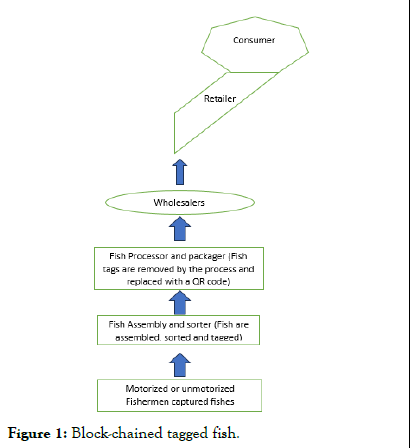
Figure 1: Block-chained tagged fish.
This key features of block chain technology makes it very useful to monitor or trace the history of harvested fishes. Thus, using a combination of RFID and QR codes, information is captured throughout the fish supply chain [5]. Individual fish are tagged after capture at the port or lading site thus providing a means to address the issue of catch theft on fishing vessels and also helps fishing companies analyze fishing activities [6]. Typically, the label or tags are removed during packaging and replaced with a unique QR code that accompanies the fish or product to be marketed (Figure 1). Each QR code is unique to the original ID of the RFID tag, allowing real-time mass balance matching [7]. Some theft can still occur at the landing site. Such fishes find their way into the black market which can still be sold to unsensitized consumers [8]. However, tagged fish easily finds their way to the sensitized consumer in the authentic market. It is important to note make this technology effective, the wholesalers, retailers and consumers must be sensitized and made aware that buying fish from the black market would make our fish disappear over a short period of time, however to sustainably manage the ocean resources, fish must be purchased from the authentic market [9]. Increased awareness about the benefits of buying from authentic market will drastically reduce the penetration of illegal fish from the black market into the authentic fish market thus making the block chain technology 100% effect [10].
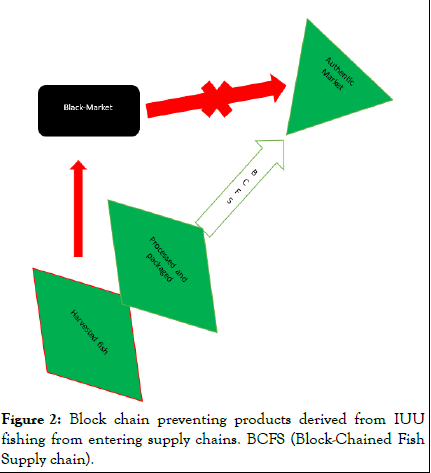
Figure 2: Block chain preventing products derived from IUU fishing from entering supply chains. BCFS (Block-Chained Fish Supply chain).
There is more illegal, unregulated and unreported fishing in west Africa than anywhere else. IUU fishing is destroying livelihoods, threatening food security and undermining the achievement of SDG 14 in west Africa. Reversing the current cycle of destruction before fish stocks are irreversibly destroyed is a priority that requires the highest level of technology. The dangers of IUU fishing should be well known in west African fishing supply chains. The Western and Central Gulf of Guinea Fisheries Commission (FCWC) and the West African Task Force (WATF) should send some of their staff for training in utilizing block chain technology.
[Crossref] [Google Scholar] [PubMed]
Citation: Awotunde M (2025) Block Chain Technology: A Possible Innovative Tool for Combating Illegal, Unreported, Unregulated Fishing in West Africa Fisheries Supply Chain. Fish Aqua J. 16:385.
Received: 21-Jul-2024, Manuscript No. faj-24-33062; Editor assigned: 25-Jul-2024, Pre QC No. faj-24-33062 (PQ); Reviewed: 01-Aug-2024, QC No. faj-24-33062; Revised: 05-Jan-2025, Manuscript No. faj-24-33062 (R); Published: 12-Jan-2025 , DOI: 10.35248/2150-3508.25.16.385
Copyright: © 2025 Awotunde M. This is an open-access article distributed under the terms of the Creative Commons Attribution License, which permits unrestricted use, distribution and reproduction in any medium, provided the original author and source are credited.