Journal of Horticulture
Open Access
ISSN: 2376-0354
ISSN: 2376-0354
Research Article - (2025)Volume 12, Issue 1
Cut flowers like Rosa hybrida play a crucial role in the floral industry, where their vase life directly impacts economic value. Salicylic acid, known for its role in plant defense and stress responses, presents potential applications in enhancing post-harvest longevity. This pilot study aimed to investigate the effect of salicylic acid on the vase life of Rosa hybrida. Flowers were treated salicylic acid 30CH solutions by immersion for 24 hours before being placed in vases with water. Control flowers were treated with distilled water. Vase life was assessed by recording the number of days until wilting. Preliminary results demonstrate a significant extension in vase life for flowers treated with salicylic acid compared to controls. Flowers treated with salicylic acid 30CH exhibited the longest vase life, with a mean of 10.26 days compared to 7.41 days in controls. In conclusion, this pilot study suggests that salicylic acid treatments hold promise for enhancing the vase life of Rosa hybrida flowers. Further research with larger sample sizes and longer observation periods is recommended to validate these findings and investigate underlying physiological mechanisms.
Rosa hybrid; Salicylic acid; Vase life; Gaultheria
Rose is a universally celebrated flower and a symbol of perfection, elegance, romance and love. Rose is recognized for their high economic value which is used in agro based industry especially in cosmetics and perfumes. Additionally, roses play a vital role in manufacturing of various products of medicinal and nutritional importance [1].
Hybrid tea varieties of roses (Rosa hybrida L.) are among the most economically important cut-flower plants belong to Rosacea family and Rosa genus, which contains more than 150 species and 1400 cultivars. However, main idea of rose plant cultivation is to get cut flowers, which greatly deals with floricultural business.
There is little research on the effects of citric acid in harvested roses or other species. On the other hand, GA3 solution increases postharvest quality and vase life of gerbera. Keeping above point in view, study was conducted to investigate vase life of cut rose with the help of salicylic acid 6CH which prepared homeopathically.
Salicylic acid
Salicylic acid is an odorless white to light tan solid. Sinks and mixes slowly with water.
Molecular formula: C7H6O3 [HOC6H4COOH]
Salicylic acid can be used to increase the vase life of cut rose for commercial purposes.
Salicylic acid is found in nature in the leaves and barks of Willows, in oil of wintergreen (Gaultheria), which is one of the chief sources of its supply and is obtained synthetically from carbolic acid. Like Carbol. ac. it has been largely used as a disinfectant and as it is supposed to be non-poisonous it is used for mixing with and so preserving foods. Salicylicum Acidum has been attended with so many unpleasant symptoms like vital depression, fainting. These symptoms in humans can point us to some indications for its use in plants. Salicylic acid forms an important part of the immune system of plants. Foliar application has been shown to speed up and increase flowering [2].
Vase life is a term used by the floristry industry that describes the period during which a cut flower or cut foliage retains its appearance in a vase. This is a major consideration in identifying plant species suitable for use in floristry, as plants with a long vase life are far more desirable than those with a short vase life. Vase life also varies across plant species and cultivars. Cut flowers with a short vase life, of less than 5 days, include dahlias, irises, daffodils and delphinium; flowers with a medium vase life (6 to 14 days) includes marigolds, snapdragons orchids and roses; and flowers with a long vase life (2 to 4 weeks) include tulips, carnations and chrysanthemums [3].
Medicine used: Salicylic acid 6CH, procured from Sharda Boron Laboratories Ltd (SBL). It is a homoeopathic pharmaceutical company's authentic homoeopathic pharmaceutical outlet with batch number SI02477 (Figure 1).
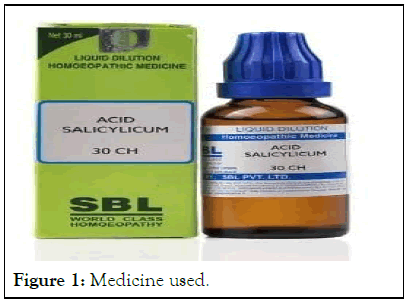
Figure 1: Medicine used.
Procedure
Experiment was conducted at the MNR homoeopathic medical college and hospital, during May 2023 to September 2023. Cut flowers of pre medicated roses were taken from rose garden at agro unit of MNR plants from which flowers were taken identically maintained. Plants will be categorized into 2 groups (Figure 2) [4,5].
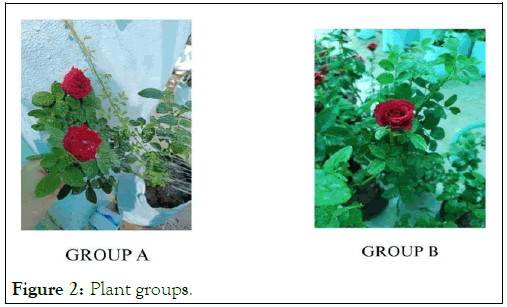
Figure 2: Plant groups.
Placebo was given to group A in foliar spray once in every 2 days. Medication was given to plants of group B by foliar spray once in every 2 days. 10 drops of Salicylicum Acidum 6c is added to 200 ml of water and given by foliar spray.
For group B until bud stage of flowers medication is given then stopped during flowering stage during the period of august month of 30 days the buds are counted for each plant from group A and group B, flowers are collected once in 3 days and complete number of flowers in each group are calculated to from total number of flowers in each group (Figure 3) [6].
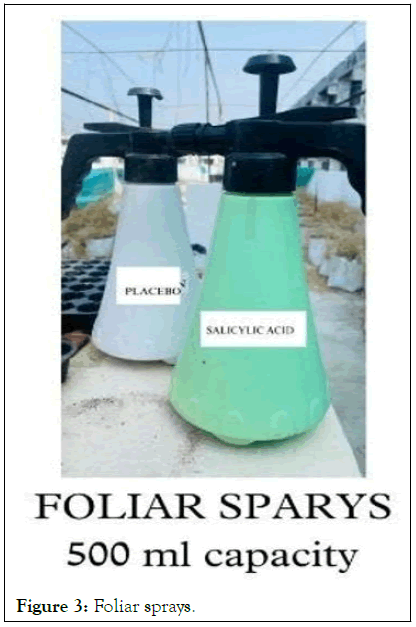
Figure 3: Foliar sprays.
Then four healthy and identical flowers are collected from each group and flowers were kept in tap water from different plants and observed vase life and then plants were identified after that flowers were taken from those identified plants. This procedure was followed to avoid rootstock effect on floral longevity.
Stems were trimmed to 30 cm under water in equal length. Slanting cut was made to provide more solution accumulated area. Leaves of stem were removed except upper one, treatments were set into two groups. In glass vase group A and group B and this glass vases are filled with tap water and kept under room temperature and air free area. The placebo is given to group A and medication is given to group B, 10 drops in 300 ml of water once in 2 days, for period of 8 days (Figure 4) [7].
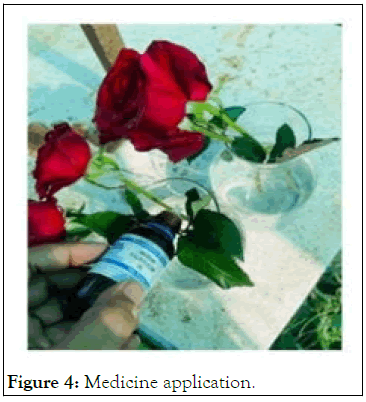
Figure 4: Medicine application.
The parameters analyzed are:
The above parameters of each group are analyzed individually and data was tabulated accordingly statistical data is analyzed by paired T test (Figures 5-8).
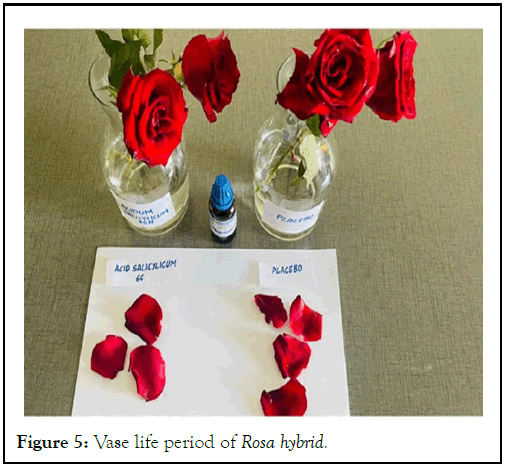
Figure 5: Vase life period of Rosa hybrid.
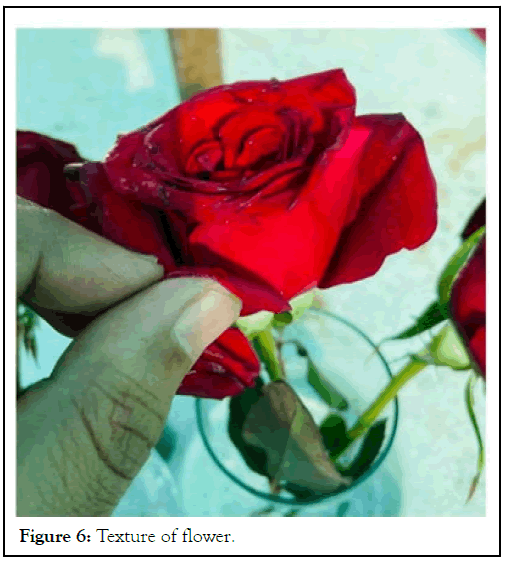
Figure 6: Texture of flower.
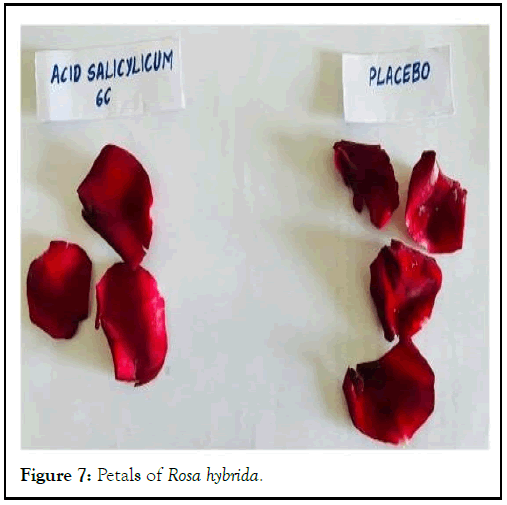
Figure 7: Petals of Rosa hybrida.
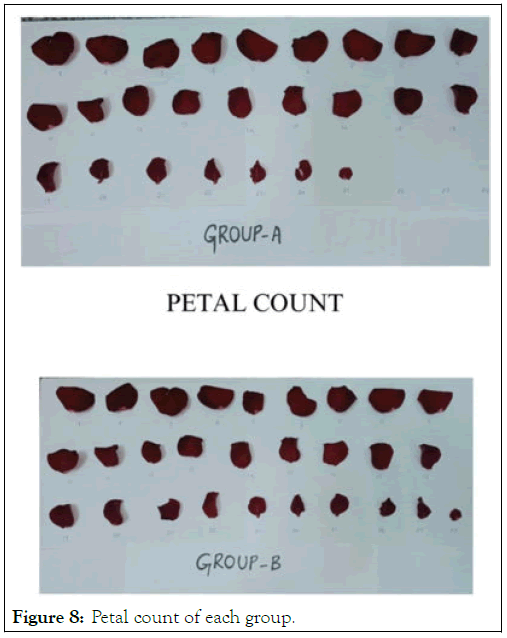
Figure 8: Petal count of each group.
From the above picture flower from group A has 24 petals and flower from group B has 29 petals [8].
Total number of buds in group A are 78, flowers obtained from them are 66 in a period of 30 days (i.e., in the month of August) (Figures 9 and 10).
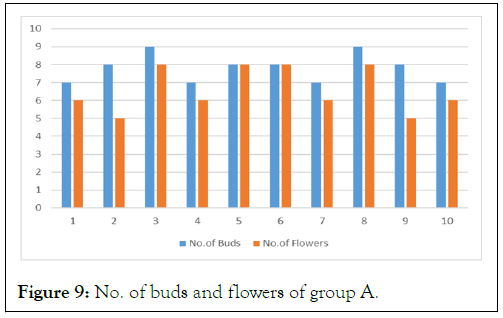
Figure 9: No. of buds and flowers of group A.
| S. no | Group | Total buds | Total flowers |
| 1 | A | 78 | 66 |
| 2 | B | 101 | 92 |
Table 1: Group comparisons of buds and flowers.
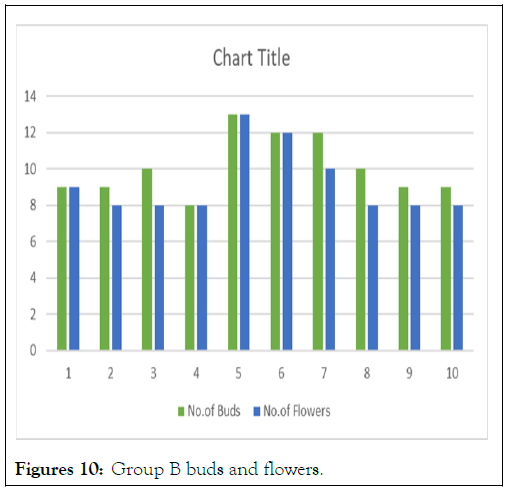
Figures 10: Group B buds and flowers.
Total number of buds in group B are 101, flowers obtained from them are 92 in a period of 30 days (i.e., in the month of August) [9].
The below Table 1 describes the comparison of no. of buds and flowers obtained from both the groups. From group A, no. of buds is 78 and flowers obtained from them are 66. Buds from group B, 101 and flowers obtained from them are 92 (Table 2 and Figure 11).
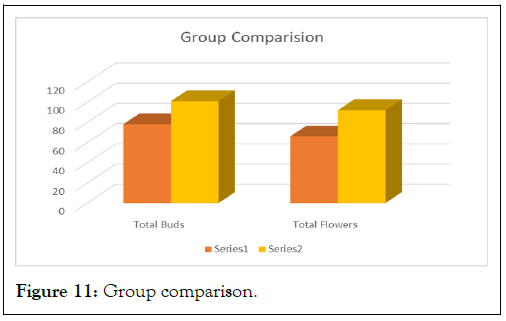
Figure 11: Group comparison.
| t-test: Paired two sample for means | ||
| Variable 1 | Variable 2 | |
| Mean | 7.8 | 6.6 |
| Variance | 0.622222 | 1.6 |
| Observations | 10 | 10 |
| Pearson correlation | 0.579066 | |
| Hypothesized mean | 0 | |
| df | 9 | |
| t stat | 3.674235 | |
| P (T<=t) one-tail | 0.002561 | |
| t Critical one-tail | 1.833113 | |
| P (T<=t) two-tail | 0.005121 | |
| t Critical two-tail | 2.262157 | |
Table 2: Paired ‘t’ table of buds.
Inference
The critical value of the study on buds is 2.262 at P<0.05 with degree of freedom (df=n-1) 9. The calculated value is 3.67. As the table value is more than calculated value salicylic acid is having significant effect on development of buds [10].
The below Tables 3 and 4 describes the petal count of group A. Four flowers from group A are taken to know the no. of petal count. Out of 4 flowers, flower 1 had 34 petals, flower 4 had 31 petals and flower 2 had 25 petals, flower 3 had 24 petals (Figures 12 and 13) [11-13].
| S. no | Group | No. of petals | |||
| 1 | A | 34 | 25 | 24 | 31 |
| 2 | B | 37 | 28 | 28 | 34 |
Table 3: Petal count of group A and group B.
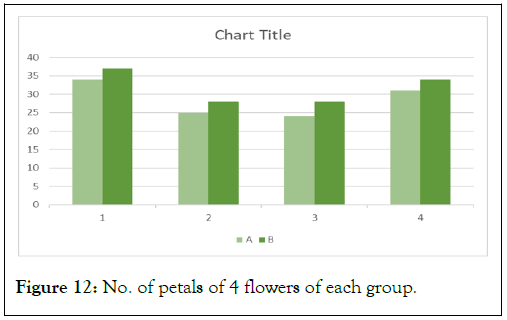
Figure 12: No. of petals of 4 flowers of each group.
| S. no | Group-A | Flowers |
| 1 | Flower 1 | 34 |
| 2 | Flower 2 | 25 |
| 3 | Flower 3 | 24 |
| 4 | Flower 4 | 31 |
Table 4: Petal count of group A.
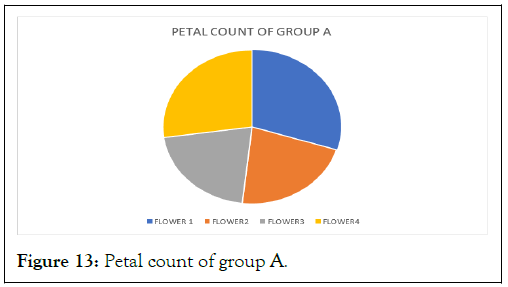
Figure 13: Petal count of group A.
The below Table 5 describes the petal count of flowers of group B. 4 Flowers from each group are taken to know the no. of petal count. Out of 4 flowers, flower 1 had 37, flower 4 had 34, flower 2 had 28, flower had 28 petals (Figure 14).
| S. no | Group-B | Petal count |
| 1 | Flower 1 | 37 |
| 2 | Flower 2 | 28 |
| 3 | Flower 3 | 28 |
| 4 | Flower 4 | 34 |
Table 5: Petal count of group B.
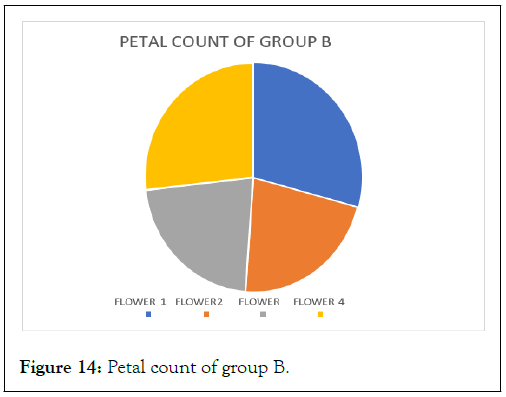
Figure 14: Petal count of group B.
The below Table 6 describes about the vase life of flowers from both the groups. Flower from group A had vase life of 7.41 days. Flower from group B had vase life of 10.6 days (Figure 15) [14,15].
| S. no | Group | No. of days |
| 1 | Group A | 7.41 days |
| 2 | Group B | 10.6 days |
Table 6: Vase life of the flowers of group A and group B.
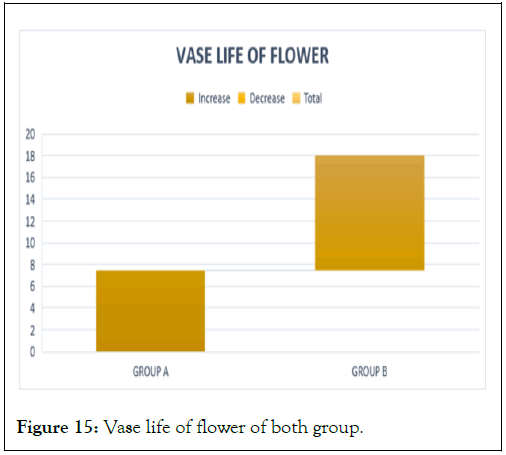
Figure 15: Vase life of flower of both group.
The aim to avoid fertilizers and use dynamic farming homoeopathy this study is conducted. So, to develop organic farming, homoeopathy plays a key role in healthy cultivating practices. Concluding the above discussed points, we derive the conclusion stating that the salicylic acid 6CH is effective in both improving the quantity and quality of Rosa hybrida, comparing to control group A if we observe the results Vase life of flowers from group A is 7.41 days Vase life of flowers from group B is 10.6 days. Time taken for color change of group A is 6.1 days. Time taken for color change of group B is 9.1 days.
No. of days taken for shriveling of flowers of group A is 6.2 days. No. of days taken for shriveling of flowers of group B is 8.2 days we can see the significant results. Further studies are required on large scale to validate and confirm. The current finding of t value is significant that means salicylic acid played a key role is preserving shelf life of Rosa hybrida. Further studies can be on Rose bouquets to know for many days’ shelf life can be improved with different homoeopathic medicines in severe condition. Hence agro-homoeopathy is a boon to the farmers both in agriculture, floriculture and horticulture.
[Crossref] [Google Scholar] [PubMed]
[Crossref] [Google Scholar] [PubMed]
Citation: Surekha T, Maniprasad G, Madhuri P (2025) Assessing Salicylic Acid's Impact on Extending Vase Life in Rosa hybrida: A Preliminary Investigation. J Hortic. 12:378.
Received: 22-Oct-2024, Manuscript No. HORTICULTURE-24-34744; Editor assigned: 25-Oct-2024, Pre QC No. HORTICULTURE-24-34744 (PQ); Reviewed: 08-Nov-2024, QC No. HORTICULTURE-24-34744; Revised: 11-Mar-2025, Manuscript No. HORTICULTURE-24-34744 (R); Published: 18-Mar-2025 , DOI: 10.35248/2376-0354.25.12.378
Copyright: © 2025 Surekha T, et al. This is an open-access article distributed under the terms of the Creative Commons Attribution License, which permits unrestricted use, distribution and reproduction in any medium, provided the original author and source are credited.