Review Article - (2025)Volume 14, Issue 2
Vehicle Accident Prevention on Curve Roads using VANET
Ermias Melku Tadessea1*, Ayene Zinabe Mengesha2, Alemu Desu G1 and Nuru Endris1Abstract
Vehicular ad hoc network is infrastructure less networks, which have dynamic wireless nodes with the RSU. In real life vehicular communication, data broadcasting is a difficult task for the drivers. This difficulty leads to vehicle accidents on curve roads. Centrifugal force, fog, coverage of vehicle by another vehicle, curved nature of the roads and skill of the drivers are the main reason for vehicle accidents on the curve roads. Due to those factors, vehicle accidents being occurred on the curved nature of roads. Therefore, in this paper vehicle, accident prevention algorithm on the curve roads has been proposed using quantitative research methodology for vehicles to vehicle and vehicle to infrastructure communications. To prevent the accident on curve roads, we have used RSU on the curve roads to create communication with the OBU of the vehicles. For these, we have implemented and tested the proposed algorithm using a simulation tool called NS2.35 for V2V and V2I communication scenario and computed the performance of the algorithm on different parameters of the network. The simulation result of the proposed vehicle accident prevention algorithm on a curve road improved the packet delivery ratio, throughput, end-to-end delay and routing overhead by 11.91%, 4.7%, 11.4% and 1.5% from the previous value of 86.8%, 20.6%, 20.9% and 22.2% respectively for different number of vehicles.
Keywords
VANET; V2V; V2I; RSU; Vehicle accidents; Vehicle; Crossroad
Introduction
Ad hoc network is a collection of heterogeneous network nodes forming the temporary networks without the need of any infrastructure as the central administrator. Nodes on the wireless ad hoc network can communicate directly by using common wireless channels. During communication over the network, they do not need additional infrastructure, such as a base station, access points, switch, router, etc. In an ad hoc network, the connected device on the network not only plays the role of an end device but also acts as a router. Each device in the network-enabled to be requested from another device as an end device and distribute the information centrally as the router. Military groups, mostly use ad hoc networks for exchanging information securely cabling in such an area is impossible or too expensive. Because establish an infrastructure using cable is impossible and very expensive.
According to the researcher, vehicular Ad Hoc networks are a class of special wireless ad hoc network with the characteristics of high node mobility and fast topology changes. A vehicular Ad Hoc network is a technology that uses moving cars as nodes in a network to create a mobile network. VANET turns every participating car into a wireless router or node, allowing cars approximately 100 to 300 meters of each other to connect and in turn, create a network with a wide range. When the connected cars leave out from the network, other cars can join the network, which is nearest to the temporary network. Vehicular ad hoc network is infrastructure less, in which nodes connected each other randomly without constant topology. An intelligent vehicular ad hoc network is the network that enables to create a vehicle to vehicle or vehicle to infrastructure communication to detect and prevent vehicle accidents. To create communication between vehicles, network communication technologies such as Wi-Fi IEEE 802.11, WAVE IEEE 1609, WiMAX, IEEE 802.16, bluetooth and Zig Bee are very crucial to create effective communication between the devices over the network.
Over traffic congestion is the major cause of the creation of vehicle accidents in a vehicular environment for different parts of the country. Every day, thousands of people were being killed and injured on the road while they are walking. When people leave out of their house, they may not return to their house due to vehicle accidents in the straight. Due to these vehicle accidents, peoples faced with the loss of life and properties. In order to reduce the accident rate, research communities and industries are working on joint projects to prevent accidents on the road and to provide post-accident care. One of the main reasons for the high death rate is the lack of post-accident medical care. To manage this issue, the development of supporting applications is required for post-accident care management. In these cases, researchers, developed testbed and an application prototype that can detect and assess accidents onroad by using smart sensors embedded in vehicles, which can automatically contact emergency services. Another major contribution of the researcher was the hardware implementation for collision detection among vehicles based on four different parts that work independently and are synchronized with each other. They analyzed the proposed application within the implemented test bed, where each of the embedded vehicles operated as either an IOT-or VANET-based device. The objective of implementing the testbed and the proposed prototype application was to provide quick medical assistance at the accident location.
Vehicle accident prevention is one of the main concerns to survive human life and properties of most peoples in Ethiopia and as well in the world. Now a day, vehicle accident is being occurred on different parts of the roads. Such as crossroads, straight roads and curve roads. One of the areas in which vehicle accidents being occurred and difficult to prevent the accident is on the curve roads. In this area, most drivers being disposed to vehicle accidents without considering the density of the road on the opposite directions of the roads. There are different factors that lead to being happened in vehicle accidents on the curve roads. Those factors are centrifugal force, fog, curved nature of the road, coverage of vehicles with another vehicle and skill of the drivers are the main reasons for vehicle accidents on the curve roads [1].
According to the researchers, they proposed a weighted cluster algorithm to detect and prevent vehicle accidents on high way. Even if the researchers tried to propose an algorithm to detect and prevent vehicle accidents on a high way, they did not put any infrastructures on the curve roads to prevent accidents on the curve roads. Therefore, to fill the gap of the researchers, we have to propose an algorithm by placing an infrastructure on the curve roads and enable to create communication with vehicular nodes to prevent vehicle accidents on the curve road. To show the specific area of the study, we tried to put Figure 1 as a sample. During their movement, the driver of car A may pass car B quickly without considering the existence of vehicles in the opposite directions. Even if car C is available in front of car B in the opposite direction, car C is hidden for car B as well as for car A due to the coverage of vehicles with mountains or other things. In these cases, a collision may have occurred somewhere in the curve in front of car B. To prevent the above problems of vehicle accidents, we proposed an algorithm to prevent an accident in the curved area.
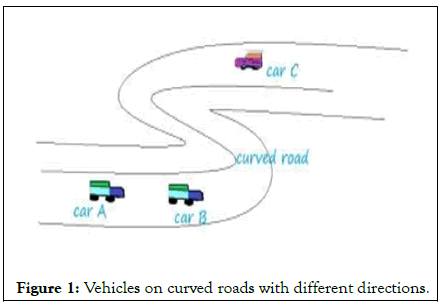
Figure 1: Vehicles on curved roads with different directions.
Literature Review
Vehicle accidents are being occurred in different areas of the country. To prevent these accidents, different researchers tried to contribute their own work using their own systems. Some of the researchers played a great role in vehicle accident prevention over the vehicular ad hoc network were mentioned as follows.
The researcher proposed a traffic avoidance routing protocol named Inter-Vehicle Collision (IVC) that can alert the drivers before the accident happened. To exchange information, all vehicles with similar characteristics were grouped into clusters. All vehicles in the cluster were broadcast a secured warning message to give further information to the other vehicles. In order to ensure IVC performance, the author used methods such as K-Mean clustering and Agglomerative Hierarchical Clustering (AHC). The AHC algorithms had an outstanding performance when compared to K-mean clustering in order to detect accidents that lie in the identical cluster as well as send data about the accident to those vehicles which lie in the cluster. Initially, the researchers thought that, preventing vehicle accidents by grouping vehicles into different clusters with the help of alert messages among the group using their own intervehicle communication system. Data dissemination was better with the help of the cluster head. During group formation, all vehicles which have different characters may not have joined under the cluster. In this case, vehicles, which are not found on the group could not get the message.
According to the information from the researcher also proposed a congestion detection algorithm for both Vehicle to Vehicle (V2V) and Vehicle to Infrastructure (V2I) communication to prevent traffic accidents caused by traffic congestions. After detecting traffic congestion, the drivers of the vehicles provided multiple options about the magnitude and location to avoid stuck in traffic congestion. The vehicle, which has the information about the traffic congestion enabled to broadcast warning messages for RSU and the RSU to transmit for other vehicles about the current conditions of the road. In this way, the next upcoming vehicle changes its decision to avoid traffic congestion and road accidents. They used the simulation tools called the net beans IDE 7.0 platform and insured that the proposed scheme achieved efficient bandwidth utilization and minimum message overhead. The proposed system assured to minimize vehicle accidents by using vehicle to vehicle and vehicle to infrastructure communication. But the researcher was not considering the result related to delay, packet loss and packet delivery ratio from the simulation result.
The researcher called, proposed a traffic congestion detection, routing scheme to avoid traffic accidents. The prettiness of this proposed scheme was that it depends on the data collection and central network infrastructure. In data collision, data were gathered from the real-time environment. Vehicles were equipped with GPS to communicate with other vehicles. Collected data only become beneficial when it was shared with other vehicles, including velocity and present location. When any vehicle broadcasts the message to the path, the sender vehicle collects the congestion message and then checked whether the area was congested or not. If not, then the vehicle stored this message in its own memory. Otherwise, it simply shares the congestion location with the other vehicles. The scheme achieved less transmission overhead and efficient utilization of the bandwidth. However, this scheme only worked in a homogenous vehicular environment. The proposed scheme also enabled the driver of the vehicle to optimize their time. These also helped them to minimize packet loss during data transmission. Since the proposed scheme was tested and worked on the homogenous vehicular environment, it was unable to prevent vehicle accidents for heterogeneous vehicular environments. Therefore, as a recommendation, it was better if the proposed system was working in both homogeneous and heterogeneous environments.
The researcher of the paper proposed another system to automatically and autonomously detect and recorded the traffic violations without the help of the human being with the device called on-board unit. To detect and record traffic violations by placing it inside the vehicle and be secured so the driver could not stop it. This on-board unit enabled us to detect and record any traffic violations in real-time in any place. The proposed system has several parts. The on-board unit that enabled to detect the violations and stored them into its memory, the violation reader that could read the committed violations wirelessly, finally an infrastructural wireless network-enabled to send an automatic violation reading from the on-board unit to traffic authorities. Then the traffic authorities could take their own measurement over the drivers. These would reduce the traffic accident at any place and at any time. As the researcher concludes that, this was the application for VANET. In the beginning, since the goal of the researcher was to detect, record and report the vehicle accidents to the traffic authority parts, the vehicle accident was limited using the proposed onboard unit [2].
According to the researcher, the proposed lane level beacon-less, infrastructure-less, GPS less Cooperative Collision Avoidance (BIG-CCA framework to prevent rear-end collision. The objective of the researcher was to ensure accident prevention using on-board sensors. The BIGCCA framework applied sensor networks to prevent chain vehicle collisions for common road accidents. When there were sudden stops on vehicles, it enabled the vehicle to equipped with onboard sensors to prevent vehicle accidents. Based on the researcher's information BIG-CCA was the first lane level CCA (Cooperative Collision Avoidance) that provided accident prevention for drivers. From the researcher's conclusion, the proposed scheme has a number of features. Such as conserved bandwidth, inaccuracy and unavailability of GPS were avoided and does not rely on costly roadside infrastructure. To test the feasibility of BIG-CCA the researcher used android based prototype using their smartphones. The result from the simulation showed that BIG-CCA could achieve the best performance for more efficient use of communication bandwidth. It also helps to avoid rebroadcasting of messages to avoid bandwidth waste. The proposed framework used for efficient utilization of bandwidth by avoiding the repetition of unwanted messages between vehicles.
The researcher of the paper proposed accident avoidance and congestion prevention method in a vehicular environment. The proposed scheme checked the occurrence of the accident between vehicles, generate and transmitted to the other vehicle to avoid another accident. The proposed scheme operated after the accident was occurring. In this scheme, after the accident occurs, the affected vehicle generates the emergency message. The RSU accepts the generated emergency message from the vehicle and forwarded it to the other RSU which was on the same line of range to prevent the duplication of another accident on the other vehicles. The beauty of this proposed scheme was that it prevented the duplication of an emergency message. Before receiving the emergency message, the RSU will check whether the same emergency message has been received or not. If the emergency message was received by the RSU, it avoided duplication of messages from the other RSU. This routing scheme has tested with the simulation tool called NS2 and successfully achieve less delay, a high delivery ratio and maximum throughput. During warning message transmission, the proposed scheme was enabled to avoid duplication of accident and warning messages transmission between vehicles.
The researcher of the paper proposed a vehicle-to-vehicle and vehicle to infrastructure communication protocol for the cooperative collision warning. Based on the proposed protocol the researcher tried to develop the wireless technologies for Vehicle-to-Vehicle (V2V) and Vehicle to Infrastructure (V2I) communication to reduce the number of roadway accidents by providing early warning messages. The main problem addressed by the researchers were, to achieve low latency in delivering emergency warning messages in different road situations. Based on a careful analysis of application requirements, they designed an effective protocol, involved congestion control policies, service differentiation mechanisms and methods for emergency warning dissemination. They demonstrated the proposed protocol with the NS2 simulation tool and they have got low latency in delivering emergency warning message and efficient bandwidth was utilized.
Most of the researchers conduct the research for vehicle accident prevention mechanisms after the accident has occurred. These help to prevent the duplication of another accident on the other vehicles. Because reducing vehicle accidents was one of the most critical issues for different researchers in different years. But the researcher proposed a method called Support Vector Machine (SVM for early car accident detection and prevention in VANET. Once the vehicle detected any dangerous situation, it distributed an alert message to the other vehicles to avoid accidents, which may be created for the future. The researcher tested the proposed method using the simulation tool called mat lab. After the researcher implemented the proposed method with the simulation tool, they suggested for drivers based on the result that they have got from the simulation. When the time interval before the predicted car accident was high, the accident rate was minimized. The vehicle accident rate was 0.3% and 0.1% for the time interval of 10 seconds and decreased the vehicle accident to 81% and 88%. In another case, if the time interval was 5 seconds, the accident rates were 0.4% and 0.2% and decreased the vehicle accident to 63% and 77%. Based on these, the researcher concluded that, if the accident detection time was high, the accident rate was low. Therefore, the proposed system assured accident detection in which before the accident has occurred.
Proposed method
Nodes in vehicular ad hoc networks can exchange information by using V2V and V2I communications between vehicular nodes and RSU. This research work is based on vehicle accident prevention mechanisms on curve roads with V2V and V2I communication using a vehicular ad hoc networks. vehicle accident on the curve road is one of the accidents on the roads in which the accident is being occurred without considering the traffic loads in the opposite directions of the road. In these works, to prevent the accident on the curve roads, an algorithm has been designed over a vehicular ad hoc networks [3].
In the proposed algorithm, the RSU enable to create communication between vehicles in the opposite directions of the curve roads with V2I communication. To create communications between nodes, the source node will send RREQ to the destination node to check the willingness of the receiver device before transmitting the actual data. If the receiver device received the request from the sender device, it forwards a reply message (RREP to the requested node. The roadside unit in the proposed algorithm plays an important role by detecting the occurrence of vehicles in both directions of the curve road and broadcast the traffic load for the available vehicles which is found on the communication range. The intermediate node found on the curve road announces the vehicles either to decrease the speed or to stop if the traffic load is high. The vehicles found on the road also create V2V communication using the onboard units installed on the vehicle. The RSU gives more priority for the vehicle which is more nearest to the curve road. The other vehicle will continue to pass the curve road safely for the purpose of preventing vehicle accidents.
Proposed algorithm: The vehicle accident prevention algorithm focused on accident prevention mechanisms on the curve road. The proposed algorithm focused on vehicle accident preventions by considering vehicle speeds, vehicle identification numbers and the distance from the static nodes using AODV protocols.
In this study, we have used the reactive types of routing protocol called Ad hoc on Demand Distance Vector (AODV) protocols with the NS2.35 simulator tool. First, each vehicle and RSU were deployed.
•Assumptions for the proposed algorithm.
•Preferred the curved road to deploy the RSU.
•When the nodes were deployed, enabled communication among them.
•Enabled the on-board unit to detect the device around it.
•Enabled the RSU to detect the nodes around it.
•The RSU to create communication with onboard units of the vehicles and control the accidents on the curved roads.
•The RSU enabled to compare the distance between the vehicles and the RSU itself with opposite directions.
•Give more priority for the nearest vehicle to be continuing with the same distance (Figure 2).
•The roadside unit enabled to warn the vehicles by telling the nature of the road and the traffic loads.
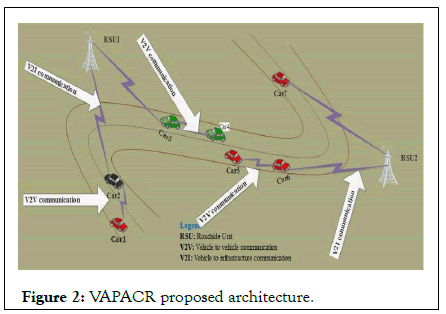
Figure 2: VAPACR proposed architecture.
As shown in the above-proposed architecture, centrally the RSU has the ability to establish connections with the nearest vehicle which are found in the communication area. The onboard unit installed on each vehicle also enables the vehicles to create vehicle to vehicle and vehicle to infrastructure communications on the network. the sensor on the RSU has the ability to detect the nature of the roads and to announce for the other vehicles. Generally, to create communication between all nodes, the nodes should be found under the communication area.
Pseudocode for the proposed algorithm
•Finite number of vehicular nodes and roadside units.
•detecting the occurrence of vehicles on the curve roads and prevent vehicle accidents.
Step 1: Deploy finite number of vehicular nodes and RSU.
•Set the distance between nodes
•Create a communication between nodes.
•Send hello messages or RREQ using AODV protocols between nodes.
•Get reply messages or RREP from the nodes.
Step 2: Announce the nature of the road by static nodes to the other nodes (vehicles).
•The vehicular nodes send hello messages to the roadside unit.
•The RSU reply messages to the vehicular nodes about the nature of the roads with the parameters vehicle speed, distance from the RSU, the number of vehicles, etc.
Step 3: Set the solutions
•Forward warning messages to the other vehicles.
•If (the road is busy. Forward warning message to decrease their speed. Else Data transmission is started. Go with the normal speed of the vehicles
Experimental setup
Simulation: Network simulation is a kind of technology that simulates the network behavior through mathematical modeling and statistical analysis method and then obtains the specific parameters which reflect the characteristics of the network. NS2 is one of the most famous network simulation software which was developed by the LBNL network research group at UC Berkeley in the USA. It is primarily useful for simulating local and wide area networks, no matter what is wired or wireless networks. It has great value for network researchers, especially for the designers of new network protocols. NS2 is an objectoriented, discrete event-driven network simulation tool. One major component of NS2 is the event scheduler. An event in NS2 is a packet ID that is unique for a packet with scheduled time and the pointer to an object that handles the event. In NS2, an event scheduler keeps track of simulation time and fires all the events in the event queue scheduled for the current time by invoking appropriate network components, which usually are the ones who issued the events and let them do the appropriate action associated with packet pointed by the event.
NS2 is designed to simulate a variety of IP networks. It covers a very large number of applications, network types, network elements and traffic models which are called simulated objects. It implements network protocols such as TCP and UDP, traffic source behavior such as FTP, telnet, Web, CBR and VBR, router queue management mechanisms such as drop tail and CQB, routing algorithms such as Dijkstra andmore. NS2 also implements multicasting and some of the MAC layer protocols for LAN simulations. NS2 simulator is based on two languages: An object-oriented simulator, written in C++ and an OTcl (an object-oriented extension of Tcl), used to execute user’s command scripts. For efficiency reason, NS2 separates the data path implementation from control path implementations. In order to reduce packet and event processing time, the event scheduler and the basic network component objects in the data path are written and compiled using C++. These compiled objects are made available to the OTcl interpreter through an OTcl linkage that creates a matching OTcl object for each of the C++ objects and makes the control functions and configurable variables specified by the C++ object act as member functions and member variables of the corresponding OTcl object. In order to observe and analyze the simulation result intuitively, NS2 provides a graphical simulation display tool called Network Animator (NAM).
We have also used MOVE, which is a mobility model generator and the traffic model generator for VANET currently implemented in Java which can be run using SUMO. In these mobility model generators mainly there are two activities. These are map editor and vehicle movement editor. In the case of the map editor, we tried to create a new topology, which is called the curve road. To create the curve road, we used x, y coordinates with an edge of the road which can connect nodes in different directions. MOVE can help to create the structure of the road especially for curved and junction roads over vehicular ad hoc networks. In-vehicle movement editor, it enables us to create the movement of vehicles by considering turning and flow of vehicles. In our case, we have created the movement of the vehicles in two directions i.e., From right to left and from left to right directions. Not only the flow of the vehicles but also the route of the vehicles from the starting to the endpoint was given manually. Finally, the mobility model of the vehicle was easily exported to NS2 using a traffic model generator.
Implementing routing for VANET using AODV protocols
In VANET, using AODV protocol to find the exact paths from routes of one vehicle to the other paths of the vehicle to know the readiness of the next node to transfer the information for the purpose of communication over the network. The vehicle that needs to transfer the message to the other destination needs to send RREQ to check the willingness of the destination vehicle. Then the destination vehicle reply message with RREP to the source node. These indicate that the destination node is willing to receive the message and want to create communication over the network. In our work, there are only two directions to transfer the message from source to destination nodes. As shown in the following figure V2V and V2I communication is performed on the network using AODV protocol [4].
Since the AODV protocol is on-demand, routing is performed when it is needed. On the curved road when the traffic was busy, these routing protocols detect the traffic load and establish connections with the nearest nodes for the purpose of exchanging information. First, the RSU on the curved road finds the nearest vehicle around it and gives an alarm to move slowly or to stop until the traffic becomes free to allow to move nodes without an accident. In addition to that V2I communication, the communication between vehicles on the lane is important to prevent accidents on the curved road (Figures 3 and 4).
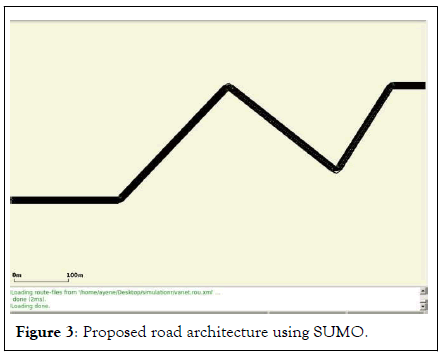
Figure 3: Proposed road architecture using SUMO.
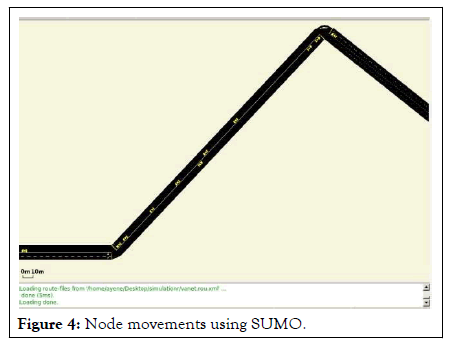
Figure 4: Node movements using SUMO.
Implementation of vehicle accident prevention on curve roads
To prevent vehicle accidents on the curve road, we implemented vehicle to vehicle and vehicle to infrastructure communication by using RSUs as an intermediate communicator for vehicles in both directions. As we know, the nature of the curved road is sensitive to vehicle accidents anywhere. After we observe the areas of how the vehicle accident could have occurred, we have to design VAPACR, which can prevent accidents in such areas.
Like that of implementing RSUs for straight roads, it was possible to deploy RSUs on the curved road and enabled them to create communication with the other nodes around it. Not only the RSUs but also the OBUs, which are found on each intelligent vehicles, had a great role in vehicle accident prevention in such area. Those OBU could exchange information between vehicles and vehicles with infrastructure (RSUs).
On the curved roads of the following Figure 5, the RSU controls the activity of each vehicle movement by sending a warning message to the vehicles in both directions to prevent vehicle accidents on the curve roads. Each vehicle on the curve road also creates communications by detecting the occurrence of nodes on the communication ranges. If the vehicle is found on the communication range, it can create V2V or V2I communications with vehicles and roadside units respectively.
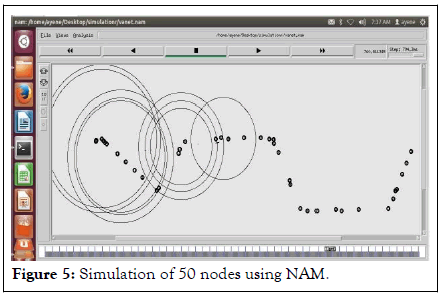
Figure 5: Simulation of 50 nodes using NAM.
Simulation parameters
On the proposed VAPACR, there are a number of parameters, which were used for simulation purpose on network simulator 2. Those lists of parameters were proposed by the researchers to implement the newly proposed algorithm. To design the proposed algorithm for accident prevention on curve rod using VANET, we have used different simulation parameters. The simulation parameters have been selected based on the characteristics of vehicular ad hoc networks. as shown in Table 1, we have used the given list of simulation parameters to simulate the proposed algorithm on NS2.
Table 1: Simulation parameters for VAPACR.
| Parameter name | Values |
| Simulation area | 1852*272 |
| Number of tested nodes | 10,20,30,40,50 |
| Number of static node | 8 |
| Vehicle speed | 20 Km/h |
| Routing protocol | AODV |
| Antenna model | Omnidirectional antenna |
| Channel type | Wireless channel |
| Simulation time | 1000 ms |
| Traffic type | TCP |
| Connection type | CBR |
| Packet size | 1000kb |
| Channel Model | Log-normal shadowing, Multipath- fading |
Results and Discussions
In this section, the result of the investigation and various scenario results of previous studies of vehicle accident prevention over VANET would be discussed. The simulation results of the current and the previous study would be done using both graphically and numerically using performance metric parameters. The simulation results of the proposed algorithm would discuss based on VAPACR using network performance metrics. The network performance metrics are used to measure the proposed algorithms in terms of speed of the data transmission and the network performance of vehicular ad hoc networks with different number of nodes and figure out the graph averagely for each network performance metrics.
Analyzing trace files
To analyze the trace file for the proposed algorithm, we have used trace graph and APP tool. We tried to analyze the new VAPACR to measure the network performance related to the number of packets successfully received, the number of packets transmitted through the channel, the time required to transmit the data from source to destination and packet routings with different number of nodes. We have analyzed the simulation results of the proposed algorithm using 10, 20, 30, 40, 50 number of nodes with constant speed of vehicles 40 m/s. Analyzing the proposed algorithm of VAPACR for network performance was done with respect to WCA based on the simulation results. We have targeted to design VAPACR and had better network performance compared with the WCA [5].
Performance evaluation metrics
To analyze the proposed algorithm, we have to identify and select the vehicle accident prevention network performance metrics like that of the packet delivery ratio, throughput, end to end delay and routing overhead to know the effectiveness of the algorithm. Those network performance metrics have been select and identified based on the characteristics of vehicular ad hoc networks. Because all ad hoc networks may not have the same network performance metrics. Those the selected metrics direct relationships to prevent vehicle accidents by measuring the performance of the proposed algorithms. By considering the speed of the vehicles and the fast topology changes, if the algorithm has high packet delivery ratio and low end to end delay compared with the other algorithms, the proposed algorithm may assure the accident preventions
Packet Delivery Ratio (PDR)
Packet delivery ratio is the ratio between the numbers of packets delivered to the receiver to the number of packets sent by the source. packet delivery ratio is a very important metric to measure the performance of routing protocols in vehicular ad hoc networks. To measure the performance of the routing protocol, different parameter types may be used, such as packet sizes and number of nodes. Mathematically, it can be calculated using Equation 1.
Packet delivery ratio=(Packets received/packets generated (packet sent)) × 100
• Packet generated: The number of actual data packets sent by the source node to the destination node.
• A packet received: The number of actual data packets received by the destination node.
In vehicular ad hoc networks, vehicle accidents are being occurred due to the shortage of information delivered to the destination device. If the information is successfully received at the destination side with the given period of time, the rate of the vehicle accident may be decreased. If the algorithm has high speed to transfer packets between vehicular nodes for the purpose of communication throughout the network, the accident rate on vehicles can be decreased. In the reverse way, if the speed of the data transmission is low, the accident rate can be high (Figure 6). Therefore, the packet delivery ratio has a direct relationship to prevent or decrease the vehicle accident rates on VANET [6].
Note: The performance of the proposed algorithm is better if the packet delivery ratio is high.
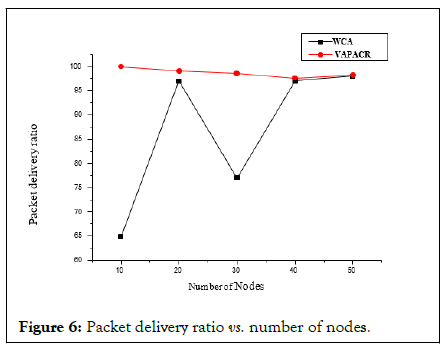
Figure 6: Packet delivery ratio vs. number of nodes.
As shown in Figure 6, the packet delivery ratio of the proposed algorithm is high compared with WCA. In these work, the packet delivery ratio value for different number of nodes were better, but in the previous work, the packet delivery ratio was lower than the proposed algorithm. The result of the graph shown that the proposed algorithm can transmit the packets from source to destination in a better way. For the better result of the packet delivery ratio, we have used a traffic type called TCP. TCP is connection-oriented and used to minimize packet loss and to maximize the packet delivery ratio and throughput value of the algorithm. From these results, we can conclude that the proposed algorithm was better to prevent vehicle accidents on the curve road by transferring the information between vehicular nodes on the network.
Throughput: Throughput is the average number of messages successfully delivered per unit time. The average throughput is the average of the total throughput. It can also be measured in a packet per unit time interval length. Mathematically it can be shown as Equation 2.
Average throughput=(receivedsize/(stop time-start time)) × (8/1000) (2)
For the successful communication of nodes on VANET, the number of packets successfully delivered at the destination side has an impact on preventing vehicle accidents on different parts of the rod especially on the curve roads. Because on the curve roads the available information from the vehicle may not accurately reach the other vehicle which is found on the opposite directions of the curve road. When the number of packets received successfully at the destination side which is free from error, the vehicles enable them to aware of the nature of the road and as well as the traffic load on the curve roads. In this case, the vehicles become to prevent themselves from an accident. From this point of view, the throughput value of the given algorithm has an impact on preventing vehicle accidents by measuring the number of packets delivered at the destination node, which are free from error (Figure 7) [7].
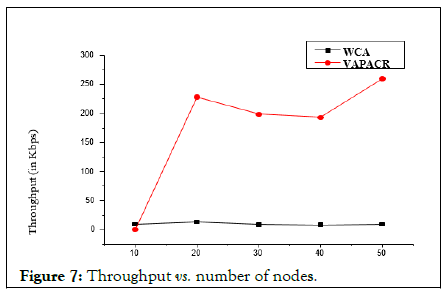
Figure 7: Throughput vs. number of nodes.
As shown from the above Figure 7, the average throughput values of WCA was increasing to some extent, when the number of nodes was increased. However, the average throughput value of the proposed algorithm was highly increased, when the number of nodes was increased. These show that the number of successfully received packets is high on the proposed algorithm compared with the previous work.
End-to-end delay: End to end delay is the average time packets take to navigate over the network. This is the time for the generation of the packet from the sender up to send at the destination side of the node until the packet received at the destination side. Mathematically it can be expressed as shown below in Equation 3.

Where, AED is average end to end delay ti (r), receiving time of the packet ti(s), sent time of the packet NPR, Total number of packets received.
From the definition of end to end delay, it is the time required to transfer the packet from source to destination device on the network. During transmission of packets from source to destination node, the packet which takes a long time to navigate from sender to receiver node may have an impact on the performance of the given algorithm. In vehicular ad hoc network, end to end delay is intolerable, since the communication is possible for short-range. The algorithm which has low end to end delay can enable to prevent vehicle accidents over VANET. Because the number of required packets can be reached at the destination side with a short period of time (Figure 8).
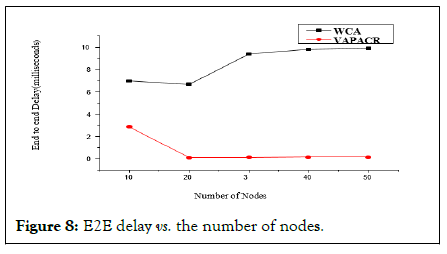
Figure 8: E2E delay vs. the number of nodes.
From the above Figure 8 on WCA, when the number of nodes increased, the value of end-to-end delay was not decreased for all nodes, whereas in VAPACR, when the number of nodes increased, the value of the end to end delay decreased. Therefore, VAPACR has less end-to-end delay compared with WCA. From this, we can conclude that the proposed algorithm can enable the node to deliver the packets with a short period of time [8].
Routing overhead: It defined as the total number of packets transmitted in kilobits per data packet. It can be calculated by dividing the total number of routing packets sent (including forwarded routing packets) by the total number of packets received.
RO=routing packets/received packets (4)
RO:Routing Overhead
Before creating the actual communication, nodes establish a connection using RREQ from sender to receiver and RREP from receiver to sender nodes. When the total number of packets including RREQ, RREP and RERR is high, the routing overhead value of the given algorithm is high, the accident rate also becomes high. On the other way, the given algorithm is more preferable which has minimum routing overhead value. During communication of nodes, with the high number of routing overheads, the network becomes busy and finally unable to prevent vehicle accidents due to a lack of information from the other nodes. To the reverse of this idea, if the network has minimum routing overhead, resulting in successful packet delivery and nodes enable to prevent vehicle accidents (Figure 9).
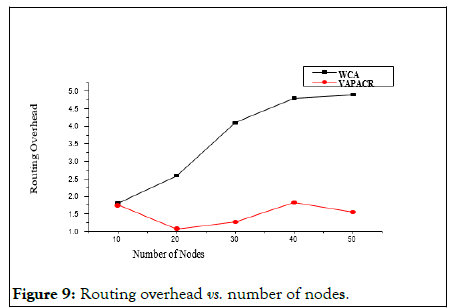
Figure 9: Routing overhead vs. number of nodes.
From the above Figure 9, we have seen that the routing overhead value of the WCA was increased, when the number of nodes increased. Whereas the routing overhead value of the proposed algorithm was decrease when the number of nodes increased. Therefore, the routing overhead value of the proposed algorithm has been decreased compared with WCA. These indicate that the proposed algorithm was also better with routing overhead value [9].
Conclusion
Vehicular ad hoc network is a subclass of mobile ad hoc networks used in intelligent transportation systems. In this research, we tried to address a very serious problem called vehicle accidents on curve roads and its prevention mechanisms. To prevent the vehicle accidents on curve roads, we proposed VAPACR algorithm. The proposed algorithm could successfully prevent vehicle accidents either in the same direction or in opposite directions using V2V and V2I communication with an alarm message. In our proposed algorithm, the complete analysis has been performed on the AODV routing protocol using the APP tool, trace graph and identified its effectiveness. We simulate and analyzed the vehicular ad hoc network in different scenarios with respect to the number of vehicles at a constant simulation time. As shown in the analysis, the newly proposed VAPACR increased the average packet delivery ratio and average throughput value from 86.8% to 98.7% and 20.6% to 25.3% respectively. Average end to end delay also decreased from 20.9% to 9.04% and average routing overhead from 22.2% to 20.7%.
Therefore, as verified using performance metrics, the proposed algorithm was better in terms of end-to-end delay and routing overhead and scalable with packet delivery ratio and throughput to prevent vehicle accidents on curve roads over vehicular ad hoc network.
Future Works
Even if we tried to design an algorithm for preventing vehicle accidents for curve roads with the same or different directions of nodes before the accidents have occurred, there have been problems, which are not solved with the newly proposed algorithm. For future researchers, we recommended that to solve the problems, which is not still solved. Currently, we did not consider identify false alarm messages during communication of nodes over vehicular ad hoc networks. Because on the curve road there may be network overhead due to the highest number of nodes. We did not also consider the congestions on the curve road. Therefore, we recommended that future researchers in VANET study the congestions on the curve roads and identifying false alarm messages during communication of nodes for preventing vehicle accidents.
References
- Zaldivar J, Calafate CT, Cano JC, Manzoni P. Providing accident detection in vehicular networks through OBD-II devices and Android-based smartphones. In2011 IEEE 36th Conference on Local Computer Networks, IEEE, 2011;813-819.
- Mohamed SA. Automatic traffic violation recording and reporting system to limit traffic accidents: based on vehicular Ad-hoc networks (VANET). In2019 International Conference on Innovative Trends in Computer Engineering (ITCE), IEEE, 2019;254-259.
- Roy A, Chakraborty J. Communication based accident avoidance and congestion control mechanism in VANETs. In2015 International Symposium on Advanced Computing and Communication (ISACC), IEEE, 2015;320-327.
- Yang X, Liu L, Vaidya NH, Zhao F. A vehicle-to-vehicle communication protocol for cooperative collision warning. InThe First Annual International Conference on Mobile and Ubiquitous Systems: Networking and Services. IEEE. 2004;114-123.
- Wu Q, Hui LC, Yeung CY, Chim TW. Early car collision prediction in VANET. In2015 International Conference on Connected Vehicles and Expo (ICCVE), IEEE. 2015;94-99.
- Khairnar VD, Pradhan SN. Mobility models for vehicular ad-hoc network simulation. In2011 IEEE Symposium on Computers & Informatics, IEEE. 2011;460-465. IEEE.
- Santos RA, Edwards A, Edwards RM, Seed NL. Performance evaluation of routing protocols in vehicular ad-hoc networks. Int J Ad Hoc Ubiquitous Comput. 2005;1(1-2):80-91.
- Kabir MF, Roy S. Real-time vehicular accident prevention system using deep learning architecture. Expert Syst Appl. 2022;206:117837.
- Das A, Ray A, Ghosh A, Bhattacharyya S, Mukherjee D, Rana TK. Vehicle accident prevent cum location monitoring system. In 2017 8th Annual Industrial Automation and Electromechanical Engineering Conference (IEMECON). IEEE. 2017;101-105.
Author Info
Ermias Melku Tadessea1*, Ayene Zinabe Mengesha2, Alemu Desu G1 and Nuru Endris12Department of Computer Science, Woldia University, Wollo, Ethiopia
Citation: Tadessea EM, Mengesha AZ, Desu AG, Endris N (2025) Vehicle Accident Prevention on Curve Roads using VANET. Global J Eng Des Technol. 14:254.
Received: 09-Aug-2024, Manuscript No. gjedt-24-33454; Editor assigned: 12-Aug-2024, Pre QC No. gjedt-24-33454 (PQ); Reviewed: 26-Aug-2024, QC No. gjedt-24-33454; Revised: 12-Apr-2025, Manuscript No. gjedt-24-33454 (R); Published: 19-Apr-2025 , DOI: 10.35248/2319-7293.25.14.254
Copyright: © 2025 Tadessea EM, et al. This is an open-access article distributed under the terms of the Creative Commons Attribution License, which permits unrestricted use, distribution and reproduction in any medium, provided the original author and source are credited.