
Internal Medicine
Open Access
ISSN: 2165-8048
ISSN: 2165-8048
Research Article - (2025)Volume 15, Issue 1
Background: Peritoneal Dialysis (PD) is a safe and effective replacement therapy for patients with terminal stage renal disease, alternative to hemodialysis. However, its success depends on the placement of a peritoneal catheter with a safe, functional and durable access. Currently, several techniques are put into practice for peritoneal catheter placement.
Methods: We present a detailed stepwise description of our operative technique for PD catheter placement. This description is combined with intraoperative photographs to highlight key steps.
Results: We describe potential pitfalls that may prevent optimal catheter function and we report our results in the medium and short term.
Conclusion: This technique performe safely and standardized reproducible method for minimally invasive placement of peritoneal dialysis catheters.
Peritoneal dialysis; Laparoscopic; Catheter; ESRD
Peritoneal Dialysis (PD), first described as a long-term management modality for End-Stage Renal Disease (ESRD) in 1976, is becoming an increasingly utilized method for renal replacement therapy [1].
Peritoneal Dialysis (PD) is an effective treatment for end-stage kidney disease; the literature supports PD as having a more beneficial effect on residual renal function and on patient’s quality of life and it offers several advantages in comparison to tradition hemodialysis renal replacement [2].
Drawbacks of PD include the need for surgery and anesthetic induction for catheter placement, the need for PD to be performed daily and requirement of an external catheter, which some patients may and cosmetically unappealing.
Placement of a functioning catheter is essential. The main catheter related complications can include peritonitis, infection, catheter outflow obstruction, leakage, and migration, which hinder optimal functioning of the PD catheter. These complications can lead to catheter displacement or even loss of peritoneal access.
Surgical techniques for catheter placement include open laparotomy, percutaneous puncture and laparoscopic technique. Every step of this described approach to achieve optimal catheter placement and promote long-term catheter function.
New catheter placement procedures have evolved due to progress in minimally invasive surgery and nowadays laparoscopic placement of peritoneal dialysis catheter is a widely accepted and effective technique with minimal complications.
Meta-analysis shows the laparoscopic procedure as a superior catheter placement procedure with lower incidences of catheter malfunction; the laparoscopic technique compared with open surgery reduces morbidity, duration of hospital stay, postoperative pain and recovery [1].
Adhesiolysis, omentum section, and mobilization of the loops may be necessary to optimize the procedure.
In this article we describe step by step our technique that offers a safe and standardized reproducible method for minimally invasive placement of peritoneal dialysis catheters. This is a fully illustrated description with figures and intraoperative photographs to highlight and emphasize key anatomy and critical surgical steps.
Surgical technique
In our experience we have used soft silicone catheters, with a multi-hole pig-tail distal end to be placed in the Douglas cul-desac and a proximal end with two Dacron® cuffs one of which is placed in the preperitoneal space and the other in the subcutaneous space.
We placed the catheter on the right side of the abdomen to accommodate the peristalsis; the peristalsis results in clockwise movement of the ileal loops so a left-sided catheter could be easily displaced [4].
The procedures were all performed by the same surgical team.
After general endotracheal tube anesthesia induction, the skin is prepped with chlorhexidine scrub and an adhesive Betadine skin barrier is placed. The Betadine skin barrier serves as an added precaution to ensure that direct contact between the PD catheter and the skin does not occur.
Antibiotic prophylaxis with cefazolin is performed 30–60 minutes before the skin incision. The patient empties the bladder immediately before surgery and is placed in supine position with legs closed with shoulder supports and both arms along the body.
The laparoscopic rack is positioned to the right of the patient, the operator and the assistant are positioned to the left.
Abdominal access is performed with the TUOL technique, through a 1.5-2 cm transverse skin incision on the lower edge of the umbilical scar and subsequent introduction of the 10 mm Hasson trocar.
Once insufflation has been performed, first we examined peritoneal cavity then we position the patient in Trendelenburg for a better pelvic exposure [5].
Two 5 mm trocars are inserted, all under direct vision, according to the patient’s habitus, in the left ipocondrium and in the left iliac fossa; these trocars should be positioned equidistant from each other and from the umbilicus (Figure 1).
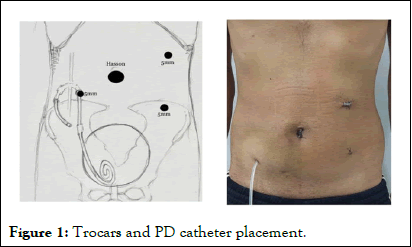
Figure 1: Trocars and PD catheter placement.
If necessary, we performed adhesiolisys with energy device and we place additional trocars.
A 7 mm trocar is inserted in the right side of the abdomen, medial to the epigastric vessels, about 3 cm laterally and inferior to the umbilicus, with a 2 cm preperitoneal tunnelling and we insert the catheter into the abdomen up to the limit shown by the first Dacron cuff [6].
The distal part of the catheter is placed in the pouch of Douglas and fixed right in the pelvis with a peritoneal tie obtained by constant suture 5 cm long with barbed non-absorbable thread 2/0 (Figure 2 and 3).
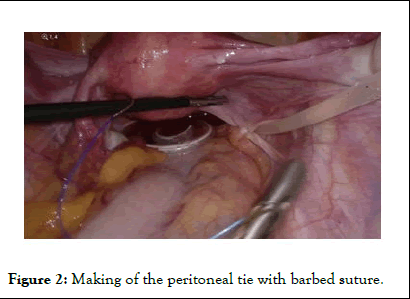
Figure 2: Making of the peritoneal tie with barbed suture.
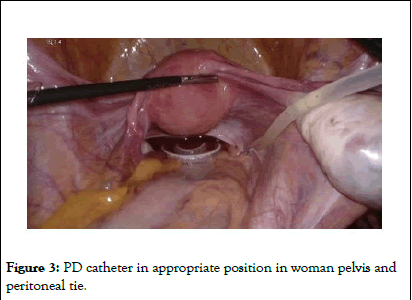
Figure 3: PD catheter in appropriate position in woman pelvis and peritoneal tie.
However, this solution allows its removal without necessarily having to reoperate the patient.
At the end, a subcutaneous tunnel is created with an appropriate tunnelling kit (tunnelizer). The outer Dacron cuff remains completely subcutaneous lateral to the inner cuff. The PD catheter exit site on the skin is placed about 2–4 cm laterally from the subcutaneous cuff.
Correct inflow and outflow will be tested with at least 500 ml of saline with the patient in the neutral position.
Umbilical access muscle fascia is sutured with absorbable suture long term. Skin closure is performed with absorbable sutures. Patients are discharged safely on the first postoperative day. The nephrologist is responsible for catheter management and breakin to peritoneal dialysis [7].
We performed 35 procedures from October 2019 to June 2023. 13 patients were women and 22 were men with an average age of 46 years. This technique showed 91% success rate for catheter placement with average operative time of 45 minutes with 0% mortality rate.
The 30-day morbidity was 8% including one patient with intraabdominal bleeding which did not require surgical revision.
During the follow-up, an incisional hernia was reported in 3 patients: A catheter was removed after 12 months because of non-antibiotic treatable peritonitis.
Malfunctioning occurred in 4 cases, one patient with inflow and tree patients with outflow obstruction: In the all case, we performed a laparoscopic second look for adhesiolysis; while in the latter case, we removed the catheter for a complex adhesional syndrome.
In a female patient, we removed a bulky right ovarian teratoma during the procedure.
No omentopexy or omentectomy was performed in any of our patients, which may be related to the small sample size. Ten of the 35 patients underwent renal transplant. For those patients, peritoneal dialysis was a bridge to surgery [8].
A optimal PD catheter placement technique is necessary to provide patients with the highest chance of success.
We believe that our laparoscopic peritoneal catheter placement and xation technique is simple, highly reproducible and safe.
We describes rational for each step. Our findigs include low complication rates and good catheter seal in the short and medium term: higher one-year catheter survival and less migration.
All procedures performed in studies involving human participants were in accordance with the ethical standards of the institutional and/or national research committee and with the 1964 Helsinki declaration and its later amendments or comparable ethical standards. The authors arm that human research participants provided informed consent for participate.
The authors arm that human research participants provided informed consent for publication.
The datasets used and/or analysed during the current study available from the corresponding author on reasonable request.
The author declares no conflict.
No funding was received to assist with the preparation of this manuscript.
G.O. and P.S. wrote the main manuscript text and C.S prepared Figures 1-3. All authors reviewed the manuscript. All author have approved the submitted version (and any substantially modified version that involves the author's contribution to the study) and have agreed both to be personally accountable for the author's own contributions and to ensure that questions related to the accuracy or integrity of any part of the work, even ones in which the author was not personally involved, are appropriately investigated, resolved and the resolution documented in the literature.
[Crossref] [Google Scholar] [PubMed]
[Crossref] [Google Scholar] [PubMed]
[Crossref] [Google Scholar] [PubMed]
[Crossref] [Google Scholar] [PubMed]
[Crossref] [Google Scholar] [PubMed]
[Crossref] [Google Scholar] [PubMed]
[Crossref] [Google Scholar] [PubMed]
Citation: Pasquale S, Oliva G, Carmen S, Gianluigi S, Guido L (2025) The Peritoneal Tie Technique: Our Laparoscopic Catheter Placement for Peritoneal Dialysis. Intern Med. 15:504.
Received: 01-Aug-2024, Manuscript No. ime-24-33299; Editor assigned: 06-Aug-2024, Pre QC No. ime-24-33299 (PQ); Reviewed: 20-Aug-2024, QC No. ime-24-33299; Revised: 21-Jan-2025, Manuscript No. ime-24-33299 (R); Published: 28-Jan-2025 , DOI: 10.35248/2165-8048.24.15.504
Copyright: © 2025 Pasquale S, et al. This is an open-access article distributed under the terms of the Creative Commons Attribution License, which permits unrestricted use, distribution and reproduction in any medium, provided the original author and source are credited.