Journal of Chemical Engineering & Process Technology
Open Access
ISSN: 2157-7048
ISSN: 2157-7048
Research Article - (2025)Volume 16, Issue 3
Increasing wastewater production is posing a threat to the safety and cleanliness of the water and also increase in population and industrial activities has resulted in harmful pollutants in our water sources that cause a concern for our future health and environmental well-being. These pollutants include pharmaceuticals, nitroarenes, synthetic dyes, oil and heavy metals that can be toxic, carcinogenic and lead to multiple organ failure. Conventional methods used to remove these toxins are of high cost, poor recyclability and low efficiency. Adsorbents have been used in various industries to remove contaminants from wastewater. Naturally occurring and laboratory synthesized adsorbents, their past and recent advancements and future wastewater treatment strategies are comprehensively described. Nanoparticles possess useful characteristics such as high surface-to-volume ratio, high optical absorption coefficient and tunable band edges for optimized catalytic capability. Magnetite NPs in specific have proven great efficiency in the removal and degradation of such pollutants as it is affordable, recyclable and easy to remove in the presence of an external magnetic field. Surface functionalization of these magnetic NPs is seen as an excellent bridge between homogeneous and heterogeneous catalysis. A metal catalyst immobilized on the surface of these Magnetic Nanoparticles (MNPs) affords customization and optimization of their properties for targeted applications. In this review the synthesis of the magnetic core and different immobilization methods used to secure a metal catalyst onto its surface was discussed and the future research should focus on enhancing the binding strength between hydride metal nanoparticles and magnetite and scaling up the production and application of MMNPs for industrial-scale and as well as developing robust regeneration methods that do not compromise the performance of MMNPs.
Magnetite (Fe3O4); Nanoparticles; Immobilized metal nanoparticles; Hybride materials
Water contamination has been a persistent global issue as it has been the root for many health and environmental problems that trouble our food security. The drastic increase in the world population along with the increased need for food and industrial production has contributed to this problem. These toxins include heavy metals, radionuclides, oil, natural organic matter, pharmaceuticals, dyes, nitrogen and phosphorous compounds, which can accumulate in nature and cause severe health and environmental damage. These toxins are conventionally removed via biological methods using various microorganisms, physiochemical methods such as coagulation, electrocoagulation, chemical precipitation, irradiation and ion exchange or physical methods such as filtration, sedimentation and skimming. These methods are ineffective, slow and result in high chemical waste that is difficult to manage [1].
Nanotechnology has proven to be one of the greatest advancements in this fields as Nanoparticles (NPs) have high absorbing capability and good catalytic capability due to a large surface-to-volume ratio increasing the contact area available for catalysis to occur. NPs have attracted a lot of attention due to their unique behavior, shapes and electron movement on its surface. The particle is defined as ranging between 1 nm and 100 nm in size allowing for a large surface-to-volume ratio resulting in many active sites available for catalysis to occur. As the particle consists of multiple atoms clustered together it enables electron movement on its surface as well as multiple sites of catalysis on its surface. The possible manipulation of the shape, composition, monodispersity, microstructure and surface coatings allows for alterations in the catalytic ability and absorption capacity of the nanoparticle. This leads to improved recyclability along with increased selectivity, activity and stability.
In addition, NPs can also consist of more than one metal through relatively easy synthesis methods. Bimetallic NPs are unique as they utilize some characteristics of both the individual metals present as well as new characteristics due to the interaction of the two metals with one another.
These characteristics are unique electronic, optical and magnetic properties that improve the overall stability and catalytic efficiency of the NPs. When preparing NPs researchers aim to synthesize monodispersed NPs. As monometallic NPs frequently lack in control over size, stability, activity and selectivity, bimetallic NPs have thus received great interest to improve these factors.
Magnetite is a combination of Fe (II) and Fe (III) salts that undergone co-precipitation under basic conditions and has unique superparamagnetic characteristics and absorption capabilities. It is one of the oxides abundantly present in iron ores and as iron is the most abundant transition metal, the use of this metal in catalysis allows for a more affordable and sustainable alternative to traditional catalysts. Magnetite has been widely utilized for the removal of toxins from different water sources including monometallic iron NPs and bimetallic iron alloys or core shell NPs [2].
Multiple synthetic approaches have been reported for the preparation of MNPs including chemical, physical and biological approaches. Chemical synthesis is, however, preferred as it allows for better control over the shape and size of the NPs. The most popular chemical synthesis methods used include coprecipitation, thermal decomposition, micro emulsion and hydrothermal methods as seen in Figure 1. However, other methods such as vapor deposition, spray pyrolysis, laser pyrolysis, sol gel, polyol and no-thermal plasma methods have also been reported. From these methods chemical co-precipitation is the most favored as it is seen as simple, inexpensive and does not require toxic solvents or harsh reaction conditions. This method, however, lacks in control over shape and particle size in which cases thermal decomposition or hydrothermal methods can be utilized. The macro emulsion method of synthesis is, however, not preferred as it delivers low yields, requires a lot of solvent and is complicated to execute.
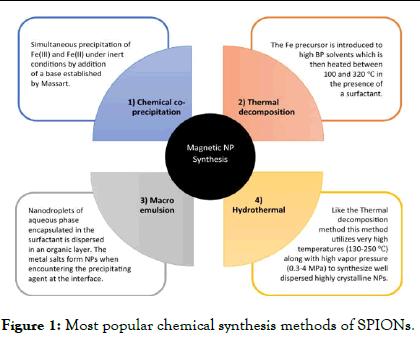
Figure 1: Most popular chemical synthesis methods of SPIONs.
Superparamagnetic Iron Oxide Nanoparticles (SPIONs) are greatly reported in the removal and treatment of various water pollutants, they often lack in activity compared to other metal NPs. Various immobilization methods enable the active metals to be anchored onto the surface of the magnetic NP. This allows researchers to easily bridge the gap between homogeneous and heterogeneous catalysis as the surface catalyst can be carefully tailored for its intended application. The use of SPIONs as a core and immobilization of active metals on the surface allows for the benefits associated with magnetite while optimizing reactivity. The use of these NPs as supports can also help to improve the stability and recyclability of previously unstable NPs. The benefits of this design method thus allow for more active, stable and easily recyclable catalysts and absorbents to remove hazardous materials. Here we review the synthesis of nano-metal catalysts immobilized on magnetite as a support and their efficiency in the treatment of common water pollutants (Table 1) [3].
| Pollutants | Permissible limits (mg/L) | Sources | Adverse effects |
| Fluoride | 1 (BIS) | Steel manufacturing, coal combustion, phosphate fertilizer production, geological origin | Enamel development and skeletal fluorosis, neurological disorders |
| 1.5 (WHO) | |||
| Chloride | 250 (BIS) | Runoff of soils, salt-bearing geological formations, deposition of salt spray, salt used for road de-icing | Nausea and vomiting, swelling in body parts, stomach ache |
| 200-300 (WHO) | |||
| Chlorite | 0.7 (WHO) | By-products of chlorine treatment of water | Irritation in the eye, nose, throat, nose bleeding, esophagus |
| Nitrite | 0.02 (BIS) | Fertilized agricultural lands, municipal and industrial wastewater, refuse dumps, animal feedlots, septic tanks, urban drainage and decaying | Cyanosis, circular system failure, affects the central nervous system |
| 3 (WHO) | |||
| Bromide | 0.5 (BIS) | Steel manufacturing, coal combustion, phosphate fertilizer production, geological origin | Cough, irritation in the mucous membrane, heavy watery eyes, dizzines |
| Nitrate | 45 (BIS) | Leakage from fertilized cropland, septic system, urban drainage, animal feedlots | Headache, lightheadedness, increased pulse rate |
| 50 (WHO | |||
| Phosphate | 0.1 (BIS) | Anthropogenic waste, poor agriculture processes, leaking septic systems, fertilizer, industrial discharges | Muscle cramps, irregular heartbeat, convulsions, numbness |
| Sulphate | 200 (BIS) | Mineral dissolution, mining drainage, sewage filtration, synthetic detergent, smelters, textile mills, tanneries | Reduced lung functions aggravated asthmatic symptoms and chronic heart or lung diseases |
| Ammonia | 0.5 (BIS) | Urea, corrosion inhibitors, protein and amino acid breakdown in organic waste | Irritation of the skin, mouth, throat, lungs and eyes |
| 1.5 (WHO) | |||
| Lithium | 0.01 (BIS) | Hectorite clay, electronics, lithium mining, lithium industries, batteries, glass and ceramics | Diarrhea, dryness of mouth, thirst, slight shaking of the hands (mild tremors), weight gain |
| Molybdenum | 0.07 (BIS) | Mining, sewage sludge, coal and coal waste, household products, septic tank | Joint pain, gout, high blood levels of uric acid, liver and kidney disease |
| 0.07 (WHO) | |||
| Cyanide | 0.05 (BIS) | Chemical industries, photography, lectroplating, metal cleaning, mining, iron and steel plants, household waste, bacteria, fungi | Cyanide poisoning of the heart, respiratory and central nervous system, dizziness headache, nausea and vomiting |
| 0.07 (WHO) | |||
| Lead | 0.01 (BIS) | Batteries, automobile emissions, pesticides, mining, mineral eathering, old pipelines, paint, urning of coal | Toxic to humans and aquatic |
| 0.01 (WHO) | |||
| Arsenic | 0.01 (BIS) | Fungicides, pesticides, insecticide, metal smelters, toys, paints, electric waste, geological origin | Hepatotoxicity, Immunotoxin, causes melanosis, keratosis, hyperpigmentation and liver damage in humans, vomiting and diarrhea, have toxicological and carcinogenic effects |
| 0.01 (WHO) | |||
| Cadmium | 0.003 (BIS) | Electroplating, welding, batteries nuclear fission plant, fertilizer, pesticides | Acute effects on children, cause severe problems to kidneys and bones, emphysema bronchitis, anemia, nephrotoxicity, pulmonary toxicity |
| 0.003 (WHO) | |||
| Iron | 0.3 (BIS) | Corrosion of iron or steel | Diabetes, emochromatosis, stomach ache, nausea, damage of the liver pancreas and heart |
| Mercury | 0.001 (BIS) | Pesticides, paper industries, paints, mining, batteries, volcanoes, dental filling, fishes | Poisonous, gingivitis, tremors, causes mutagenic changes, neurotoxic spontaneous abortion, protoplasm poisoning |
| 0.006 (WHO) | |||
| Chromium | 0.05 (BIS) 0.05 (WHO) | Electroplating, leather tanning, metal finishing, nuclear power plant, chromate preparation, textile industries | DNA damage, cancer development skin and eye irritation, gastroenteritis, asthma, nasal ulcers |
| Copper central | 0.05 (BIS) | Mining, chemical, industry, pesticide production, metal piping, electroplating mucosal irritation and corrosion | Nervous system irritation, depression, phytotoxic, toxic to aquatic fauna |
| 2 (WHO) | |||
| Zinc | 5 (BIS) | Refineries, metal plating, plumbing, brass manufacture industries | Lack of muscular coordination, anemia, abdominal pain, corrosive effect on skin and nervous membrane, hemotoxicity, phytotoxic |
| Manganese | 0.1 (BIS) 0.4 (WHO) | Welding, ferromanganese, production, fuel addition | Cause damage to the central nervous system |
| Nickel | 0.02 (BIS) 0.07 (WHO) | Electroplating, battery, industries, zinc base casting | Eczema of hands, phytotoxic, causes DNA damage, damages fauna |
| Dye | 0.01 (BIS) | The textile industry, printing, dyeing plants, wool spinning plants, silk factories, knitting plants, paints, food coloring, leathers, pharmaceuticals | Increase biochemical and chemical oxygen demand, impair photosynthesis, inhibit plant growth and provide bioaccumulation, mutagenicity and carcinogenicity |
| 0.02 | |||
| Methylene blue anionic surfactant | (MBAS) 0.2 (BIS) | Household detergents, consumer products, pesticides, industrial discharges, domestic sewage, drilling fluids | Disrupt lipid membranes, irritation of skin, eyes and respiratory systems |
| Pesticides DDT endosulfanaldrin/Dieldrin | 1 (BIS) | Pesticide manufacturing plants, wastewater recharge, sewage treatment plants, farmlands, gardens | Cardiac disease, necrosis, asthma, reproductive disorder, cancer, neurotoxicity |
| 0.4 (BIS) | |||
| 0.03 (BIS) | |||
| Oil/Grease | 0.5 (BIS) | Food processing, restaurant, kitchen, slaughtering industry, automobile companies | Fueling climate change, damaging public lands, disrupting wildlife, heart disease, stunting growth, and affecting the immune system |
| Organo-halogens | 0.001 (BIS) | Biomass/biofuel burning, marine, refrigerants and foam blowing | Endocrine and lung damage, neurotoxic, reduce immunity, affects reproduction |
| Volatile Organic Compounds (VOCs) | 0.005 (BIS) | Vehicle exhaust, fossil fuels, paints, wood preservatives, cleansers, disinfectants, dry- cleaned clothes, adhesives and caulks | Liver and kidney damage, central nervous system damage, asthma, headache, dizziness |
| Microplastics | <1 nm (WHO) | Textile fibers, city dust, tire dust, road construction, cosmetic and personal care products | Plastic pellets cytotoxicity, neurotoxicity, oxidative stress, lungs and placenta disease |
Table 1: Soluble organic and inorganic water/wastewater pollutants: Sources, permissible limits and adverse effects according to the Bureau of Indian Standards (BIS) and World Health Organization (WHO).
Methods to support catalysts on magnetite
There are multiple methods of successfully immobilizing metal NPs onto the SPION surface. The choice of method is able to tailor its stability, morphology and electron movement and should thus be considered as an important aspect when designing a catalyst or absorbent. This article focused on impregnation, co-precipitation, dumbbell composites, coating, grafting and coating-grafting methods as depicted in Figure 2.
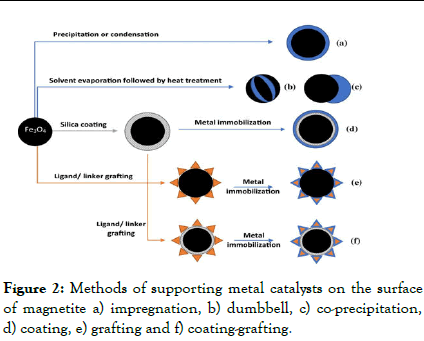
Figure 2: Methods of supporting metal catalysts on the surface of magnetite a) impregnation, b) dumbbell, c) co-precipitation, d) coating, e) grafting and f) coating-grafting.
Impregnation is the most popular method of introducing a metal catalyst onto the magnetic surface. This method is the easiest and least expensive method where the metal catalyst is simply precipitated or condensed directly onto the surface of the magnetic support. This method, however, lacks in a stabilizer and often leads to poor reproducibility of shape and size achieved. This resulted in more complicated methods being studied to introduce some control [4].
Co-precipitation method mixes the active metal and supports to enable nucleation and growth of the combined solid precursor of the active metal and support. The method incorporates solvent evaporation followed by heat treatment which result in different metal oxide domains on the magnetic surface that can be substituted with a transition metal of choice. The one-step process allows for very high active metal loadings while still maintaining a small particle size. This method is often preferred for producing catalysts with very high loadings. Nucleation is very sensitive for fluctuations in the reaction conditions which can lead to inhomogeneous growth patterns or the precipitation of different phases. New techniques such as continuous consecutive precipitation and spray-drying have thus been developed to overcome this hurdle.
Dumbbell composites are defined as two different functional NPs in intimate contact with one another. The interfacial interaction originates from electron transfer across the interface of these different NPs. The unique structure is commonly obtained by sequential growth of a second NPs on an allocated specific area on the magnetic center obtained by solvent evaporation followed by heat treatment. This method is also similar to the impregnation method but relies heavily on the promotion of heterogenous nucleation while suppressing the homogeneous nucleation from occurring.
Coating is one of the most common methods employed to avoid problems associated with naked magnetite. The core is coated and stabilized by an appropriate substance followed by precipitation of the metal catalyst on its surface. Silica is one of the most popular oxides reported in the coating process of magnetite as it is environmentally safe, affordable and abundantly available. This is usually achieved by the sol gel method which is followed by a second layer containing an active metal [5].
Grafting, other than silica, tailored ligands can also be used as a linker between the magnetic center to an active metal center. This method aims to protect the magnetic center from oxidation and increases its stability. These ligands can be carefully selected to tailor the electron movement, selectivity and activity of the MNP. It does, however, increase the cost associated with these MNPs generated.
Coating-grafting, combining the first two named methods both silica and a tailored ligand is utilized to bound the selected metal catalyst to the magnetic surface. The ligand commonly used in this process contains a triethoxysilane group capable of binding to both the silica surface and the preferred metal catalyst. Not only does this protect the magnetite centre but also allow for additional control over specific metal anchor points. This method is not commonly used as it is complex, expensive and generates very large particle sizes.
Synthesis of Magnetite (Fe3O4) nanoparticles
Materials
• Ferric chloride (FeCl•6HO)
• Ferrous chloride (FeCl•4HO)
• Sodium hydroxide (NaOH)
• Deionized water
Procedure
Preparation of solution: Dissolve 5.2 g of FeCl3
• 6H2O and 2.0 g of FeCl2
• 4H2O in 100 mL of deionized water and heat the solution to 70°C under a nitrogen atmosphere.
Co-precipitation: Add 10 mL of 2 M NaOH solution drop wise to the heated iron salt solution while stirring vigorously. Maintain the temperature at 70°C and continue stirring for 1 hour to ensure complete precipitation.
Magnetite formation: After 1 hour, cool the solution to room temperature and use a magnet to separate the black precipitate (Fe3O4 nanoparticles) from the solution. Wash the precipitate several times with deionized water and ethanol to remove any residual ions and Dry the magnetite nanoparticles in a vacuum oven at 60°C for 12 hours.
Immobilization of metal nanoparticles
Materials
• Magnetite nanoparticles (FeO)
• Metal precursors (e.g., HAuCl for gold, AgNO for silver, HPtCl for platinum, Pd (NO) for palladium)
• Reducing agents (e.g., sodium borohydride (NaBH) or hydrazine hydrate (NH•HO))
Procedure
Preparation of magnetite suspension: Disperse 1 g of synthesized magnetite nanoparticles in 100 mL of deionized water using ultra sonication for 30 minutes.
Metal nanoparticle immobilization: Add the metal precursor solution to the magnetite suspension under continuous stirring.
For gold nanoparticles, add 10 mL of 1 mM HAuCl4 solution. Gradually add the reducing agent (0.1 M NaBH4 solution) drop wise while stirring to reduce the metal ions and form metal nanoparticles on the magnetite surface. Continue stirring for 2 hours to ensure complete reduction and immobilization.
Separation and washing
• Use a magnet to separate the MMNPs from the solution.
• Wash the MMNPs several times with deionized water and ethanol to remove any unreacted precursors and reducing agents.
• Dry the MMNPs in a vacuum oven at 60°C for 12 hours [6].
Characterization of MMNPs
X-ray Diffraction (XRD): Determine the crystalline structure and phase purity of the synthesized MMNPs.
Scanning Electron Microscopy (SEM): Analyze the surface morphology and size distribution of the MMNPs.
Transmission Electron Microscopy (TEM): Observe the detailed structure and distribution of metal nanoparticles on the magnetite surface.
Energy Dispersive X-ray spectroscopy (EDX): Confirm the elemental composition and the presence of metal nanoparticles on the magnetite.
Vibrating Sample Magnetometry (VSM): Measure the magnetic properties of the MMNPs to ensure they retain adequate magnetic responsiveness for easy separation.
Brunauer-Emmett-Teller (BET) surface area analysis: Determine the specific surface area and pore size distribution of the MMNPs, which are crucial for adsorption capacity.
Evaluation of adsorption and catalytic removal
Batch adsorption experiments
• Optimization of conditions: Investigate the effects of pH, contact time, temperature and initial metal concentration on the adsorption capacity of MMNPs and use Response Surface Methodology (RSM) to optimize these parameters.
• Isotherm and kinetic studies: Conduct adsorption isotherm studies using models like Langmuir and Freundlich to understand the adsorption mechanism and perform kinetic studies using pseudo-first-order and pseudo-second-order models to evaluate the adsorption rate.
Catalytic removal studies
• Catalytic degradation experiments: Evaluate the catalytic activity of MMNPs in degrading heavy metals using techniques like Fenton-like reactions and monitor the degradation process using UV-Vis spectroscopy or atomic Absorption Spectroscopy (AAS) or (Microwave Plasma Atomic Emission Spectrometers (MP-AES).
• Reusability tests: Assess the recyclability of MMNPs by performing multiple adsorption-desorption cycles and determine the adsorption capacity and catalytic activity after each cycle to evaluate the long-term stability of MMNPs.
This detailed approach to developing and characterizing MMNPs will provide valuable insights into their effectiveness and practical application in wastewater treatment for the removal of heavy metals. By optimizing the synthesis, characterizing the materials and evaluating their performance, this research aims to establish MMNPs as a viable solution for environmental remediation.
Among all the conventional wastewater treatment processes, adsorption has proven to be the most efficient. However, factors such as adsorbent capacity, regeneration requirements and the potential release of adsorbed pollutants during disposal are not evaluated extensively in reported studies.
Therefore, while adsorption is a promising wastewater treatment process, further research and optimization are needed to overcome these limitations (Table 2) [7].
| Adsorbent | Pollutants | Adsorption isotherm model | Kinetic model |
Method of removal |
Experimental conditions |
Mechanism used for adsorption |
Adsorption capacity (mg/g) |
Removal (%) |
| Graphene/SiO2 | Pb (II) | Langmuir and Freundlich | Pseudo-second-order |
Batch method |
pH=6 T=25°C |
Electron donor-acceptor formation complex |
119.6 |
98.82 |
| Graphene oxide/EDTA | Pb (II) | Langmuir and Freundlich | NS |
NS |
pH 6.8 T=25°C contact time=24 h |
Ion-exchange reaction |
479 |
90-95 |
| Carbon nanotube | Pb (II) | Langmuir and Freundlich | Pseudo-second-order- |
Batch method |
pH=5 contact time=80 min agitation speed=50 rpm/min |
Exchange of electrons |
102.04 |
96.03 |
| MWCNT/SiO2 | Pb (II) | Langmuir, Freundlich and Temkin adsorption isotherms | Lagergren first-order, pseudo-second order, intraparticle diffusion |
Batch method |
pH=6 T=25°C Contact time=100 min agitation speed=150 rpm |
Heterogeneous adsorption process |
13 |
90 |
| MWCNT/Fe3O4 | Pb (II) | Langmuir | pseudo-first-order, pseudo-order and the Elovich second |
Batch experiments |
pH=5.3 |
Electrostatic, hydrophobic, π-π interaction |
22.04 |
NS |
| Activated carbon | Pb (II) | Extended Freundlich and Langmuir isotherms | Pseudo-second-order |
Batch method |
pH=6.3 Contact time=400 min T=303 K |
Electrostatic interaction |
116.62 |
87.5 |
| Graphene Oxide/ZrO(OH)2 | As (III) | Langmuir and Freundlich | Pseudo-second-order |
Batch method |
pH=7.13 Agitation speed=100 rpm/min |
Electrostatic attraction |
95.15 |
95 |
| Graphene Oxide/ZrO(OH)2 | As (V) | Langmuir and Freundlich | Pseudo-second-order |
Batch method |
pH=7.13 Agitation speed=100 rpm/min |
Electrostatic attraction |
84.89 |
95 |
| Macro porous chitosan membrane | Cu (II) | Langmuir and Freundlich, Redlich-Peterson | Pseudo-first and second order |
Batch method |
pH=5 T=20°C contact time=24 h |
Amino (NH2) and/or Hydroxy (OH) groups serve as coordination sites |
25.64 |
68.74 |
| Macro porous chitosan membrane | Ni (II) | Langmuir and Freundlich, Redlich-Peterson | Pseudo-first and second order |
Batch method |
pH=5 T=20°C contact time=24 h |
Functional groups serve as coordination sites |
10.3 |
45.9 |
| Hitosan/polyvinyl chloride | Cu (II) | Langmuir and Freundlich | Lagergren pseudo-first order, pseudo-second order and weber-morris intraparticle diffusion |
Column flow experiments |
NS |
Cation exchange mechanism |
87.9 |
94 |
| Ni (II) |
120.5 |
96 |
||||||
| Chitosan/Cellulos e acetate (CS/CA)/Tetrakis (1- methyl-4- pyridinio) porphyrin tetra (toluene sulfonate) | Cd (II) | Langmuir and Freundlich | The pseudo-first-order and pseudo second-order adsorption |
NS |
NS |
Surface complexation or ion exchange process |
43.78 |
NS |
| OMWCNT/Polypyrrole | Cr (VI) | Langmuir and Freundlich | Pseudo-first-order and pseudo-second-order kinetic |
Batch method |
pH=2 T=25°C Contact time=24 h Agitation speed=200 rpm |
Protonation of -NH- of ppy and the reduction of Cr (VI) to Cr (III) takes place |
294 |
99.99 |
| Reduced graphene oxide/2, 6-diamino pyridine | Cr (VI) | Langmuir and Freundlich | Pseudo-second-order kinetics |
Batch method |
pH=1 T=25°C, Contact time=75 min Agitation speed=200 rpm |
Protonation of the -NH2- group takes place and carboxylic groups act as binding sites |
NS |
96 |
| MWCNT/Tetra N heptyl ammonium bromide (Ionic liquid) | Cr (VI), Cr (III) | Langmuir | Pseudo-second order |
Column flow experiments |
Agitation speed=150 rpm Contact time=24 h |
Electrostatic, cation-π interaction, anion-π interaction |
85.83 |
99.5 |
| Graphene oxide/SOxR-TiO2 | Cd (II) | RedlichPeterson | Pseudo second order |
Batch method |
Contact time=0-300 min |
NS |
217 |
NS |
| Pb (II) |
285 |
|||||||
| Zn (II) |
196 |
|||||||
| Ni (II) |
175 |
|||||||
| Fe2O3-Al2O3 nanocompo sitefibers | Hg (II) | Langmuir and Freundlich | Lagergren pseudo-first-order and pseudo-second-order |
Batch adsorption |
NS |
NS |
63.69 |
90 |
| inc nitrate/4-amino-3 hydrazine-5 mercapto-1,2,4 triazole | Hg (II) | Hill | Pseudo-second order kinetic |
Batch experiment |
pH=3 contact time=24 hT=Room temperature |
Ion exchange, chelation |
802.8 |
98 |
| MWCNTs/Fe3O4/3-Mercaptopropyl triethoxysilane | Hg (II), Pb (II) | Langmuir | Pseudo-second-order kinetic |
Batch method |
pH=6.5, T=25°C |
Lewis’s acid-base interactions |
65.52 65.40 |
NS |
Table 2: Adsorbents used for removal of inorganic contaminants (cations) from water/wastewater samples and associated adsorption isotherms, kinetic models and removal efficiencies of adsorbent.
Inorganic pollutant removal/toxic element absorption
Other pollutants that are a great threat for our health and food security include heavy metals that are released through metallurgy, mining, chemical plants, metal refineries, agriculture and household wastewater. These polluting metals include Pb, Hg, Mo, Cr, Zn, As, Se, etc., which can be a severe health threat as it can lead to kidney failure, central nervous damage, cancer and lung problems among others. Magnetite has received attention in separation of these toxic metals due to their ease of separation and recyclability. Some core–shell magnetic materials evaluated include the iron/iron oxide NPs encapsulated in organic materials such as polyethyleneimine, polyrhodanine, oleate, polyethylene glycol, chitosan and humic acid. Porous materials have also been utilized in the coating of MNPs. Fe3O4/GO, Fe3O4/Carbon Nanotubes (CNTs) and Fe3O4/carboxylic multi-walled CNTs are some of the magnetic porous structures that have proven efficient in trapping these hazardous metals.
Although the use of MNPs for the removal of hazardous metals has received a lot of attention and show great promise in capture and absorption of metal contaminants, little research has been done on the incorporation of additional metal catalyst on the magnetic surface to try and improve its capability of absorption. The results of these absorption studies are shown in Table 3.
| Absorben | Immobilization method | NP size (shell thickness) | Sorption capacity (mg/g)/Sorption efficiency (%) | ||||
| Pb(II) | Cu(II) | Cd(II) | Zn(II) | As(III)/(V) | |||
| Fe3O4@SiO2@MgO | Coating | 55 nm+12 nm | 1477 | ||||
| Fe3O4@MnO | Impregnation | 60 nm | (95%)* | (95%)* | 53 (95%)* | (80%)* | |
| Fe3O4@Mn | Co-precipitation | 11 nm | 488 | 97/136 | |||
| Fe3O4@ | Co-precipitation | 6 nm | 673 | 146/207 | |||
| Mn@GO | |||||||
| Few layered GO | 842 | ||||||
| NiFe3O4/MnO2 | Co-precipitation grafting | 400-500 nm | 86 (80%) | ||||
Table 3: Comparison of MNPs used in the absorption and removal of inorganic water pollutants.
The Fe3O4/MnO2 NPs were evaluated in the absorption and removal of Cu(II), Pb(II), Zn(II) and Cd(II) where it proved to be relatively fast and efficient. The efficiency was, however, drastically lowered by hydro chemical conditions such as low pH, the presence of Ca(II) ions and increased ionic strength. Cd(II) absorption was further investigated and showed a maximum absorption capacity of 53.2 mg/g and very good recyclability of up to 5 runs with little loss in the activity but did, however, show some structural damage that occurred by these processes [8].
Another approach reported by Kumar et al. utilized Fe3O4/Mn and GO coated Fe3O4/Mn in the absorption and removal of Pb(II), As(III) and As(V). These NPs were synthesized by coprecipitation techniques and the average particle size calculated from XRD as 11 nm and 6 nm, respectively. The latter are situated on the surface of graphene flakes. The Fe3O4/Mn generated proved to be much better in absorption of these heavy metals compared to the core–shell structures due to its stabilized small size. The Fe3O4/Mn/GO composites had even better absorption capabilities achieving 673, 146 and 207 mg/g for Pb(II), As (III) and As(V), respectively. These NPs were additionally compared to various commercial absorbents including different compositions of GO, EDTA and chitosan hybrids as well as naked magnetite and Fe-Mn composites which prove superior with only few layered GO being more efficient achieving capacities of up to 842 at RT. The Fe3O4/Mn/GO composites were, however, able to benefit from the magnetic capability of the NPs for easy removal and excellent recyclability, even after 5 runs.
The Ni-incorporated version of these flower shaped Fe3O4/MnO2 NPs was reported by Xiang et al. The Ni/Fe3O4 NP were synthesized via coprecipitation methods in the presence of PVP. This PVP could then function as grafting sites for immobilization of MnO2 on the magnetic surface to successfully synthesize flower-like NiFe3O4/MnO2 NPs of 70-100 nm in size. These NPs further cluster to microspheres with an average diameter of 400-500 nm. These NPs proved to successfully remove Pb(II) from water sources at a maximum adsorption capacity of 86 mg/g. This study also proves sufficient removal of Pb(II) in the presence of Mg(II), Cu(II) and Zn(II).
The core–shell Fe/MgO NPs discussed in Sect. ‘‘reduction of nitroarenes’’ also showed further promise in Pb adsorption with a very high maximum absorption capacity of 1477 mg/g. This is slightly lower than the non-magnetic flower-like MgO NPs reported by as 1980 mg/g but does, however, benefit from the magnetic characteristics of the magnetic core by ease of removal. The paper does, however, report the formation of Fe/MgO-Pb composites. This is promising as these Pb incorporated composites can improve adsorption capacity of MO but decreases its reusability in Pb adsorption.
Hybrid material offers several advantages in wastewater treatment
Adsorption capacity: MMNPs have high surface area due to the presence of MNPs, which enhances their adsorption capacity for various pollutants such as heavy metals, organic dyes and pharmaceutical residues.
Magnetic recovery: The magnetic property of magnetite allows easy recovery of MMNPs from treated water using an external magnetic field. This facilitates their reuse and reduces operational costs.
Catalytic activity: MNPs immobilized on magnetite can catalyze degradation reactions, breaking down organic pollutants into less harmful substances through processes like Fenton-like reactions.
Selective removal: MMNPs can be engineered to selectively target specific pollutants, depending on the type of metal nanoparticles immobilized.
Challenges and future directions
Long-term stability and recyclability: Ensuring the long-term stability and recyclability of MMNPs remains a significant challenge. Future research should focus on enhancing the binding strength between metal nanoparticles and magnetite, as well as developing robust regeneration methods that do not compromise the performance of MMNPs.
Environmental and toxicological studies: Comprehensive studies on the environmental impact and toxicity of MMNPs are essential for their safe application. This includes understanding the potential release of metal ions and magnetite particles into the environment and their effects on aquatic life [9].
Scalability and practical application: Scaling up the production and application of MMNPs for industrial-scale wastewater treatment poses challenges related to cost-effectiveness and operational feasibility. Future research should address these issues by developing cost-efficient synthesis methods and integrating MMNPs into existing treatment systems.
Regulatory and standardization issues: The lack of standardized protocols for the synthesis, characterization and application of MMNPs hinders their regulatory approval and commercialization. Developing guidelines and standards will facilitate the acceptance and implementation of MMNP-based treatments in the wastewater industry [10].
Soluble pollutants in the water system pose a major health and environmental hazard. To protect living creatures and the ecosphere, it is essential to treat domestic and industrial wastewater before discharge and reconditioning. Various methods of water purification have been investigated. NPs, specifically the use of MNPs, have been one of the greatest advancements in this field as it allows for easy separation, quick absorption and/or catalytic degradation of the pollutants. Surface modification of SPIONs has been greatly studied to improve its absorption capability through addition of various ligands. Reviews have focused on new and intuitive immobilization methods to produce robust absorbents and catalysts that can be successfully recycled. Many of the immobilization methods reported proves great advancements in the stabilization of the NPs through use of various ligands and/or surfactants to inhibit agglomeration from occurring. The use of ligands and surfactants also allows for better electron transfer in the catalytic or absorption capability.
Before practical applications can be considered, a thorough assessment of risk to health and the environment needs to be performed. Reusability of spent materials and a circular approach may be envisioned to mitigate this problem sustainably. Future research is needed to add value to secondary toxic waste and new products and nanotechnologies may be created in the near future and although further studies are still highly required to optimize immobilization and bioremediation conditions and to reduce cost of the process, the application of immobilized biocatalysts for removal of heavy metals pollutants is expected to be a breakthrough in the future.
[Crossref] [Google Scholar] [PubMed]
[Crossref] [Google Scholar] [PubMed]
[Crossref] [Google Scholar] [PubMed]
[Crossref] [Google Scholar] [PubMed]
[Crossref] [Google Scholar] [PubMed]
Citation: Tucho F (2025) Synthesis of Hybrid Magnetite Catalyst Immobilized Metal Nanoparticles for the Treatment and Removal of Heavy Metals from Waste Water. J Chem Eng Process Technol. 16:543.
Received: 15-Jul-2024, Manuscript No. jcept-24-32897; Editor assigned: 18-Jul-2024, Pre QC No. jcept-24-32897 (PQ); Reviewed: 01-Aug-2024, QC No. jcept-24-32897; Revised: 13-Jun-2025, Manuscript No. jcept-24-32897 (R); Published: 20-Jun-2025 , DOI: 10.35248/2157-7048.25.16.543
Copyright: © 2025 Tucho F. This is an open-access article distributed under the terms of the Creative Commons Attribution License, which permits unrestricted use, distribution and reproduction in any medium, provided the original author and source are credited.