
Journal of Pharmaceutical Care & Health Systems
Open Access
ISSN: 2376-0419
ISSN: 2376-0419
Review Article - (2025)Volume 12, Issue 1
The most prevalent kind of cancer and the primary reason for cancer-related deaths in the US is lung cancer and worldwide. Smoking is an obvious risk factor and not everyone who develops lung cancer possesses a history of smoking. Lung cancer may be fatal, but effective diagnosis and management improve the outlook. Lung cancer rates vary worldwide, reflecting geographic differences in tobacco smoke and air quality. Women's lung cancer is on the rise worldwide. In Europe, for example, women's lung cancer has been increasing for majority of the 21st century and in 2017, for the initial instance, it exceeded the death rate from breast cancer, with 14.6 lung cancer deaths per 100,000 people, compared to 14 breast cancer deaths per 100,000 people. Currently, the the finding of lung cancer with various types of imaging is supplemented by pathological evaluation and biopsy, bronchoscopy and radiographic examination, but these methods cannot detect the early development of lung cancer. The main management in lung cancer surgery, radiotherapy, adjuvant, chemotherapy and some approved drugs and natural anti-tumor drugs.
Lung cancer diagnosis techniques; Biomarkers; Bodily fluids and natural remedies
In the US, among all cancers, lung cancer is majorly prevalent kind of cancer and the main cause of cancer deaths. More Americans, in particular, are dead from lung cancer than from breast, prostate and colon cancer. According with reference to the American organization for cancer research, it is more common in men and black American men are 12%-15% more likely to develop the disease than white men in all directions. Smoking is an obvious risk element. and not everyone who develops lung cancer had history of smoking. Lung cancer may be fatal, but effective diagnosis and management improve the outlook. Lung cancer typically starts in the lungs' tiny air sacs, called alveoli or airways, called bronchi or bronchioles. Later on, it might spread to other organs (Figure 1).
Cancer causes changes in otherwise healthy cells. Cells do not die, but quickly develop their provenance. The body's healthy cells typically expire at a specific point in the cell's life cycle and thus stop producing more cells. But in cancer, cells keep proliferating and multiply. As a result, the tumor grows.
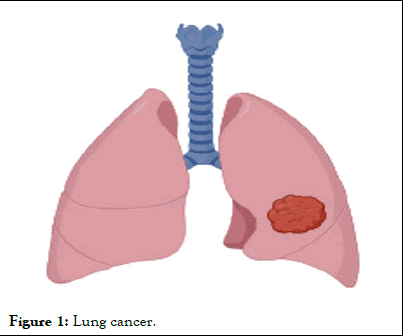
Figure 1: Lung cancer.
Symptoms of lung cancer can be divided into two groups: Paraneoplastic symptoms, which are systemic symptoms due to the direct mass effect or tumor growth or material secreted by the tumor. Primary tumor symptoms include hemoptysis, dyspnea, cough, wheezing, pneumonia obstructive resulting from the primary tumor's endobronchial growth, chest wall discomfort and dyspnea due to restrictive dysfunction due to peripheral tumor growth. The spread of the tumor in the area can cause symptoms depending on the organ involved. Distension of the trachea by swelling can cause dyspnea, distension of the esophagus can cause dysphagia, recurrent laryngeal nerve involvement causes hoarseness and diaphragmatic nerve involvement causes difficulty breathing due to diaphragm spasm. In addition, compression of the sympathetic nerves. the cervical spine causes Hornoz syndrome, distinguished by miosis, ptosis, enophthalmos and anhidrosis. Gastrointestinal syndrome because of the compressing of the 8th cervical and 1st or 2nd thoracic nerve, shoulder pain with ulnar nerve distribution and compression of the superior vena cava leading to vena cava superioris syndrome. Lung cancer can metastasize to any organ in the body, causing symptoms associated with metastatic lesions [1-5].
Some practicable symptoms include trusted source.
•Changes to a person’s voice, such as hoarseness
•Chest pain •Shortness of breath and wheezing
•a lingering cough that may start to get worse
•Swelling in the lymph nodes in the middle of the chest
•Frequent chest infections, such as bronchitis or pneumonia
Epidemiology of global trends in lung cancer
Lung cancer spreading worldwide, reflecting geographic differences in exposure to tobacco smoke and air quality. The prevalence of lung cancer is increasing worldwide. The incidence of male lung cancer is significantly more in developed nations as opposed to less developed countries, mostly due to smoking, but the overall incidence among men in developed countries has decreased due to tobacco control policies. women’s lung cancer is more common in the developed world and is associated with smoking. The incidence of female lung cancer is increasing worldwide. In Europe, for example, women's lung cancer is increasing throughout 21 st century and in 2017, majority of, it exceeded the death rate from breast cancer, with 14.6 lung cancer fatalities for every 100,000, compared to 14. every 100,000 for breast cancer. In some regions, especially in Asia, contamination of indoor air and occupational exposure play a major role in women’s lung cancer. Compared to the United States, there are geographic and ethnic variance in lung cancer incidence and deaths across regions. Developed countries relatively improve their standard of living compared to less developed countries. In countries of particular concern for the future, the recent growth in smoking, where 65% of men start smoking before the age of 20, could create an lung cancer outbreak in coming years [6,7].
Causes of lung disease
Smoking causes most lung cancers in both smokers and individuals impacted by secondhand smoke. However, nonsmokers can also develop lung cancer and people who have not been exposed to secondhand smoke for an extended period of time. In this case, lung cancer may not have a specific cause.
Lung cancer caused by smoking
Doctors believe that smoking causes lung cancer, which damages the lungs. When you inhale secondhand smoke, which is filled by carcinogens that cause lung cancer, changes in lung tissue begin quickly.
First, your body can repair the damage. But with each repetition, the normal cells that line your lungs are gradually damaged. Over time, the damage prompts cell action. strangely and can ultimately result in cancer.
Classification of lung cancer
Lung cancer's cause respiratory epithelial cells and can be classified in two broad categories. The small cell lung cancer can extensively cancerous growth originating from cells that exhibit neuroendocrine characteristics, accounting for 20% of lung cancer. the remaining 85% can be explained by lung cancer that is not small cell. Three subtypes are identified:
•Adenocarcinoma
•Squamous cell carcinoma
•Large cell carcinoma
Adenocarcinoma makes up 38.5% of lung cancers, squamous cell carcinoma for 20% and bigger cell carcinoma for 2.9%. Lately the occurrence of adenocarcinoma has been increased significantly and adenocarcinoma has overtaken squamous cell carcinoma as main type of NSCLC. The 6-year American lung cancer survivor rate from 2001 to 2008 was 16.9%. Patients with regionalized disease at diagnosis have a 60% 6-year survival rate; however, more than 56% of patients with distant metastases at diagnosis have a 6-year survival rate of 4.0%, suggesting the need for better screening methods to detect early-stage cancer (Figure 2).

Figure 2: Subtypes of small cell lung cancer.
Traditional diagnosis of lung cancer
Sputum examination: Another diagnostic procedure for cancer of lungs is a cytological evaluation of sputum, especially a large sample that helps diagnose the type of central tumor from large bronchi (e.g. squamous cell carcinomas and small). Sputum samples typically do not reveal tiny adenocarcinoma arising from the airways, such as small bronchioles, bronchi and alveoli. This becomes even more important because changes in cigarette exposure (filters and reduced nicotine content) increase adenocarcinoma and decrease squamous carcinoma. Sputum cytology's sensitivity in identifying lung cancer early ranges from 20% to 30% in screening studies. Preliminary studies have shown ability to diagnose malignant conditions based on several factors, including cells' kind and quantity (deeper airways). Studies have found that the sputum cytology is not sensitive or accurate enough to participate in the standard examination of all individuals who may have lung cancer.
Bronchoscopy: White light broncoscopy is the most widely used diagnostic tool to obtain a definitive lung cancer diagnosed by histopathology. But still, bronchoscopy has diagnostic limitations for malignant lesions. These lesions are difficult to diagnose visually because they are composed of several layers, 0.2 mm-1 mm thick and several millimeters in diameter.
Apparently, visualizing or finding these small-volume lesions requires a high level of training, because only 30% of cases are diagnosed by an experienced bronchoscopist. Evaluation of fluorescein bronchoscopy addressed this limitation. However, although these techniques can localize early and in situ invasive disease, the diagnosis of dysplasia remains problematic. Furthermore, the development of photodynamic detection systems has been hampered by insensitivity to tissue auto fluorescence and difficulty in intervention. To overcome this, a new photodynamic laser tumor-specific drug fluorescence was utilized in the development of a diagnostic system at a wavelength of 630 nm. This wavelength is clearly distinct from the tissue's normal endogenous fluorescence in the 500 nm-580 nm range (Figure 3).
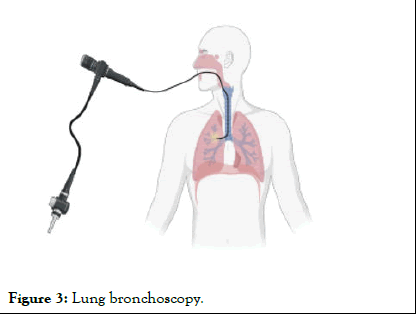
Figure 3: Lung bronchoscopy
Lung tissue biopsies: The benchmark for cancer screening is tissue biopsy. Lung tissue biopsy specimens must contain sufficient tissue material to determine the type of lung cancer by histopathology. An early biopsy is important to confirm the initial diagnosis, avoiding repeat biopsies with increased risk of complications and delays in management. Procedures commonly employed in using or not using a transbronchial needle during fiber optic bronchoscopy is one method used to diagnose lung cancer. Endobronchial ultrasonography, aspiration, transthoracic needle aspiration image, pleural fluid analysis (thoracentesis), mediastinoscopy, thoracoscopy and surgical approaches. This procedure is expensive, prone to complications and may require more samples.
Radiographic examination and diagnosis: A study in Japan showed a 25% reduction in lung cancer mortality for lung cancer patients who underwent annual clinical-based chest X-ray screening. Interestingly, a study in Osaka, Japan, demonstrated that risky smokers using Low-Dose Vertical Computed Tomography (LDCT) had a 20% reduction in relation to lung cancer conventional radiographic screening.
In a lung cancer diagnosis, the chest's sensitivity radiography to detect tumors is about 1 cm, with 109 cells likely to disturb the bronchial and vascular epithelium. When it comes to identifying lung lesions in the periphery, Computed Tomography (CT) is a more reliable method than whole lung conventional tomography. Spiral CT scan can obtain data more frequently due to shorter scan time, lower radiation exposure and improved diagnostic accuracy than plain radiography. Then, this method can image the full breast in a short time (one or two breaths), with better results in missing points with reduced artifacts Nodules as tiny as 1 mm-5 mm can be seen with a contemporary spiral CT technology. Screening regarding lung cancer is routinely performed either any way extra testing, such as sputum cytology, utilizing CT. Two obstacles that tends to resist general implementation are cost and availability. In addition, low-dose radiation exposure increases patients' risk of breast, thyroid or lung cancer, especially if they undergo multiple CT scans. LDCT can detect non-cancerous abnormalities (false-positive) that require patients to undergo more invasive tests such as biopsy and surgery to exclude anomalies and can indicate surgical and postoperative risks and complications.
Spiral CT scan has shown better diagnostic ability to detect small peripheral tumors. Spiral CT, however, is much less sensitive for tumors that are more centrally located (particularly squamous cell carcinoma) than it is for tumors that are peripherally located tumors. Interestingly, roughly 40% of participants displayed a minimum of one positive screen in the program for national lung screening trial's LDCT with a false positive rate of 96%. The high false positive rate may translate into expensive screening as well as invasive operations in lung cancer-free subjects. Together, lung cancer screening using inexpensive tools and non-invasive methods constitute a priority for lung cancer detection.
Cell-free DNA (cfDNA) and Circulating Tumor Cells (CTCs): The first detection of circulating DNA and RNA in the plasma of healthy and sick people began in 1948. This discovery was recognized more than 30 years later when it was discovered in large quantities in cancer cells. Studies from 2000-2010 showed a direct link between cfDNA and cancer, with increased tumor size and cellular debris. cfDNA was also found to be at a steadystate level with a uniform increase due to cellular damage. Therefore, one suggestion is cfDNA. as a marker of cancer cell death. The goal of using CFDNA as a biomarker for screening and diagnosis has proven to recognize early-stage lung cancer.
Finding Plasma ctDNA is dependent upon cfDNA shedding, which is calculated by the difference between DNA secretion by tumor cells and renal clearance. Key variables include mitotic and tumor rates. For example, when metastases involve bone or liver, ctDNA detection is preferred. On average, the amount of cfDNA produced in normal humans is 5 mg/ml-10 mg/ml. In cancer, based on the type and stage of cancer accumulation of cfDNA can be 50 times higher than normal concentration.
Liquid biopsies use in lung cancer: Liquid biopsy is used to identify transcriptomic, genetic and epigenetic biomarkers of lung cancer as an initial screening before CT. Therefore, the initial diagnosis using biomarkers can determine the intermediate point determined by CT, which will lead to the selection of subjects requiring surgical biopsy.
Liquid biopsy has clinical applications in early detection, tracking of primary and metastatic sites, evaluation and monitoring of treatment and resistance to treatment. However, there are challenges in mass implementation as complex analytical methods are required for analysis. However, projects such as the FDA sequence phase II of quality control and the blood profile atlas in cancer consortium have focused on this area.
Application of biomarkers in clinical samples
Blood circulating antigens: A number of antigens produced in the blood have been evaluated as lung cancer biomarkers. CYFRA 21-1, Carcino Embryogenic Antigen (CEA), NeuronSpecific Enolase (NSE) and antigen for squamous cell carcinoma are the most studied biomarkers. The table below gives a summary of reactivity and characteristics reported in clinical trials.
A comparison of microarray changes in tumor and plasma DNA from SCLC patients was performed. The results represent that 93% of patients with microarray changes in tumor DNA also showed changes in plasma DNA.
Sputum: Although sputum cytologic analysis is a useful screening method. method for lung cancer early detection. It may miss peripheral tumors such as small airway adenocarcinomas.
PCR techniques can be applied to determine molecular biomarkers for earlier lung cancer. A study of 15 individuals from the lung project at Johns Hopkins showed this to be even higher. In this study, about 50% of patients with a substantial adenocarcinoma cell carcinoma were diagnosed with mutations in salivary cells before clinical diagnosis (1-13 months) when conventional methods missed them.
Urine: Urine is rarely tested while looking for biomarkers. However, urine exhibits promise for use as a lung cancer biomarker. Various analyses, like volatile organic compounds signatures and using proteomic analyses, proposed as possible biomarkers for lung cancer diagnosis.
Metabolomics: Metabolomics data have the advantage of providing information on metabolite levels that can characterize disease stages. Currently, metabolomics's application in predict cancer progression has been reported with accurate results in various fluids such as saliva, serum, urine and sweat.
Managements of lung cancer
This division will discuss standard and emerging management for early-stage, brain cancer and recurrent, advanced NSCLC metastases. This section summarizes the various drugs mentioned and the purpose of each (Table 1).
| Drug | Target | Type |
| Aflibercept (AVE0005) | VEGF | Humanize VEGFR-trap |
| Apomab | DR5/TRAIL-R2/TNFRSF10B | Monoclonal antibody |
| Axitinib | PDGFR | Tyrosine kinase inhibitor |
| Bevacizumab | VEGF | Monoclonal antibody |
| Carboplatin | DNA | Small molecule inhibitor |
| Cisplatin | DNA | Small molecule inhibitor |
| Docetaxel | Tubulin | Small molecule inhibitor |
| Erlotinib | EGFR | Tyrosine kinase inhibitor |
| Gefitinib | EGFR | Tyrosine kinase inhibitor |
| Linifinib | PDGFR | Tyrosine kinase inhibitor |
| Motesanib | PDGFR | Tyrosine kinase inhibitor |
| Olaparib | PARP-1 | Small molecule inhibitor |
| Paclitaxel | Tubulin | Small molecule inhibitor |
| Pemetrexed | Thymidylate Synthase | Small molecule inhibitor |
| Sunitinib | VEGFR-1/2/3, PDGFR-α/β, c-Kit, Flt-3 and RET | Multiple target tyrosine kinase inhibitor |
| Topotecan | Topoisomerase I | Small molecule inhibitor |
| Vinblastine | Tubulin | Small molecule inhibitor |
| Vinorelbine | Tubulin | Small molecule inhibitor |
Table 1: Drugs and corresponding targets.
Surgery (Treatment of early stages): The primary management for benign and favorable early-stage disease (stages I and II) is surgery, which provides the best option for long-term survival. The 5-year survival rate following surgical resection is 60%-80% for stage I NSCLC and 40%-50% for stage II NSCLC. Primary radiotherapy such as stereotactic body radiotherapy can be used in high-risk patients or in patients who refuse surgical resection or for unrespectable tumors. However, postoperative radiotherapy is not advised for stage I and II. To date, platinumbased chemotherapy has been shown to be beneficial for patients with type II NSCLC and is a recommended management strategy for patients with complete resection. In contrast, no clear advantage has been demonstrated so far for adjuvant chemotherapy in individuals with stage I NSCLC.
More than 60%-70% of NSCLC patients are diagnosed with stage or metastatic disease (stage III and IV). Stage III NSCLC is a diverse illness. Ranging lymph nodes to treatable tumors with microscopic metastases, large disease involving unresectable, multinodular areas. The OS rate over five years differs between 10% and 15% for IIIA-N2 disease and involving 2% and 5% for large IIIA illness involving the mediastinal region. Among this diverse group of stage III NSCLC patients, treatment strategies such as chemotherapy, radiotherapy and resection through surgery are decided by tumor location and resectability.
Radiotherapy: Radiotherapy uses high-energy rays to break the DNA inside cancer cells, thereby destroying them. These treatments can help control or eliminate tumors in specific areas of the body. Patients with NSCLC localized to the breast who don't qualify for surgical excision can benefit from radiotherapy. It can also be part of palliative care to provide a current assessment of the NSCLC patients who do not respond to radiotherapy, surgery or chemotherapy.
A technique called treatment with stereotactic body radiation is used for NSCLC patients with a single lung nodule absent from the early lymph node metastases. This method employs a sophisticated coordinate system to determine the exact location of the tumor and guarantee that the tracking device is positioned precisely. This allows for the delivery of concentrated and highly focused radiation therapy. A meta-analysis comparing carbon, protons and photons in radiotherapy ions for NSCLC suggested that SBRT had a 2-year overall survival rate, lower costs and better patient satisfaction.
Adjuvant: Some patients who have had surgery may benefit from additional treatment to reduce the danger of lung cancer recurrence. Treatment options may include chemotherapy, radiation and targeted therapy. Patients with NSCLC in stages IIA, IIB and IIIA typically obtain chemotherapy after surgery to eradicate any cancer cells that may still be present.
Chemotherapy: About 40-50% of newly diagnosed lung cancer patients are stage IV. The goal of managing these patients is to increase longevity and decrease disease-related adverse events. For stage IV NSCLC, cytotoxic combination chemotherapy is the first-line treatment, depending on histology, age vs. may be influenced by comorbidity and Performance Status (PS). The United States of hematologic sciences states that treatment of a patient with a PS of 0 or 1 is a regimen of platinum (cisplatin or carboplatin) plus gemcitabine, vinorelbine, docetaxel, paclitaxel, irinotecan or pemetrexed. The results of four large randomised clinical trials conducted across multiple sites studying the above agents with platinum or carboplatin have yielded similar results.
For chemotherapy therapy, serious adverse events should prompt a change in agents. Treatment should be discontinued if the cancer progresses or after four treatment cycles, the illness is not changing, but the therapy does not shrink tumors.
Natural products for treatments of cancer (Lung): Natural products are a precious gift from nature to humans. They include animal and plant extracts, marine organisms, insect metabolites and microorganisms, in addition to numerous chemical constituents found locally in humans and animals.
We enlisted the pertinent natural products with an explanation given to lung cancer patients, of their anti-tumor effects individually (Table 2), in combination with anti-cancer drugs (Table 3) and in conjunction with substances from traditional Chinese medicine in lung cancer.
| No | Natural product | Common source | Function or molecular mechanism |
| 1 | Parthenolide | Tanacetum parthenium | Inhibition of growth between A549 and H526 cells with and without nicotine; apoptosis induction; inhibition of the formation of new blood vessels; up- and down-regulation of Bcl-2 expression, E2F1, p53, GADD45 and Bax and Bim |
| 2 | Galbanic acid | Ferula assafoetida | Limitations on the creation, migration and invasion of tubes during VEGF-stimulated reduced expression of VEGFR targeting eNOS, phosphorylation of p38MAPK, JNK and Akt, inhibition of tumor-induced angiogenesis and growth of tumors in mice are all examples of the effects of LLC proliferation in HUVECs |
| 3 | Salvicine | Salvia prionitis | Inhibition of the viability of A549 cells; suppression of the HMEC migration and tube formation; decreased bFGF mRNA expression levels; VEGF mRNA expression remained constant |
| 4 | Tubeimoside-1 | Bolbostemma paniculatum | Inhibition of the viability of H460 and A549 cells; vascular sprouting; tumor development and vascularization, eEND2 cell migration, expression of VEGFR2 and Tie2 and the mTOR/Akt pathway |
| 5 | Ergosterol | Agaricus blazei | Prevention of neovascularization brought about by matrigel and LLC cells; suppression of tumor growth |
| 6 | Pomegranate fruit extract | Inhibition of the activation of NF-κB, IKKα, PI3k and mTOR and phosphorylation of IκBα, MAPKs, Akt and c-met; down-regulation of Ki-67, PCNA, CD31, VEGF and iNOS expression | |
| 7 | Green tea extract | Decreases apoptosis in the expression of MVD, VEGF and CD31 | |
| 8 | Erbanxiao solution | Chinese medicine | Inhibition of tumor angiogenesis by changing the amounts between VEGF, bFGF and TNF-α |
| 9 | Curcumin | Curcuma logna | Attenuation of the GLUT1/MT1-MMP/MMP2 pathway |
| 10 | Rhubarb serum metabolites | Suppression of MMP-2 activity and expression; suppression of the NF-κB/c-Jun pathway; suppression of the expression of u-PA; suppression of lung and in vitro cell motility metastasis in vivo | |
| 11 | Methanolic extract of Euchelus asper | Reduction of MMP-2 and -9, A549 proliferation, subG1 phase of the cell cycle arrest and the branching sites of the 1st order blood vessels or capillaries of the chorio-allantoic membrane |
Table 2: The effects of natural products on alteration of the tumor microenvironment.
| No | Natural product | Common source | Function or molecular mechanism |
| 1 | Brucea javanica oil | Anlotinib | Enhancement of anlotinib's effectiveness in preventing liver metastases from SCLC; decrease in weight loss caused by anlotinib in mice; and augmentation of amlotinib's anti-angiogenic effect (inhibition of tumor microvessel growth) |
| 2 | Mahonia aquifolium extract | Doxorubicin | Increased cytotoxicity, subG1 phase cell cycle arrest, strong DOX retention and reduced migration ability and colony formation potential; decrease in MMP-9 expression |
| 3 | Resveratrol | Dasatinib, 5-fluorouridine | Inhibition of cell migration; ADAM9 degradation via the ubiquitin-proteasome pathway; synergistic anticancer effects to inhibit cell proliferation |
| 4 | Ginsenoside Rh2 | Cisplatin | Enhancement of cisplatin-induced cell death through autophagy suppression; scavenging of cisplatin-induced production of superoxide autophagy; inhibition of cisplatin-induced EGFR-PI3K-AKT pathway activation; inhibition of the PD-L1 expression increased by cisplatin |
| 5 | Water extract of Ginseng | Cisplatin | Increase reduction in the expression of the M2 marker Arg-1, control of TAM polarization and increase when the M1 macrophage marker is expressed iNOS; reductions in tumor growth and cisplatin-induced immunosuppression |
Table 3: The effects of natural products in addition to chemotherapy medications on modulation of the traditional Chinese medicine.
Natural products have always been the main source of drug discovery. According to the latest statistics on drugs given the US pharmaceutical and Food Administration's Approval (USFDA), many drugs used for management are derived from natural products. From 1946 to 2019, greater than 50% of recently authorized medications were natural small molecules.
In the US, as for lung cancer, it's the primary cause of cancerrelated mortality for both men and women. About 85%-90% of lung cancer is resulting from smoking and using tobacco products. other factors for example asbestos, radon gas, exposure, air pollution and chronic infections may contribute to lung carcinogenesis. In addition, several hereditary and obtained systems of lung cancer susceptibility have been proposed. Lung cancer is classified into two different histological classes, which proliferate and extend similarly nonsmall cell lung carcinomas as well as non-small cell lung carcinomas. In the previous ten years, many technical, pharmacological and service Improvements have been achieved in the treatment and care of lung cancer, nevertheless uncertainty remains about how to implement these and their cost-effectiveness.
We extend our thanks to all those who supported and contributed to this work.
The authors declare no conflicts of interest related to the publication of this manuscript.
[Crossref] [Google Scholar] [PubMed]
[Crossref] [Google Scholar] [PubMed]
[Crossref] [Google Scholar] [PubMed]
[Crossref] [Google Scholar] [PubMed]
[Crossref] [Google Scholar] [PubMed]
Citation: Sadgir A, Patil H, Talele S, Borse L (2025) Rapid Diagnostic Methods and Technologies in the Management of Lung Cancer. J Pharm Care Health Syst. 12:379.
Received: 03-Jul-2024, Manuscript No. JPCHS-24-32618; Editor assigned: 08-Jul-2024, Pre QC No. JPCHS-24-32618 (PQ); Reviewed: 22-Jul-2024, QC No. JPCHS-24-32618; Revised: 14-Jan-2025, Manuscript No. JPCHS-24-32618 (R); Published: 21-Jan-2025 , DOI: 10.35248/2376-0419.25.12.379
Copyright: © 2025 Sadgir A, et al. This is an open-access article distributed under the terms of the Creative Commons Attribution License, which permits unrestricted use, distribution and reproduction in any medium, provided the original author and source are credited.