
Journal of Geology & Geophysics
Open Access
ISSN: 2381-8719
ISSN: 2381-8719
Research Article - (2025)Volume 14, Issue 5
Earth as mud bricks, has been used in building construction for thousands of years and approximately 30% of the world’s present population still live in earthen shelters. Mud brick is an inexpensive, environmentally friendly and abundantly available building material. It has been used extensively for building construction around the world, particularly in extreme hot, dry desert climates like that of most Arabian countries. In these countries, mud bricks are made by blending mud and water together into a goopy mixture.
Mud brick; Environment; Climate; World
There are few studies on the behavior of historic structures of mud brick and rammed Earth in Latin America, which has contributed to the deterioration of these buildings, which are part of our architectural and cultural heritage. Colombia has 90% of its heritage buildings made of Earth and most of them are located in high and intermediate seismic risk zones. the use of Earth building technics such as mud bricks, rammed Earth and wattle were bringing from Spanish colonization in Colombia and their use is broad for rural housing construction due to the easy attainment of raw materials [1,2]. The use of the soil is the basis of one of the technologies that best adapt to the environment and contemporary ways of conceiving sustainable construction. On the other hand, the impact of construction on the environment means that mankind is looking for alternatives to make the most of the resources offered by nature, especially given the current levels of pollution. Through the construction with raw this impact is diminished, since the alteration of the ecosystems is avoided.
This is the building material with the least ecological footprint and can be used without sophisticated training, which implies that it can be applied basically for the solution of housing demands [3]. Mud bricks have several advantages over other conventional building materials, like concrete masonry. These advantages include: Minimal manufacturing process; skilled labor is not necessary; mud is available from natural resources in any places all over the world; cheapest construction materials; and mud structures are able to perform satisfactorily under hot environmental conditions [4]. The study area is found in Benishangul Gumuz regional state, the geology of the study area comprises meta granite, Schist Meta basalt and Meta diorite rock unit [5]. Several analysis and tests are takes place to investigate the soil quality.
Description of the study area
Location and accessibility: The study area is found in Benishangul Gumuz regional state, the Western part of Ethiopia, which is some 750 km away from Addis Ababa. Geographically, is bounded between 9°44'59.99'' to 9°74'99'' N and 34°29''59.99'''' to 34°49''99.98'''' E, respectively, with an average elevation of 1668 m m.a.s.l. Bambasi Woreda is bordered by the Mao Komo special Woreda on the Southwest, Abramo and Oura Woreda in the Northwest, Buldiglu in the Northeast and Bengua in the Southeast. As shown in the Figure 1, the study area is accessed through asphalted and graveled road [6].
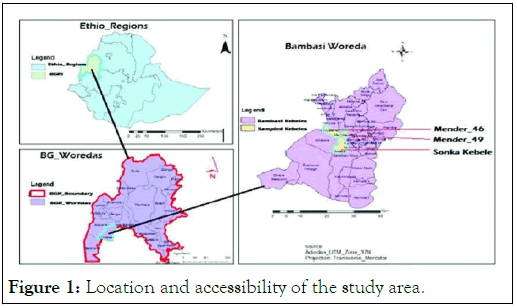
Figure 1: Location and accessibility of the study area.
Objective
The aim of this study was to, improve the proprieties of the mixtures of teff straw and clay. By conducting study related to the mixtures of teff straw, clay for their use as building material. And this study tries to investigate the soil types of the study area.
Materials: The materials used in this study for mud brick production were sand and mud as the main matrix and hay/ straw/fiber as fibrous materials. Materials necessary for mud brick productions are shown in Figure 2.
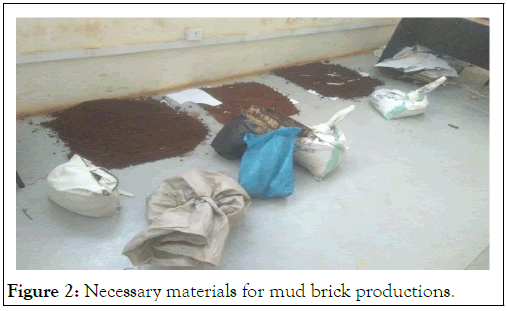
Figure 2: Necessary materials for mud brick productions.
Methods: In this experimental program, physical tests were carried out on natural mud obtained from Bildigilu woreda. The objective of these tests was to analyze and investigate the physical properties of the material used in manufacturing the bricks. A sample of the soil material used for mud brick productions are shown in Figure 3 [7].
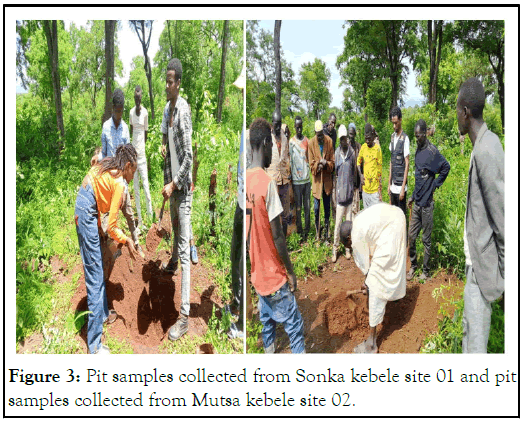
Figure 3: Pit samples collected from Sonka kebele site 01 and pit samples collected from Mutsa kebele site 02.
Procedures of mud brick production
The following is a summary of the main aspects to be taken into account in the manufacture of mud brick, given that in the use of this material as a masonry element is not regulated, that is:
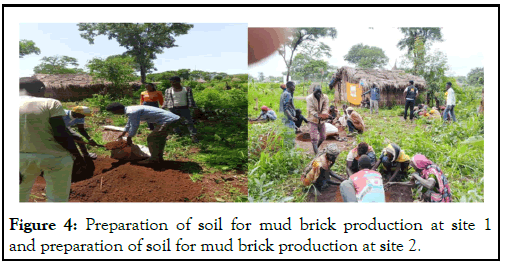
Figure 4: Preparation of soil for mud brick production at site 1 and preparation of soil for mud brick production at site 2.
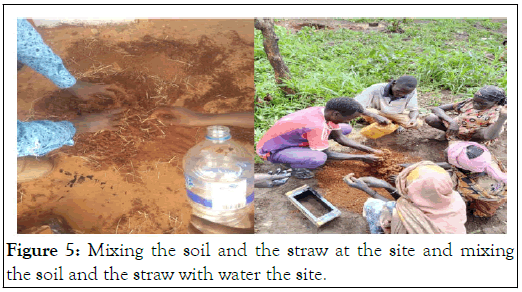
Figure 5: Mixing the soil and the straw at the site and mixing the soil and the straw with water the site.
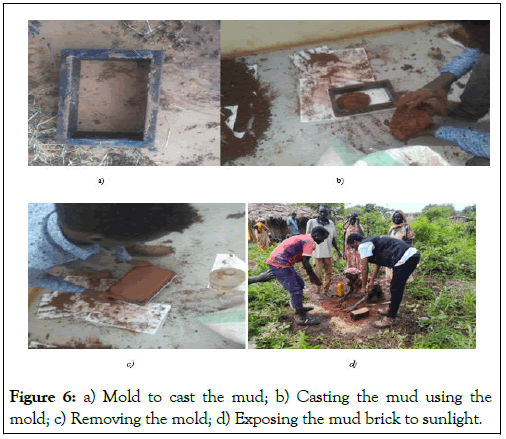
Figure 6: a) Mold to cast the mud; b) Casting the mud using the mold; c) Removing the mold; d) Exposing the mud brick to sunlight.
Sample description
The soil specimens for this project work were collected from study area. Accordingly, three test pits were chosen and GPS reading is recorded to locate the area were the sample is collected. Mostly at the top the other sampling pits also contain disturbed and dry soils but after drilling some depth it has great variations, like moisture content, grain size and composition. All samples were sealed with plastic cover to control moisture loss. A sieve analysis test was performed on the specimen to determine the grading and the ratio of fines. The soil material was washed on a no. 200 sieve. The results of this test showed a relative ratio of sand to fines as follows: % Sand=8.9% Fines=91.1%. Plastic limit and liquid limit tests were carried out on the soil specimen [9,10].
Tests of mud bricks characterization
The following laboratory tests were undertaken:
Moisture content: For coarse and fine grained soil, water content can have a significant effect on the soils properties when used for construction purposes. Moisture content affects the settlement (consolidation) condition and suitability of soil for compaction. Moreover, the swelling, shrinkage condition of a particular soil is related to its moisture content and its changes with time. Consistency of fine grained soil also depends largely on its moisture content. Samples were collected and immediately submitted to determine moisture content of soil.
The result is shown below in Table 1. It is calculated by wt. of water (g) times 100 over wt. of dry soil (g).
Moisture content=mass of wet soil−mass of dry soil,
Sample of pt2=4800.5 g-3846.5 g=954 g, the weight of water in the soil sample is 954 g
Average moisture content=Weight of wet soil/weight of dry soil × 100, so 954/3846.5 × 100=24.
|
Serial no |
Depth (m) |
Location |
Elevation (m) |
Aver. moisture content |
|
|
E |
N |
||||
|
PT1 |
1.5 |
34º59''408'''' |
10º07''49.4'''' |
1569 |
27.3 |
|
PT2 |
1 |
34º59''47'''' |
10º08''26.1'''' |
1520 |
24.8 |
|
PT3 |
1.5 |
345915.5 |
10º07''40.8'''' |
1553 |
26.5 |
Table 1: Average moisture content, % of each soil sample of study area.
Grain size analysis: The particle sizes larger than 0.075 mm (No. 200 sieve) is usually analyzed by means of sieving. It is a screening process in which coarse fractions of soil are separated by means of series of sieves. The soil classification was made based on the USCS and AASHTO. Figure 7 shows the laboratory result of the other soil samples are included [11].
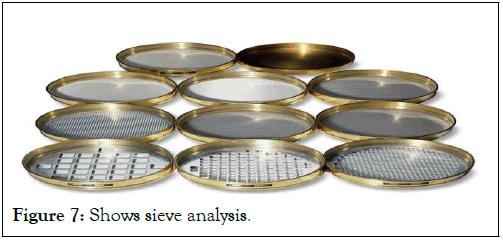
Figure 7: Shows sieve analysis.
The laboratory result of the AASHTO and USCS classification of the entire soil sample is given in the Table 2 and Figure 8 shows relation of Sieve size and percentage of retained soil sample below.
| Pit 1 | ||||
| Sieve size (mm) | Wt retd. | % Wt retd | Cum wt retd. | % passing |
| 37.5 | 0 | 0 | 0 | 100 |
| 25 | 0 | 0 | 0 | 100 |
| 19 | 0 | 0 | 0 | 100 |
| 12.5 | 0 | 0 | 0 | 100 |
| 9.5 | 0 | 0 | 0 | 100 |
| 4.75 | 1 | 0.2 | 0.2 | 99.8 |
| 2 | 3.5 | 0.7 | 0.9 | 99.1 |
| 0.425 | 30 | 6 | 6.9 | 93.1 |
| 0.075 | 128 | 25.6 | 32.5 | 67.5 |
| Pan | 337.5 | 67.5 | 100 | ` |
| Total retain (gm) | 500 | |||
Table 2: The percentage of soil that are retained or passed using sieve analysis.
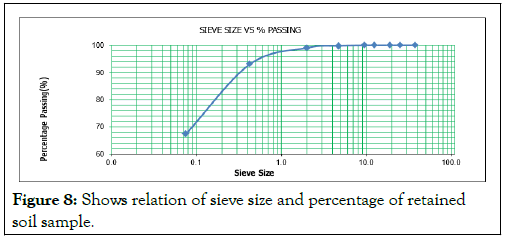
Figure 8: Shows relation of sieve size and percentage of retained soil sample.
For two samples i.e., Figures 8 and 9, the percent pass for 0.075 mm (No 200, standard sieves), was more than 50%. Therefore, it is classified as fine grained soils in the USCS classification systems (Table 3).
| Pit 2 | ||||
| Sieve opening (mm) | Weight of retained soil | % Retained | CC% retained | % Passing |
| 9.5 | 0 | 0 | 0 | 100 |
| 4.75 | 11 | 1.87 | 1.87 | 98.13 |
| 2 | 9 | 1.53 | 3.39 | 96.61 |
| 0.425 | 60 | 10.18 | 13.57 | 86.43 |
| 0.075 | 170 | 28.84 | 42.41 | 57.59 |
| pan | 337.5 | 57.25 | 99.66 | 0.34 |
| 587.5 | ||||
Table 3: Dry sieve analysis (Test method AASHTO T-88).
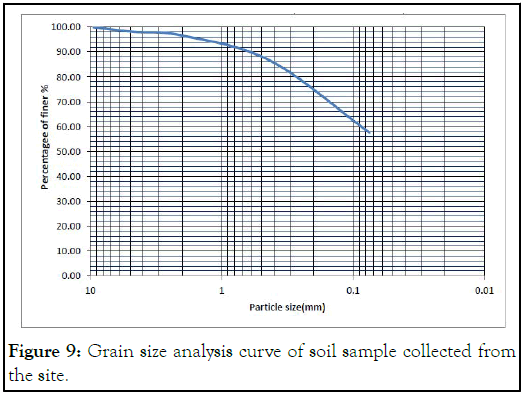
Figure 9: Grain size analysis curve of soil sample collected from the site.
Atterberg limits: Atterberg limits are arbitrary boundaries through which a soil passes from 0.425 mm sieve opening is used to determine the liquid limit and plastic limit. The Atterberg limits are concerned on the moisture content of the soil. The wide variety of soil engineering properties have been correlated to the liquid and plastic limits and these Atterberg limits are also used to classify a fine-grained soil according to the unified soil classification system and AASHTO system.
Liquid limit
A plot of water content against the log of blows is made as shown in Figure 9 below. Within the range of 21 to 34 blows, the plotted points lie almost on a straight line. The curve so obtained is known as a flow curve. The water content corresponding to 25 blows is termed the liquid limit. Except soil sample number 1 all the other soil sampes their liquid limits included in appendix B, but soil sample number 1 is showed as follows in Figure 10.
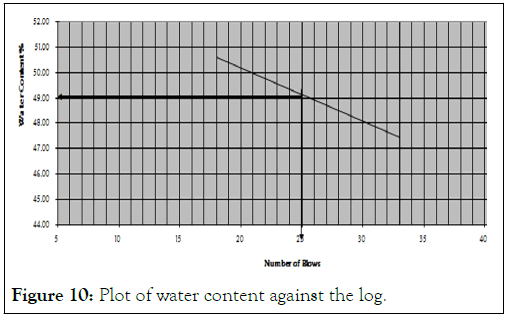
Figure 10: Plot of water content against the log.
Plastic limit
The plastic limit is the moisture content that defines where the soil changes from a semi-solid to a plastic (flexible) state. The equipment used to measure plasticity of the soil are moisture cans, balance, glass plate, wash bottle filled with distilled water, drying oven set at 105°C. Figure 11a-c shows lab investigation of Liquid limit and Plastic limit soil of the samples collected from study area (Tables 4-6) [12].
| Pit 1 | |||
| Test method: AASHTO T89, T90 and M145 | |||
| Liquid limit WL | |||
| Run number | 1 | 2 | 3 |
| Tare number | C | 5 | e2 |
| A. Weight of wet soil+Tare | 38.42 | 40.33 | 39.81 |
| B. Weight of dry soil+Tare | 31.25 | 32.41 | 32.56 |
| C. Weight of water (A–B) | 7.17 | 7.92 | 7.25 |
| D. Weight of tare | 16.23 | 16.11 | 18.41 |
| E. Weight of dry soil (B–D) | 15.02 | 16.3 | 14.15 |
| Water content % (C/E × 100) | 47.74 | 48.59 | 51.24 |
| Number of blows | 33 | 23 | 18 |
| Liquid limit % | 49 | ||
Table 4: Shows determination of liquid limit, plastic limit, plastic index and classification of soil.
| Plastic limit WP | ||
| Run number | 1 | 2 |
| Tare number | C1 | d5 |
| F. Weight of wet soil+Tare | 21.84 | 22.94 |
| G. Weight of dry soil+Tare | 21.01 | 21.91 |
| H. Weight of water (F–G) | 0.83 | 1.03 |
| I. Weight of tare | 18.01 | 17.99 |
| J. Weight of dry soil (G–I) | 3 | 3.92 |
| Water content % ( H/J × 100 ) | 27.6 | 26.3 |
| Plastic limit % (Average ) | 26.9 | |
Table 5: Shows plastic limit
| Pit 2 | |||||
| PI specification limit | |||||
| Liquid limit | Plastic limit | ||||
| No. of blows | 33 | 26 | 22 | ||
| Container number | H4 | Front3 | G2 | C4 | B2 |
| Wt. of container+Wet soil (g)=(W1) | 43.14 | 57.92 | 54.28 | 30.3 | 23.94 |
| Wt. of container+Dry soil (g)=(W2) | 32.74 | 44.25 | 41.67 | 26.61 | 20.51 |
| Wt. of container (g) =(W3) | 11.5 | 18 | 18.23 | 18 | 13 |
| Weight of moisture (g)=(W1–W2)=A | 10.4 | 13.67 | 12.61 | 3.69 | 3.43 |
| Weight of dry soil (g)=(W2–W3)=B | 21.24 | 26.25 | 23.44 | 8.61 | 7.51 |
| Moisture content (%)=(A/B ) × 100 | 48.96 | 52.08 | 53.8 | 42.86 | 45.67 |
| 52.52 | 44.26 | ||||
Table 6: Atterberg limits analyzed and results for soil of pit of the study area.
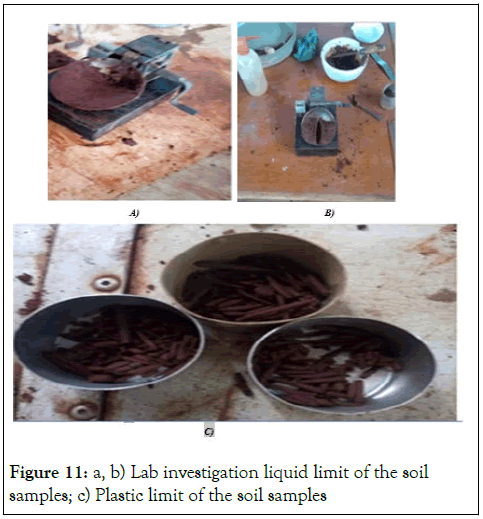
Figure 11: a, b) Lab investigation liquid limit of the soil samples; c) Plastic limit of the soil samples
Atterberg limit analysis shown Table 7 and Figure12 shows percentage of soil passed vs. number of blows liquid limit vs. plasticity index has been plotted and for two samples fall below A-line. Therefore, it is classified as silty and clay mixture. These kinds of soils have high water permeability capacity. Therefore, the water which percolates through the weathered profile, when it reaches to the low permeable media, the seepage forces develops and ultimately leads to potential instability of the slope. From plasticity index of the soils of study area the all are grouped under low plastic, except the Pt3, because it is grouped higher plasticity.
| No. | Moisture content % | Atterberg limit | Description of plasticity properties | Classification of soil according to USCS | ||
| S | PL | PI | ||||
| Pt1 | 28.55 | 49 | 26.9 | 22.1 | In organic clay of low plasticity | Clay soil of low plasticity |
| Pt2 | 22.5 | 52 | 32 | 20 | In organic cay low plasticity | Clay soil of low plasticity |
Table 7: Shows Atterberg limit analysis, liquid limit vs. plasticity index.
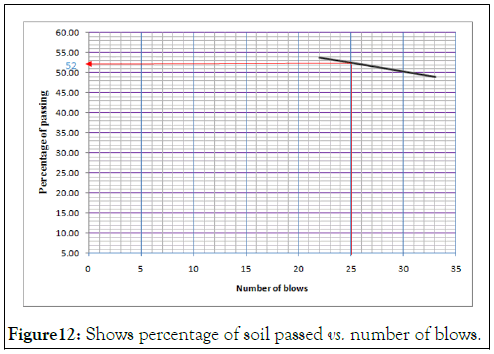
Figure12: Shows percentage of soil passed vs. number of blows.
From plasticity index of the soils of study area the all are grouped under low plastic, except the Pt3, because it is grouped higher plasticity. Figure 13 shows the general plastic limit and liquid limit of all samples that were collected at the site.
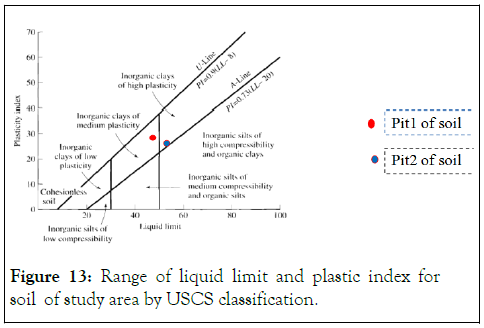
Figure 13: Range of liquid limit and plastic index for soil of study area by USCS classification.
Therefore, it can be concluded from the above analysis that the soils of the study area have some clay content. However, it is in small amount thus soils in general possess low cohesion, same has been deduced from the laboratory results also. According to their grain size, soil particles are can be classified as shown the Figure 14 below.
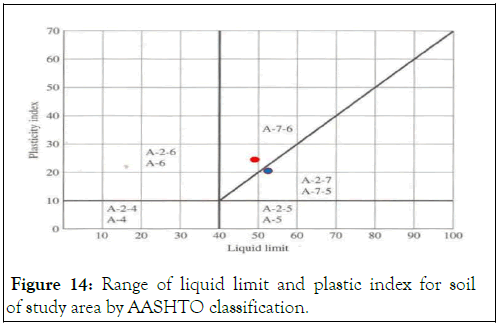
Figure 14: Range of liquid limit and plastic index for soil of study area by AASHTO classification.
Soil particles classification according to AASHTO soil classification
Based on Murthy, AASHTO soil classification the laboratory result of the soil samples can be classified as silty clay soils. Therefore, the general rating of the sub grade is excellent too good for construction of bricks as shown in Table 8.
| No. | Moisture content % | Atterberg limit | Description of plasticity properties | Classification of soil according to USCS | AASHTO soil classification | ||
| LL | PL | PI | |||||
| Pt1 | 28.55 | 49 | 26.9 | 22.1 | In organic clay of low plasticity | Clay soil of low plasticity | A-2-7 |
| Pt2 | 22.5 | 52 | 32 | 20 | In organic cay low plasticity | Clay soil of low plasticity | A-2-7 |
Table 8: Shows AASHTO soil classification.
During the sample preparation process, variations in the consistency of the material were observed at the time of mixing as the straw content increased. According to the granulomere results, the soil used for the manufacture of the mud brick is a material containing 5%-10% sands and 90%-95% fines. This characterization of the soil and taking into account other studies made and referenced, is within the limits suitable for the soil can be used for the manufacture of mud bricks. Increasing the sand content in the mud brick shows a reduction in its resistance to both bending and compression, because the density of the material and the adhesion between the particles decreases. At the mean values of compressive and flexural strength, the respective standard deviation was calculated with a 90% confidence level because the results showed great dispersion since there are factors such as the irregularity of the faces which may generate errors in the tests.
Citation: Wolde MT, Tadesse A, Hagos A, Defaru A (2025) Innovative Shelter Assistance Service and Mud Brick Productions for Bambasi Woreda, Assosa Zone Benishangul Gumuz, Western Ethiopia. J Geol Geophys. 14:1248.
Received: 22-Oct-2024, Manuscript No. JGG-24-34767; Editor assigned: 25-Oct-2024, Pre QC No. JGG-24-34767 (PQ); Reviewed: 08-Nov-2024, QC No. JGG-24-34767; Revised: 01-Oct-2025, Manuscript No. JGG-24-34767 (R); Published: 08-Oct-2025 , DOI: 10.35841/2381-8719.25.14.1248
Copyright: © 2025 Wolde MT, et al. This is an open-access article distributed under the terms of the Creative Commons Attribution License, which permits unrestricted use, distribution and reproduction in any medium, provided the original author and source are credited.