
Journal of Cell Science & Therapy
Open Access
ISSN: 2157-7013
ISSN: 2157-7013
Research Article - (2025)Volume 16, Issue 2
Antibody-based therapeutics constitute a significant class of biological drugs, approved for treating a broad spectrum of diseases from cancer to autoimmune disorders. These antibodies achieve their pharmacological effects through diverse mechanisms, including direct neutralization of target antigens, Antibody-Dependent Cell-Mediated Cytotoxicity (ADCC), Complement-Dependent Cytotoxicity (CDC), and immune activation. Consequently, the development of monoclonal Antibodies (mAbs) as biopharmaceuticals demands a comprehensive characterization of their mechanisms of action. Both the biological activities and pharmacokinetics of mAbs are highly dependent on their binding to the target antigen, making precise control of this binding crucial for thorough characterization. Surface Plasmon Resonance (SPR) technology is a valuable tool for assessing the in vitro biological activity of mAbs during their development. It enables precise measurement of mAb binding to receptors and antigens, and allows for the determination of the active concentration required for binding. This technology is widely employed to investigate mAb competition, encompassing both epitope binding and neutralization capacity. However, conventional SPR assays, which rely on recombinant targets, often fall short in fully reflecting the intricate in vivo interactions of mAbs with cell-surface antigens. To address this limitation, the present study introduces a novel analytical approach: Utilizing live cells in SPR binding assays to achieve a more physiologically relevant assessment of mAb potency. This proposed method facilitates the characterization of two distinct competitive mechanisms: Neutralization activity, assessed by inhibiting ligand-receptor binding on live cells immobilized on the sensor chip, and epitope competition between two mAbs targeting the same cell-surface antigen. This advancement in SPR technology promises to significantly improve the accuracy and relevance of mAb characterization, even at the early stages of therapeutic development.
Surface Plasmon Resonance (SPR); Cell-based competition assays; Potency assays; Monoclonal antibodies
Antibody development is a critical process in biotechnology and medicine, focusing on the creation of highly specific antibodies, often monoclonal, designed to target and interact with particular antigens [1-5]. These biologics exhibit a wide array of biological activities, including the neutralization of pathogens, activation of the immune system and modulation of cellular processes. Comprehensive characterization of antibodies is essential for ensuring safety, efficacy and manufacturing consistency, particularly given their inherent complexity and variability [6-8]. Detailed characterization aids in understanding the biologic's structure as well as the function and potential for eliciting immune responses, ultimately influencing drug development, regulatory compliance and patient outcomes [9,10].
Specifically, understanding the mechanism by which an antibody targets a specific antigen is crucial for predicting its efficacy. In vitro potency bioassays are analytical procedures applied to determine the functional activity of a biological product, such as therapeutic mAb, during the development, registration and quality control of biological products [11-13]. Therefore, they should be as representative as possible of the predicted MoA to serve as final confirmation of mAbs capability to perform the expected function. Various types of potency assays, tailored to each mAb class, can be developed to support their characterization [14] including cell-based functional assays, binding assays and competitive binding assays.
Cell-based functional assays represent the most accurate reflection of the MoA for those mAbs which exploit Fc-mediated functions like ADCC (Antibody Dependent Cytotoxicity), CDC (Complement Dependent Cytotoxicity) or ADCP (Antibody Dependent Cellular Phagocytosis). These assays provide an in vitro replication of what happens in vivo, while also accounting for the biological variations related to the use of cells. Traditional cell-based assays measured the biological activity of the analyte by monitoring the phenotypic changes in cells, such as cell proliferation, apoptosis, differentiation and migration [15-17]. More recently, cell-based reporter assays have been introduced, which are easier to handle and indirectly are able to determine the product potency by monitoring the activation of interaction sites (receptor or ligand), signaling pathway mediators and effector molecules [18].
Binding assays are used to determine whether the mAb is able to correctly binds its target. These assays are typically performed using recombinant targets (antigens or receptors) to quantify the amount of mAb having specific activity (ELISA assay) or to characterize the targets binding kinetic (SPR) [19,20]. While informative, these assays only partially evaluate the biological activity, limited to the target/receptor recognition and do not provide information about the complete therapeutic function [12]. Furthermore, isolating the biomolecules from their biological environment, could significant affect the protein-protein interaction. This is particularly relevant, as example, for cell membrane proteins which may exhibit different conformations when analyzed as full-length recombinant molecules or as extracellular domain [21,22].
Competitive binding assays support the mAbs characterization under two primary perspectives: evaluating the mAb ability to block or inhibit ligand-receptor binding (MoA of neutralizing mAbs) and determining potential competition among mAbs for the binding epitope on the target. Recombinant targets are commonly used to assess competition in ELISA-based and/or SPR-based kinetic assays [23-27], which often underestimate the significant impact of biological environment on the biomolecular interactions [11]. To address this limitation, cell-based competition assays utilizing advanced techniques like FACS (Flow Cytometry) or ECL (Electrochemiluminescence) have been introduced. However, these techniques involve laborious and time-consuming procedures and they necessitate differential staining of the interacting molecules, which may interfere with the protein-protein bindings [28,29].
An emerging and significant improvement to overcome the limitations of these existing methods is the combination of cell-based assays and SPR kinetic binding assays. This approach provides a comprehensive overview of biomolecular interactions within their biological environment, along with real-time measurement of biomolecules interactions. Furthermore, SPR is a label-free technique and unlike other approaches that require coupling an additional reporting label, such as radioactive compounds or fluorescent tags to one or both proteins, SPR allows for direct and unperturbed analysis avoiding the potential interference with protein-protein binding [30].
To date, only a limited number of preliminary studies have reported cell-based SPR approaches, mainly due to the complexity of using whole, live cells within the SPR system [30]. Cell-based SPR assays present several challenges, including baseline drift, non-specific binding and difficulties in interpreting complex cell responses. Optimizing the cell concentration, buffer conditions and surface regeneration protocols is essential for obtaining reliable results. The most challenging aspect of these methods is finding the optimal balance between promoting the interaction with target-expressing cells, in alignment with drug pharmacokinetic and maintaining whole cells in the optimal conditions [31].
With the present study we demonstrated not only the feasibility to use whole live cells in SPR system for the fully characterization of mAbs MoA, but we also propose two alternative workflows potentially applicable to any kind of therapeutic molecule and target cell.
SPR cell-based competition assay to verify mAb capability to block/inhibit a ligand-receptor binding
A receptor-expressing cell line, the specific ligand and an anti-ligand mAb commercially available were used in the present study for SPR verification of mAb capability to block/inhibit the ligand-receptor binding directly on live cells.
In particular, the receptor-expressing cell line was purchased by BPS Bioscience and it was a recombinant clonal stable Chinese Hamster Ovary (CHO) cell line constitutively expressing the full-length human receptor of interest. The specific ligand, with verified binding affinity for the receptor of interest, was a recombinant human glycoprotein purchased by 2BScientific. The mAb specifically targeting the ligand glycoprotein was a recombinant human IgG1 purchased by Invitrogen.
Preparation of cell bank: CHO Cells were cultivated in adhesion at +37°C, 5% CO2, 80% humidity using flasks (T25 Corning #430639; T75 Corning #30720U and T175 Corning #431080) in complete medium: Gibco™ Ham's F-12K medium, Thermofisher #21127022)+10% Fetal Bovine Serum (FBS, Thermofisher #16250-078).
Passages were performed when cells reached 80-90% of confluency. At passage 5 cells were frozen at 3 × 10⁶ cells/vial in freezing medium (45% fresh medium, 45% spent medium and 10% DMSO (Sigma, #D2438-10mL).
Cells thawing (or detaching from the flask, with TrypLE™ Select Enzyme IX (Thermofisher #12563029) for 3 minutes at 37°C, 5% CO2, 80% humidity). Centrifugation at 1100 rpm for 10 minutes. Pellet suspension in 1 mL of complete culture medium (Gibco™ Ham's F-12K medium, Thermofisher #21127022)+10% Fetal Bovine Serum (FBS, Thermofisher #16250-078) and count by Vi-cell™ (Beckman coulter #B00020935). Transfer of 3 × 10⁶ cells in a new vial. Centrifugation of 3 × 10⁶ cells at 1100 rpm 10 minutes. Pellet suspension in 200 µL of Immobilization solution (1:1 DPBS: NaOAc pH 2.5) pH measurement.
If the pH results still higher than 5.0 ± 0.1 (it could depend from cell passages and or age of medium) an additional centrifugation and pellet suspension in Immobilization solution can be performed without affecting cells viability and assay performance.
The Amine coupling kit (Cytiva # BR-1000-50) was used to immobilize acidified cells on the active Flow cell and Bovine Serum Albumin (BSA, Thermofisher #23209) on the reference Flow cell of the SPR CM5 Sensor chip (Cytiva #BR-1005-30) adapting the Cytiva amine coupling protocol as reported in the following Table 1.
| Assay step | Conditions |
| Activation | EDC/NHS supplied with the Amine coupling kit, 10 µL/min, 420 s |
| Immobilization | Active flow cell: 3 × 10⁶ host cells, 2 µL/min, 4000 s |
| Reference flow cell: BSA 1 mg/mL, 10 µL/min, 420 s | |
| Deactivation | Ethanolamine supplied with the Amine coupling kit, 10 µL/min, 420 s |
| Running buffer | 20 mM DPBS, 0.15M NaCl pH 7.4 |
Table 1: Amine coupling protocol for cells immobilization.
SPR MCK competition assays: In SPR binding assays interaction kinetics are determined from the change in response as a function of time. Sensorgrams are recorded for a series of analyte concentrations and evaluated together as one data set and a mathematical model of the interaction is fitted to the experimental data to calculate the kinetic constants of biomolecular interaction. In Multy-Cycle Kinetic (MCK) experiments, the analyte concentrations are injected in separated cycle with surface regeneration between cycles. In SPR competition assays, the MCK aapproach is commonly followed by immobilizing one of the potentially competing analytes on the sensor chip surface and injecting in each cycle mixes of target and second competing analyte at increasing concentrations. A reduction of target binding to the chip-captured analyte confirms the competition.
In the present study, the MCK competition assay principle has been adapted by immobilizing cells on the CM5 sensor chip surface as previously described.
A Biacore™ T200 instrument (Cytiva, catalog #28975001) was used to perform all the reported assays. The running buffer, as well as the association and dissociation conditions for each experiment, are detailed in the relevant tables in the results section.
SPR MCK assay on protein A sensorsensor chip (confirmation of not competition): Biacore™ T200 instrument (Cytiva #28975001) was used. Running buffer was HBS-P+ 10X (Cytiva #BR100671) diluted 1:10 in H20. The sensor sensor chip was Series S Protein A sensorsensor chip (Cytiva #29127556). Association and dissociation conditions, as well as analytes concentrations, are detailed in Table 4 in the results paragraph.
SPR cell-based competition assay to verify mAbs competition on target cells
A recombinant human IgG1 internally produced by Menarini Biotech s.r.l was used and here identified as mAb1.
A recombinant mouse IgG1, targeting the same antigen of mAb1, was used as competing mAb (mAb2) and purchased by Invitrogen. A549 cell-line, expressing the specific target, was purchased by ATCC (#CCL-185).
Preparation of cell bank: A549 Cells were cultivated in adhesion at 37°C, 5% CO2, 80% humidity using flasks (T25 Corning #430639; T75 Corning #30720U and T175 Corning #431080) in complete medium Gibco™ DMEM, high glucose, pyruvate (Thermofisher # 41966029)+10% Fetal Bovine Serum (FBS, Thermofisher #16250-078).
Passages were performed according to cells confluency. At passage 5 cells were frozen at 3 × 10⁶ cells/vial in freezing medium (45% fresh medium, 45% spent medium and 10% DMSO (Sigma, D2438-10 mL)).
SPR MCK assay using recombinant antigen on protein A chip: Biacore™ T200 instrument (Cytiva #28975001) was used. Running buffer was HBS-P+10X (Cytiva #BR100671) diluted 1:10 in H20. The target antigen was a recombinant human protein supplied by R and D systems. The sensor sensor chip was Series S Protein A sensor chip (Cytiva #29127556), consisting in a ready-to-use sensor surface of a carboxymethylated dextran matrix with a recombinant Protein A variant (MabSelect SuRe) covalently attached. Binding predominantly to the heavy chain within the Fc region of mAbs (most notably human IgG1, IgG2 and IgG4), protein A ensures antibodies are bound to the surface in a specific orientation favorable to study mAb-target interactions. Association and dissociation conditions, as well as analytes concentrations applied are reported in Table 5 in the Results paragraph.
SPR MCK competition assays: A Biacore™ T200 instrument (Cytiva, catalog #28975001) was used to perform the SPR assays. The MCK approach, described above, has been applied. In this case, mixes consisting of target cells and one of the competing mAbs at fixed cocnentrations were injected in each cycle increasing the concentration of the second competing mAb.
An AffiniPure™ Goat Anti-Human IgG, F(ab')2 fragment specific (Jakson Immunoresearch, catalog #109-005-006) was immobilized on Serie S CM5 sensor chip (Cytiva, catalog #BR-1005-30) using the Amine coupling kit (Cytiva, catalog #BR-1000-50) according to the supplier protocol.
Pierce™ Bovine Serum Albumin (BSA) immobilized on the reference flow cell was purchased by Thermofisher (catalog, #23209).
The running buffer, as well as the association and dissociation conditions for each experiment are detailed in the relevant tables in the results section.
SPR cell-based competition assay to verify mAb anti-ligand receptor blocking
One of the main mAbs MoA consists in the inhibition or complete blocking of specific ligand-receptor bindings. This mechanism is the one applied by anti-viral mAbs to neutralize viral infection of the host cells in which the ligand is a viral component and the mAb avoids the viral binding to a specific target receptor expressed by host cells, thus preventing cells infection [32].
An innovative approach, using receptor-expressing live cells in SPR Biacore™ system, is here proposed to verify the neutralization capacity of mAbs.
The assay principle is summarized in Figure 1, involving the immobilization of live host cells on the SPR CM5 sensor chip, followed by injection of different mixes containing a fixed amount of ligand and increasing amount of the anti-ligand mAb. A reduction of the ligand binding to the immobilized host cells induced by higher mAb concentrations confirms the mAb neutralization capacity. As shown in figure 1B this assay set-up reflects the anti-viral mAbs neutralizing MoA.
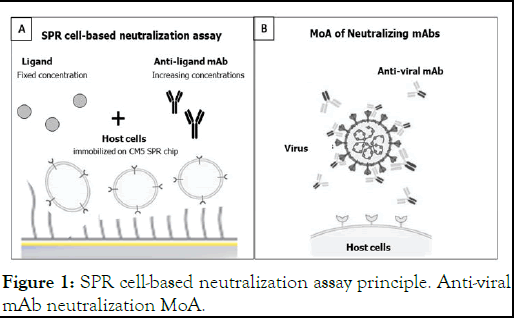
Figure 1: SPR cell-based neutralization assay principle. Anti-viral mAb neutralization MoA.
The workflow of assay development and a troubleshooting of commonest issues related to the use of live cells in SPR procedure is here presented as general guideline applicable, with minor changes related to molecule/cell line specific characteristics, to any anti-ligand mAb for evaluation of neutralizing capacity.
Cell line immobilization on the active flow cell of CM5 sensor chip: The receptor accessibility for the ligand binding is a crucial point to ensure the actual determination of mAb neutralizing capacity. The immobilization procedure on SPR sensor chip is randomly oriented and mediated by the formation of covalent amine bounds between cells and the sensor chip dextran matrix. In order to increase the binding detectability favoring the level of receptor exposure on the sensor chip, whenever possible, the use of an engineered cell line overexpressing the receptor of interest is recommended.
The first step needed to immobilize live cells on the CM5 sensor chip is the acidification of cell culture. Indeed, a pH at 5.0 is required for the Imine compounds formation and consequent binding of the cells to the carboxymethylated dextran matrix of the CM5 sensor chip gold surface.
The best acidification conditions to reach a cell culture pH of 5.0 ± 0.1 have to be experimentally identified, since cell passages and/or age of medium can impact. In the present case study, different acidification conditions were screened by pelleting a high number of cells (3 × 10⁶) and resuspending the pellet in Sodium Acetate (NaOAc), which is the recommended resuspension buffer for Amine coupling protocol according to the kit supplier, diluted 1:1 in DPBS to avoid excessive shock for the cells. Different pH of this immobilization solution was tested (Table 1) and finally pH 2.5, resulting in cell suspension pH of 4.9, was selected.
| Cells | DPBS : 10 mM NaOAc (1:1) | Resulting pH |
| 3 × 10⁶ ACE2-CHO | pH 4.0 | 6.5 |
| 3 × 10⁶ ACE2-CHO | pH 3.5 | 5.9 |
| 3 × 10⁶ ACE2-CHO | pH 3.0 | 5.4 |
| 3 × 10⁶ ACE2-CHO | pH 2.5 | 4.9 |
Table 2: Acidification trial.
The amine coupling immobilization protocol has been adapted to immobilize acidified host cells on one flow cell of a CM5 chip. To promote cells interaction with the sensor chip activated surface, cells were injected at a very slow flow rate, as described in the method paragraph. A very high cell immobilization level, ≈17000 RUs, was obtained in these conditions.
An important aspect to considerate when live cells are immobilized on the SPR sensor chip, is to ensure the viability and functional activity in terms of receptor capability to bind its natural ligand.
In our study the cells stability in the acidic environment was monitored immediately after resuspension in the immobilization buffer (time 0), after 2 hours (timing of immobilization protocol) and after 4 hours (timing of Multi Cycle Kinetic (MCK) experimental session), by measuring viability of acidified cell suspensions at Vi Cell™. A non-significant viability reduction between time 0 and 4 hours was observed (Table 3), ensuring that ligand-cells interaction capability were not impaired during the course of the experimental session.
| Time point | Cells viability |
| Time 0 | 96,0% |
| 2 hours | 90,0% |
| 4 hours | 89,5% |
Table 3: Viability test: Host cells viability was measured after resuspension in a modified immobilization buffer (pH 2.5) at different time points, corresponding to the different experimental steps. The cells viability resulted in around 90% up to 4 hours in immobilization buffer confirming the feasibility to use the acidification conditions without affecting cells.
Preparation of reference flow cell of CM5 sensor chip: In SPR assays, one of the four flow cells of the sensor chip is used as reference, without ligand immobilization, to substract the background signal. The surface of the reference flow cell is commonly activated following the Amine coupling protocol for Blank, anyway to additionally prevent potential unspecific binding of mAb-ligand mixes to the cells-free surface of the CM5 sensor chip, Bovine Serum Albumin (BSA) was immobilized on the reference Flowcell (Fc1) to saturate the surface, through the amine coupling protocol according to supplier instructions.
Competitive assay: Once prepared the chip, the neutralizing activity of anti-ligand mAb can be evaluated by following a MCK approach. Different mixes made by the ligand at fixed concentration and increasing concentrations of the anti-ligand mAb are injected on the active flow cell, where cells were immobilized.
The best experimental conditions in terms of ligand-mAb ratios, association timing and flow rate allowing to obtain detectable binding signals and to discriminate the potential neutralization effect have to be experimentally determined. As example, the final selected experimental protocol identified in our case study is reported in Table 4.
| Assay step | Conditions |
| Ligand capture | Host cells: 3 × 10⁶ cells |
| Analyte: 30 µL/min Association: 120 s Dissociation: 120 s |
Mix 1: Ligand 1.7 µM+mAb 6. 0 µM |
| Mix 2: Ligand 1.7 µM+mAb 3.0 µM | |
| Mix 3: Ligand 1,7 µM+mAb 1.5 µM | |
| Mix 4: Ligand 1.7 µM+mAb 0.75 µM | |
| Mix 5: Ligand 1.7 µM+mAb 0.38 µM | |
| Controls | mAb control (6.0 µM) |
| Ligand control (1.7 µM) | |
| Blank (running buffer) | |
| Running buffer | 20 mM Tris, 0.15 M NaCl pH 7.4 |
Table 4: SPR MCK conditions selected to evaluate neutralization effect.
Interpretation of competition assay results: As showed in Figure 2 for the present case study, the selected experimental conditions should allow to get detectable SPR sensorgrams for different mAb-ligand mixes and expected behavior for the controls. In particular, no binding to the immobilized host cells should be observed for the anti-ligand mAb control, while a significant binding level is expected for the ligand control. These results confirm that immobilized cells maintained their biological functions and that the applied SPR conditions allowed to detect a ligand-receptor binding directly on live cells.
Furthermore, the present SPR cell-based competition assay allows to verify the mAb neutralizing activity.
In particular, in this case study the lack of mAb neutralization activity was observed, since all the mAb-ligand mixes showed a comparable or even higher binding signal to the host cells compared to the ligand control. Meaning that, in presence of the anti-ligand mAb, even when it was in significant excess, the ligand is still able to bind its target receptor on cells. The mAb recognition of a ligand epitope not involved in the receptor interaction could explain the observed results.
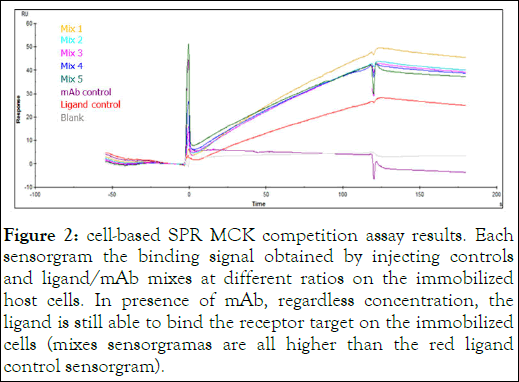
Figure 2: cell-based SPR MCK competition assay results. Each sensorgram represents the binding signal obtained by injecting controls and ligand / mAb mixes at different ratios on the immobilized host cells. In presence of mAb, regardless of its concentration, the ligand is still able to bind the receptor target on the immobilized cells (mixes sensorgramas are all higher than the red ligand control sensorgram).
This Figure 2 is representative of three independent experiments performed varying dissociation times and mAb concentrations, obtaining comparable results.
Confirmation of competition assay results: The versatility of the proposed cell-based SPR competition method allows to confirm neutralization assay results in multiple assay formats.
An alternative assay set-up has been applied to confirm the observed lack of neutralization of our case study: A proteinA SPR sensor chip was used to obtain an oriented immobilization of the anti-ligand mAb (recombinant human IgG1), then mixes of ligand at fixed concentration and increasing amount of host cells were injected (Table 5).
| Assay step | Conditions |
| Ligand capture on protein A chip | Anti-ligand mAb at 0.4 µg/mL, 120 s, 10 µL/min |
| Analyte: 30 µL/min Association: 120 s Dissociation: 120 s |
Mix 1: Ligand 10 nM+1 105 host cells |
| Mix 2: Ligand 10 nM+0.5 105 host cells | |
| Mix 3: Ligand 10 nM+0.3 105 host cells | |
| Mix 4: Ligand 10 nM+0.1 105 host cells | |
| Mix 5: Ligand 10 nM+0.06 105 host cells | |
| Controls | Host cells control (1 105 cells) |
| Ligand control (10 nM) | |
| Blank (Running buffer) | |
| Running buffer | 20 mM Tris, 0.15 M NaCl pH 7.4 |
Table 5: MCK conditions applied on proteinA sensor chip to confirm not neutralizing activity of anti-ligand mAb.
Results reported in Figure 3 showed a “sandwich” profile which typically characterizes not competing interactions [11]. Indeed, the ligand in the mixes binds the immobilized mAb and, simultaneously, cells bind to the ligand on a different binding site, with a resulting sum of signals, proportional to the number of cells in the mix.
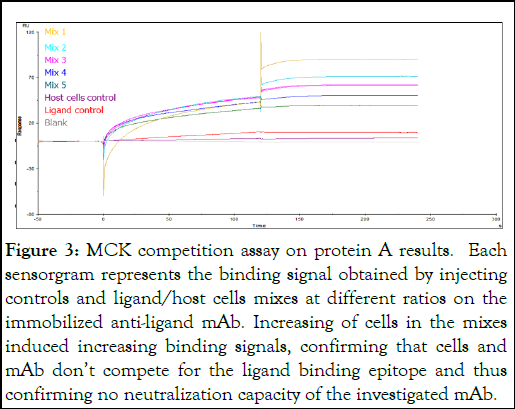
Figure 3: MCK competition assay on protein A results. Each sensorgram represents the binding signal obtained by injecting controls and ligand/host cells mixes at different ratios on the immobilized anti-ligand mAb. Increasing number of cells in the mixes induced increasing binding signals, confirming that cells and mAb don’t compete for the ligand binding epitope and thus confirming no neutralization capacity of the investigated mAb.
With this case study we demonstrated the feasibility to use live cells in SPR competition assays for characterization of mAbs MoA such as neutralization activity. In particular, the lack of neutralization capacity of the investigated anti-ligand mAb due to its binding to a ligand epitope not involved in the receptor binding, was demonstrated following two different SPR cell-based approaches, confirming the versatility of the proposed cell-based SPR assays. Furthermore, thanks to the versatility of these method, a workflow for cell-based SPR competition assay development has been identified, supplying a general and powerful guideline applicable for potency characterization of different molecules sharing a neutralizing-like MoA.
SPR cell-based competition assay to verify mAbs competition on target cells
Competition assays using Surface Plasmon Resonance (SPR) on Biacore™ instruments are a standard method for investigating whether monoclonal antibodies (mAbs) compete for the same epitope binding site on a common target antigen. In a typical setup, one mAb is immobilized on the sensor chip and mixes of the target antigen with a potentially competing mAb are injected at varying ratios. A reduction or complete blockage of the antigen binding signal to the immobilized mAb, in response to increasing concentrations of the second mAb in the mixes, confirms competitive binding. In this study, we adapted this established principle by replacing the recombinant target antigen with live target cells, aiming to supply a workflow for investigation of potential mAb competition in a more biologically relevant context. A case study is here presented using two model mAbs, a human IgG1 (mAb1) and a mouse IgG1 (mAb2) and their target-expressing A549 cell line.
Initial confirmation of mAb competition with recombinant antigen: As a preliminary step, competition between the two model mAbs has been confirmed through a “traditional” SPR MCK competition assay using recombinant human target antigen. As reported in Table 6, mAb1 was immobilized on a Protein A chip capturing the Fc region and varying concentrations of mAb2 were pre-mixed with a fixed concentration of the recombinant antigen. These mixes were then flowed over the immobilized mAb1.
| Assay step | Conditions |
| Ag capture on protein A chip | mAb1 |
| Analyte: 30 µL/min | Mix 1: Ag 10 nM+mAb2 0.5 nM |
| Association: 120 s Dissociation: 3600 s |
Mix 2: Ag 10 nM+mAb2 1.0 nM |
| Mix 3: Ag 10 nM+mAb2 2.0 nM | |
| Mix 4: Ag 10 nM+mAb2 3.3 nM | |
| Mix 5: Ag 10 nM+mAb2 6.6 nM | |
| Mix 6: Ag 10 nM+mAb2 13.2 nM | |
| Controls | Ag control (10 nM) |
| Running buffer | HBS-P+1X |
Table 6: MCK conditions applied on proteinA sensor chip to confirm that the mAbs compete for their binding epitope on recombinant target Ag.
As shown in Figure 4, sensorgrams representing the binding signal of controls and Ag/mAb2 mixes on the immobilized mAb1 were recorded. The increasing amount of mAb2 in the mixes consistently induced reduced binding signals on mAb1, unequivocally confirming that the two investigated mAbs compete for the antigen binding epitope on the recombinant target antigen.
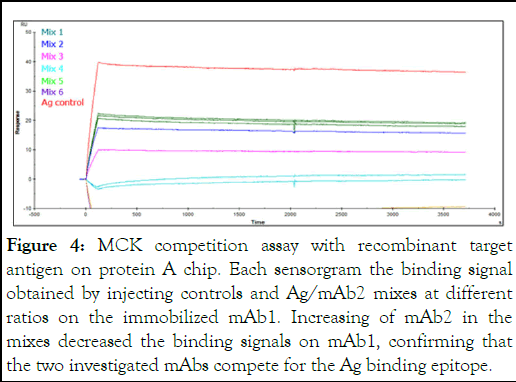
Figure 4: MCK competition assay with recombinant target antigen on protein A chip. Each sensorgram represents the binding signal obtained by injecting controls and Ag / mAb2 mixes at different ratios on the immobilized mAb1. Increasing amounts of mAb2 in the mixes decreased the binding signals on mAb1, confirming that the two investigated mAbs compete for the Ag binding epitope.
Adapting to live cells: Challenges and initial optimization: Once competition was confirmed with the recombinant antigen, we transitioned to using live target cells (A549 lung carcinoma cell line) to enhance the biological meaningfulness of the competition assay. A CM5 sensor chip was prepared with Bovine Serum Albumin (BSA) immobilized in the reference flow cell, to avoid any potential unspecific signal and mAb1 (mouse IgG1) in the active flow cell, following the Cytiva amine coupling protocol previously described for the neutralization assay.
Initial attempts involved pre-incubating mixes of fixed number of cells and increasing concentration of mAb2, for two hours at +37°C in a thermomixer to promote cell-mAb2 binding before injection into the Biacore™ system. During this pre-incubation, cells were maintained in cell culture medium to mitigate potential stress from the absence of CO2 and humidity. Cell viability remained high throughout the entire experiment (pre-incubation and subsequent SPR assay), as confirmed by Vi-Cell™ analysis (Table 7)
| Time point | Cells viability |
| Time 0 | 97% |
| 2 hours (end of pre-incubation) | 94% |
| 4 hours (end of MCK SPR assay) | 94% |
Table 7: Viability test: Target cells viability in cell culture medium was measured at different time points. Cells showed good viability up to 4 hours, corresponding to the complete timing of the experiment.
Various experimental conditions were explored to optimize cell-mAb2 ratios, association timing and flow rate, aiming for a detectable signal and clear discrimination of the competition effect. An example of a representative experimental protocol is detailed in Table 8.
| Pre-incubation | Conditions |
| mAb2-target cells (Mix 1-6) | 2 h at 37°C (in Thermomixer) |
| MCK SPR Assay step | Conditions |
| Ligand on CM5 chip | mAb1 (5400 RUs) |
| Analyte: 2 µL/min | Mix 1: 5000 target cells+mAb2 100 µg/mL |
| Association: 60 s Dissociation: 60 s |
Mix 2: 5000 target cells+mAb2 50 µg/mL |
| Mix 3: 5000 target cells+mAb2 25 µg/mL | |
| Mix 4: 5000 target cells+mAb2 12.5 µg/mL | |
| Mix 5: 5000 target cells+mAb2 6.25 µg/mL | |
| Controls | Target cells control (5000 cells) |
| mAb 2 control (100 µg/mL) | |
| Blank (running buffer) | |
| Running buffer | 20 mM Tris, 0.15M NaCl pH 7.4 |
Table 8: Example of MCK conditions applied to evaluate mAbs competition on target cells.
Promising initial results were obtained, where the cells control showed the highest binding signal on the immobilized mAb1 (Figure 5), indicating that the presence of mAb2 effectively inhibited cell binding to mAb1. However, no significant differences were observed among the mixes with increasing mAb2 concentrations, likely due to an overall low binding signal (Figure 5). This made it difficult to definitively confirm the competition effect under these conditions.
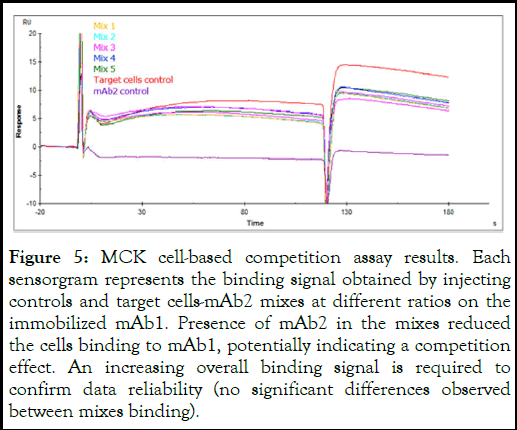
Figure 5: MCK cell-based competition assay results. Each sensorgram represents the binding signal obtained by injecting controls and target cells-mAb2 mixes at different ratios on the immobilized mAb1. Presence of mAb2 in the mixes reduced the cells binding to mAb1, potentially indicating a competition effect. An increasing overall binding signal is required to confirm data reliability (no significant differences observed between mixes binding).
Addressing low signal and viability: The long incubation strategy: To increase the overall binding signal, a different approach was followed directly immobilizing target cells on a CM5 sensor chip and injecting varying concentrations of mAb1 over cells. In this assay set-up a significant higher amount of both target cells and mAb1 could be used, aiming to identify the best condition for an increased overall binding signal.
Even with a high immobilization level of cells (around 12000 RUs), an extremely low binding affinity was observed for mAb1, with the binding signal dropping to 0 RUs very quickly, even before the end of the association phase (Figure 6).
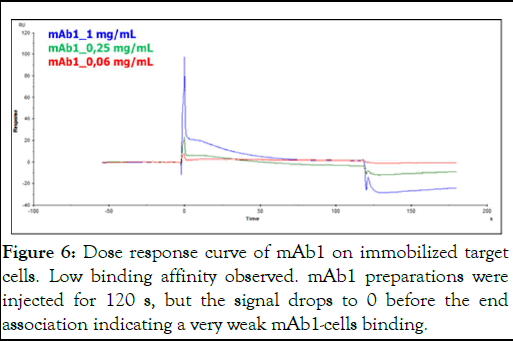
Figure 6: Dose response curve of mAb1 on immobilized target cells. Low binding affinity observed. mAb1 preparations were injected for 120s, but the signal drops to 0 before the end association indicating a very weak mAb1-cells binding.
This weak mAb-cell interaction is likely attributable to the naturally low expression of the target antigen on the A549 lung carcinoma cell line. This highlights a critical and common challenge in cell-based SPR: sufficient antigen density on the cell surface is paramount for generating robust and interpretable signals.
Furthermore, appreciating competition require a significantly longer interaction time between the cells and the two mAbs. However, a significant extension of the on-instrument SPR assay time would severely compromise cell viability, posing a major limitation.
To overcome these challenges, the assay setup was modified to incorporate a prolonged, off-instrument pre-incubation of the mixes under optimal cellular conditions before injecting samples into the Biacore™ instrument for competition detection.
This refined approach involved:
Extended Pre-incubation: different mixes made by fixed amount mAb1, target cells and increasing concentrations of mAb2 were prepared in a 96-well round bottom plate and incubated for 5 ± 0.5 hours at +37°C, 5% CO2 and 80% humidity (in a cell incubator). This ensured ample time for equilibrium to be reached between antibodies and cell-surface antigens while maintaining cell health.
Selective detection strategy: to detect competition with this new method, an SPR sensor chip capable of selectively binding only one of the two competing mAbs was required. We exploited the different species origins of the mAbs (human IgG1 for mAb1 and mouse IgG1 for mAb2). After screening various anti-human IgG and anti-mouse IgG antibodies (data not shown), an anti-human IgG F(ab)2 specific antibody was selected due to its high specificity for human IgG1 (mAb1) and lack of non-specific binding to mouse IgG1 (mAb2). This antibody was then immobilized on an SPR CM5 sensor chip using the Amine coupling protocol, following Cytiva guidelines.
The principle of this innovative assay setup is summarized in Figure 7. The immobilized anti-human IgG F(ab)2 specific antibody selectively captures mAb1. If mAb1 is already bound to cells, its F(ab)2 domain is occupied, reducing its ability to bind the chip. Therefore, if mAb1 and mAb2 compete for the same epitope on the cells, increasing concentrations of mAb2 will bind more cells, leaving a higher amount of mAb1 free to bind the sensor chip, resulting in increasing binding sensorgrams (Figure 7). Conversely, if the mAbs do not compete, mAb2 concentration will not affect mAb1-cell interaction, leading to consistently low binding sensorgrams.
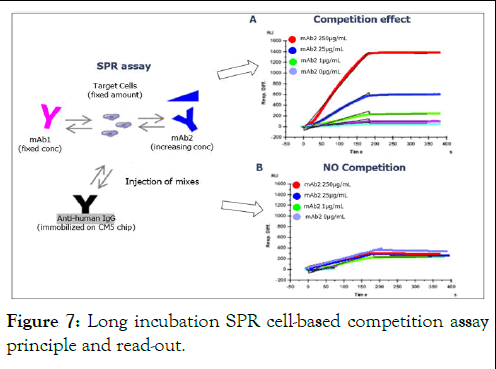
Figure 7: Long incubation SPR cell-based competition assay principle and read-out.
An anti-human IgG F(ab)2 specific Ab is immobilized on a CM5 chip. Pre incubated mixes and controls are injected on the sensor chipwhich selectively binds only the human IgG1 (mAb1). If the two mAbs compete for the target binding epitope, increasing concentration of mAb2 (muse IgG1) bind a higher number of cells, leaving higher amount of mAb1 free to bind the anti-human IgG F(ab)2 specific sensor chipand increasing binding signals are observed. If the two mAbs don’t compete, they can simultaneously bind the target cells, thus increasing concentrations of mAb2 will not affect the amount of mAb1 able to bind the sensor chipand comparable binding signals will be observed.
The optimized protocol for this cell-based SPR competition assay after long pre-incubation is detailed in Table 9.
| Pre-incubation | Conditions |
| Mixes and controls | 5,5 h at 37°C, 5% CO2, 80% Humidity (in cells incubator) |
| MCK SPR Assay step | Conditions |
| Ligand on CM5 sensor chip | Anti-human IgG F(ab)2 specific (13000 RUs) |
| Analyte: 30 µL/min | Mix1: mAb1 15µg/mL+10000 target cells+ mAb2 250 µg/mL |
| Association: 120 s | Mix2: mAb1 15µg/mL+10000 target cells +mAb2 1 µg/mL |
| Dissociation: 60 s | Mix3: mAb1 15 µg/mL+10000 target cells |
| Controls | mAb2 control 15 µg/mL |
| Target cells control (10000 cells) | |
| Running buffer | 20 mM Tris, 0.15M NaCl pH7.4 |
Table 9: Cell-based SPR MCK conditions applied after long pre-incubation of mixes and controls to evaluate mAbs competition on target cells.
Successful development of the cell-based competition assay: With this refined assay setup, our objective was successfully met: A cell-based SPR assay capable of evaluating mAbs competition for target binding was developed. As hypothesized, increasing amounts of the competitor (mAb2) in the mixes led to a lower number of cells bound by mAb1, consequently resulting in a higher binding level of free mAb1 to the anti-human IgG F(ab)2 specific chip (Figure 8). This dose-dependent increase in signal directly confirmed the expected competition read-out.
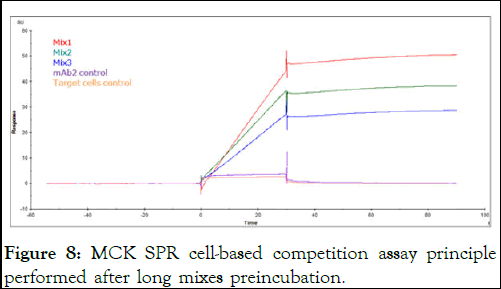
Figure 8: MCK SPR cell-based competition assay principle performed after long mixes preincubation.
Note: Pre-incubated mixes and controls are injected on the sensor chip. An anti-human IgG F(ab)2 specific which selectively binds only the human IgG1 (mAb1). Increasing concentration of mAb2 (mouse IgG1) in the mixes binds a higher number of cells, leaving a higher amount of mAb1 free to bind the anti-human IgG F(ab)2 specific chip, thus obtaining higher binding signals. This result confirms the competition effect. (This figure is representative of three independent experiments).
Assessing method reproducibility and selectivity: While this approach primarily allows for a qualitative evaluation of mAbs competition based on changes in binding level, the method's reproducibility and data significance were rigorously confirmed by performing the same experiment in three independent sessions. Furthermore, to evaluate method selectivity, mixes containing stressed preparations of mAb2 (mouse IgG1) were included and compared to non-stressed samples.
A preliminary SPR binding analysis on the recombinant target antigen showed only a slight effect of the applied stress conditions (40 hours at +37°C with 2% H2O2 and 24 hours at +50°C with 5% H2O2) on the mAb2-target Ag binding kinetics (Table 10).
| Sample | ka | kd | KD |
| Not stressed mAb2 | 7.80E+05 | 5.44E-04 | 6.97 E-10 |
| Stressed mAb2 (40 h+37°C 2% H2O2) | 1.88E+06 | 1.97E-03 | 1.05 E-09 |
| Stressed mAb2 (24 h+50°C 5% H2O2) | 5.06E+05 | 1.04E-03 | 2.05 E-09 |
Table 10: SPR Analysis of stressed preparations of mAb2 binding kinetic to the recombinant target antigen. The stressed conditions induced only a slight change in the binding kinetic.
The method reproducibility and selectivity were evaluated in two independent cell-based competition assays exploiting the sensorgrams comparison tool of Biacore™ T200 Evaluation Software.
Results are reported as similarity scores (Figure 9) which are automatically calculated by sensorgram comparison tool of Biacore™ T200 Evaluation Software according to the amount of experimental data from each mixes which follows within the standard deviation corridor of the reference condition (mix of mAb1-cells without competitor mAb2). The standard deviation corridor is made by the means of replication of the standard condition ± 3 standard deviations and thus it considers the experimental variability allowing to evaluate the effective comparability of samples.
As shown in Figure 9, the sensorgram comparison analysis confirmed the reliability of the observed competition effect and the robustness of the present cell-based SPR competition assay, indeed mixes containing cells and both competing mAbs (mAb1-target cells-mAb2 mixes, green bars) resulted significantly different to the standard condition in which the competitor is missing (mAb1-target cells, blue bar), with a mAb2 dose-dependent effect (similarity score ≤ 50% for mixes with 250 µg/mL of mAb2).
This result is particularly noteworthy given the well-known biological variability inherent in cell-based assays and moreover to the use of whole live cells in SPR system.
Method selectivity was also clearly demonstrated: When mAb2 was subjected to stress conditions, its presence in the mixes did not significantly affect the binding of mAb1 to the cells, regardless of the tested concentration (comparability scores ≥ 90%) (Figure 9).
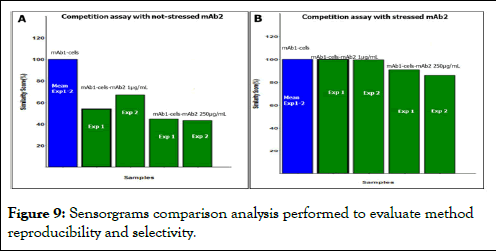
Figure 9: Sensorgrams comparison analysis performed to evaluate method reproducibility and selectivity.
These results significantly underscore the added value of using cells in SPR binding assays. They illustrate how seemingly minor differences in mAb binding kinetics to an isolated recombinant target antigen (Table 9) can translate into a substantial impact on the mAbs interaction with the same antigen when expressed in its native context on live cells.
This selective and reproducible cell-based SPR method successfully enabled the evaluation of mAbs competition directly on cells, thereby significantly increasing the biological relevance of traditional competition assays and offering a general workflow general potentially applicable to any mAbs for the investigation of epitope binding competition in a more physiological context. This advance provides a valuable tool for antibody characterization, enhancing our understanding of mAb-target cell interactions and supporting the development of more effective therapeutic antibodies.
SPR analyzes the interaction of a soluble ligand with a surface-immobilized molecule, measuring binding events through changes in refractive index and offering detailed characterization without labeling. Real-time detection allows analysis of both equilibrium and kinetics, providing robust parameters for protein interaction studies.
Cell-based Surface Plasmon Resonance (SPR) assays are an emerging technique that combines the high sensitivity of SPR with the physiological relevance of live cell systems [30]. These assays promise to enable real-time, label-free analysis of biomolecular interactions occurring on or near the cell membrane, providing insights into receptor-ligand interactions in a more physiologically relevant context.
Existing methods for measuring biomolecular kinetics in natural biological environments are limited. However, two key adaptations of Surface Plasmon Resonance (SPR) have been developed using standard equipment to study interactions with living cells. These methods involve replacing a component with cells: either the analyte, where target cells are flowed through the system (Injected Cell Analyte or ICA) or the immobilized target protein, where cells are bound to the sensor surface (Immobilized Target Cell or ITC) [31,33].
In the Injected Cell Analyte (ICA) method, the molecule that interacts with the cells is fixed to the sensor surface instead of the cells themselves. Then, cells are passed over this immobilized molecule. Finally, the surface is cleaned to remove bound cells before testing with a different cell concentration. While traditional SPR methods provide established techniques for ligand immobilization and surface cleaning, using cells as the analyte has specific pros and cons. Both immobilization and cleaning steps can be adapted from standard SPR procedures. The key limitation is that, as the molar concentration of cells cannot be accurately measured, the association rate constant, which depends on concentration and time, cannot be calculated. However, this approach still yields useful qualitative data. Moreover, repeated cleaning cycles may reduce the cell binding capability and incomplete cleaning could lead to cell debris affecting the SPR signal [31]. The Immobilized Target Cell (ITC) method involves observing how injected ligands bind to membrane or surface proteins of cells that are attached to the SPR sensor chip. This allows for direct measurement of the equilibrium dissociation constant, KD, since known ligand concentrations are used in each test, enabling direct measurement of kinetic rate constants. Furthermore, the kinetic data obtained reflects the actual binding between the ligand and its receptor, including any influences from factors like membrane composition or non-specific ligand-membrane interactions. However, the ITC method does have drawbacks. Primarily, due to the inherent limitations of SPR, the shallow penetration of the evanescent field prevents detection of the entire cell and its complete binding activity [31]. Furthermore, cells attached to a surface can detach more easily than receptors that are covalently bound, which is common in traditional plasmon resonance methods. Ensuring cell immobilization without harming their viability or receptor function can be difficult. The intricate nature of cell membranes may lead to unwanted signals. Achieving consistent and reproducible results requires meticulous optimization, especially when choosing the right flow rates and sensor surface materials [34].
In addition, to our knowledge, competitive assays using cell-based SPR have not been previously investigated. mAbs competition is commonly investigated by ELISA-based and SPR/BLI-based binding assays using the recombinant target antigen to investigate if the supposing competing mAbs recognize the same epitope. In both these approaches a reduced antigen-mAb1 signal in response to increasing concentrations of mAb2 confirms the competition, but the physiological relevance is limited due to the absence of crucial biological factors potentially affecting the mAbs-antigen interaction [21,22].
Cell-based competition assays traditionally exploiting the Flow Cytometry (FACS) technology which measures fluorescence signals from individual cells as they pass through a laser beam. For competition assays, FACS is used to assess if an unlabeled mAb can block the binding of a fluorescently labeled mAb to cell-surface antigens. The use of live cells increases the biological relevance of FACS-based competition assay, anyway the present important limitations related to the fluorescent labeling of at least one antibody which can affect the competition results [28,29].
The present study details a systematic approach employing standard label-free SPR (Biacore™) technology to assess biomolecular interactions involving live cells directly. Two different applications have been shown confirming the versatility of these kinds of assays for antibody potency evaluation.
The first method was applied to evaluate the capability of an anti-ligand mAb to block or inhibit the receptor binding, the core mechanism of action of neutralizing mAbs. The most challenging step of the assay development was immobilizing live cells on the sensorchip surface. Utilizing a cell acidification protocol, we successfully immobilized live cells via amine coupling. Subsequently mixes of ligand and mAb at varying ratios were then injected over cells. Despite increasing concentration of the mAb, no blocking or inhibition of the ligand binding to the cells was observed. The result was further confirmed by using an alternative cell-based SPR assay set-up using a protein A sensorchip to immobilize the anti-ligand mAb. Subsequent injections of ligand-cells mixes at different ratios showed a “sandwich” binding profile, confirming that two distinct epitopes of the ligand are simultaneously involved in the binding to both cells and anti-ligand mAb.
These results confirmed the lack of neutralizing activity in the investigated mAb. Moreover, a model of cell-based SPR procedure potentially applicable to any mAb involved in inhibition of ligand-receptor binding and to more advanced neutralization studies has been established. Indeed, the recombinant ligand could be replaced by pseudoviral/viral particles to evaluate the mAb capability to block or inhibit viral binding and consequent infection of the host cells.
The second method was applied to investigate mAbs competition for a common antigen directly on target cells. During the development of this assay one of the most frequent challenges occurring during bioassays development had to be faced: the low expression density of the antigen on the target cells surface. Thanks to the SPR technology, through the real-time kinetic evaluation of mAb-cells interaction, the problem was immediately identified and fixed by modifying the cells-mAbs incubation conditions and the assay set-up. Indeed, target cells and the two investigated mAbs were mixed in plate at different ratios and incubated for a long time in the cells incubator, maintaining favorable conditions for cell survival and ensuring a long association time between mAbs and cells, thus trying to overcome the issue of low antigen availability. Once identified the right incubation conditions, the competition effect was evaluated thanks to the preparation of a SPR sensor chip selectively binding only one of the competing mAbs. The possibility to prepare custom chips is another powerful advantage of SPR technology, allowing to easily change assay set-up in response to the specific requirements of molecules and cells involved. With our approach we were able to confirm mAbs competition for the epitope binding directly on target cells.
The use of live cells in SPR assays represents an important step forward in the characterization not only of mAbs competition but in general of mAbs bindings to target/receptor as part of their Mechanism of Action (MoA), overcoming limited red-out obtained performing the same analyses on recombinant targets. Indeed, the impact of the biological context, like steric hindrance phenomena, target expression density and target accessibility, is not considered in commonly binding assays. The application of SPR technology proposed in this work, significantly improves the versatility of cell-based assays. Different components can be immobilized on the sensorchip including ligands (receptors and/or target antigens), antibodies and even live cells, allowing to easily adapt the assay set-up to the research question. A variety of cell types can be also used, including primary cells, immortalized cell lines and engineered cells, as long as their size fits with the Biacore™ system needle.
The presented case studies highlight the essential contribution of cell-based SPR assays in mAbs characterization, joining the MoA-reflecting power of cell-based assays to the SPR detailed analysis of mAb binding properties. Thanks to their versatility, these assays represent an added value in the development of safe and effective therapeutic antibodies, examples of some of their potential applications are:
Selection of best mAb candidate: During mAbs development the selection of the best candidate is based on a panel of many chemical and biological properties, but among them, the biological efficacy occupies the top of the Critical Quality Attributes (CQAs) ranking. Development of potency cell-based assays reflecting the mAbs MoA could be not feasible at the early stages of development since the experimental variables are strictly related to the drug properties and different candidates could need different methods. Moreover, these assays usually require long incubations, and a lot of replicates, significantly limiting the number of samples that can be tested in a single analytical session and thus making these methods not feasible to support a screening phase. For all these reasons cell-based potency assays are commonly among the last analytical methods to be implemented during mAbs development and the selection of the best candidate in terms of biological efficacy is made using ELISA-based or SPR-based binding assays which are valuable methods, but as discussed in the introduction section have some limitations.
The proposed cell-based SPR assays, thanks to their versatility and real-time kinetic monitoring of binding interactions, represent a perfect tool for mAbs potency characterization, applicable already at the early stages of development, thus ensuring the selection of best drug candidate also based on biological efficacy.
Identification of optimal mAbs combination for therapeutic applications: Epitope binning studies which allow to verify whether different mAbs bind to the same or different epitopes on the target antigen. When only recombinant proteins are involved, all the conditions are favorable to mAbs-Ag interaction and a pair of mAbs could be able to bind simultaneously the target, while in the real biological environment different phenomena, such as steric hindrance and Ag density and conformation when expressed on the cells membrane, could limit the Ag accessibility avoiding mAbs sharing of same binding epitope. Using live cells increases the biological relevance of the epitope binning studies, reducing the risk of identifying just apparently competing mAbs.
Development of neutralizing mAbs: the selection of neutralizing monoclonal antibodies (mAbs) is a complex process involving multiple stages, aimed at identifying mAbs that can effectively block the biological activity of a target, such as a virus or a soluble factor. The first step is the identification of all the mAbs that bind the target, through ELISA, SPR and FACS, then the identified target-binding candidates are further screened for their neutralization capacity through both in vitro cell-based assays and in vivo assays. As discussed above, cells-based assays require a lot of development activities and are strictly related to sample properties, moreover just a limited number of candidates can be effectively tested in in vivo experiments. The cell-based SPR assays represent a perfect intermediate level of screening for neutralizing mAbs, indeed they could be applied with viral pseudo-particles to predict the neutralization capacity of mAbs and thus restricting the panel of candidates to be screened by in vitro cell-based and in vivo assays.
In conclusion, cell-based SPR assays can face various challenges, including baseline drift, non-specific binding and difficulties interpreting complexes cell responses. Optimizing the cell concentration, buffer conditions and surface regeneration protocols is crucial for reliable results. Our approach combines “best practices” like those existing for traditional SPR experiments with the advantages of cell-based SPR approaches allowing competitive binding potency binding potency assay quantification under biologically native conditions. This study highlights the power and versatility of cell-based SPR assays, offering a significant advancement in the characterization of therapeutic antibodies and paving the way for the development of more effective and targeted treatments.
[Crossref] [Google Scholar] [PubMed]
[Crossref] [Google Scholar] [PubMed]
[Crossref] [Google Scholar] [PubMed]
[Crossref] [Google Scholar] [PubMed]
[Crossref] [Google Scholar] [PubMed]
[Crossref] [Google Scholar] [PubMed]
[Crossref] [Google Scholar] [PubMed]
[Crossref] [Google Scholar] [PubMed]
[Google Scholar] [PubMed]
[Crossref] [Google Scholar] [PubMed]
[Crossref] [Google Scholar] [PubMed]
[Crossref] [Google Scholar] [PubMed]
[Crossref] [Google Scholar] [PubMed]
[Crossref] [Google Scholar] [PubMed]
[Crossref] [Google Scholar] [PubMed]
[Crossref] [Google Scholar] [PubMed]
[Crossref] [Google Scholar] [PubMed]
[Crossref] [Google Scholar] [PubMed]
[Crossref] [Google Scholar] [PubMed]
[Crossref] [Google Scholar] [PubMed]
[Crossref] [Google Scholar] [PubMed]
[Crossref] [Google Scholar] [PubMed]
[Crossref] [Google Scholar] [PubMed]
Citation: Mariani A, Salvi S, Longobardo I, Gabrielli M, Torre N (2025) Development of Cell-Based SPR Competition Assays to Support mAbs Potency Characterization. J Cell Sci Therapy. 16:494.
Received: 14-Jul-2025, Manuscript No. jcest-25-38672; Editor assigned: 17-Jul-2025, Pre QC No. jcest-25-38672 (PQ); Reviewed: 31-Jul-2025, QC No. jcest-25-38672; Revised: 11-Aug-2025, Manuscript No. jcest-25-38672 (R); Published: 08-Sep-2025 , DOI: 10.35248/2157-7013.25.16.494
Copyright: Copyright: © 2025 Mariani A, et al. This is an open-access article distributed under the terms of the Creative Commons Attribution License, which permits unrestricted use, distribution and reproduction in any medium, provided the original author and source are credited.