
Journal of Research and Development
Open Access
ISSN: 2311-3278
ISSN: 2311-3278
Review Article - (2025)Volume 13, Issue 3
Fishes are severe in food web and food chain as both intermediate trophic levels and top predators in all ecosystems. This review article provides the earliest chronological description of the feeding behavior of Labeo calbasu with special reference to cleaning of bottom. The feeding nature of fishes varying to stage of life cycle, season, locality, structure of food web, food supply, richness of species in water bodies, base of sexes (male or female) and organic load in the ecosystem. Feeding nature acting an important role in estimate of growth rate, productivity potential of water, habitat predilection, baseline data for culture and conservational strategies programme. It may be concluded that the L. calbasu is mostly detritus feeder and herbivorous. However, it feeds in the bottom (bottom feeder) of the water bodies (Example ponds, rivers, canals and reservoirs). It is also helping for the cleaning of bottom (aquaculture ponds and river bed) through feeding nature (detritus feeder). As the resulting, feeding nature of L. calbasu may have been helping to increasing of the aquaculture production especially Asian countries or native places. Therefore very necessary for believe as a cultivable fish species in the ponds and reservoir and this will require closer collaboration between aquaculture scientists, fish farmers and environmental managers (example river sector).
Labeo calbasu; Food and feeding; Aquaculture; Asian countries; Ponds; Cleaning of bottom; Substratum
Fishes are the backbone of the aquatic ecosystem and directly regulating to food chain, food web and formed healthy food for livig aquatic organism in same habitat. Labeo calbasu (Kalbasu) is belonging to the carp group. L. calbasu is a mainly riverine fish species, but too strongly established in the natural lakes, manmade reservoirs, canals, wetlands and ponds. But, it stocks, mainly declined due to competition (example food, space and breeding ground) by invasion of exotic fish species namely Cyprinus carpio and Oreochromis niloticus from the rivers especially in the Ganga river system. The extensive natural distribution of L. calbasu is in throughout India, Pakistan, Bangladesh, Burma and Nepal. L. calbasu is a very popular fish species that takes high market price at Ganga basin, Varanasi, Prayagraj, Kaushambi and Pratapgarh districts, Uttar Pradesh, India. In general, it is acknowledged as a prospective aquaculture fish species with Indian major carp (Catla catla, Labeo rohita, Cirrhinus mrigala) and exotic major carp (Hypophthalmichthys molitrix, Ctenopharyngodon idella, Cyprinus carpio) in various parts of the planet including India, Nepal, Pakistan, Bangladesh, Myanmar and other southern Asian countries [1].
It forms an important economically fishery in lotic and lentic water bodies of India. It is very common in the commercial catch of the Narmada, Godavari, Yamuna and Ganga rivers and Vindhyan region, India. The average annual catch from the Narmada during the period 1958-59 to 1965-66 was 4.1% of the total 60.4% carp landings which is much more than the other major carps. L. calbasu catches from the upper stretches of the Ganga and Yamuna rivers was sizeable, with an average yield during 1972-76 being 7.38 tonnes, 1.03 tonnes and 9.57 tonnes at Agra, Kanpur and Prayagraj, respectively. Out of 8.73%-11.14% of the major carp landing from these rivers Kalbasu alone composed 1.82%-3.07%. The L. calbasu was sizably proportion catches from the Vindhyan region (namely Ken, Paisuni and Tons rivers). In terms of yield from the Nagarjuna Sagar reservoir, L. calbasu fishery is remarkable higher than that of Indian Major Carp (IMC) [2].
The study of food and feeding nature of fishes is valuable tool for fishery management, conservation and ecological studies. The style of feeding nature is powerfully correlated with its internal and external morphological characters as like mouth shape, body shape, tooth and fins shape and placement, gut length, gill raker shape and size. In general, the interest in studying feeding ecology of fish is to understand the natural history of a species and its role in the trophic ecology of aquatic ecosystems. The knowledge of food requirements of fish is helping in understating many aspects of fish biology. The diets of most fish species changes with age, growth and abundance of species in respect of season and climatic condition. A through knowledge on the food and feeding habit of fishes provide key for the selection of culturable species and the importance of such information is necessary for successful fish farming especially composite fish farming/polyculture [3].
Food the bottlenecks theory: There are two broad topics conventionally addressed although discussing feeding nature of animals in natural system. These are: (i) Diet that comprises of the food habitually eaten by the animal as basic food or primary food; (ii) The mode of feeding or ingesting diet in a particular spatio-temporal dimension as secondary food. Examining the food and feeding habits of a species is important for evaluating the ecological role and position of the species in the food web of ecosystems.
The feeding nature of fishes is the spotlight of research in fish farming, ecology, aquatic biology, conservation technique, fisheries and restoration of fishes at different seasons of the year. The climate change, invasion of species, fishing pressure and mining all have the potential to alter the ecosystem function and their food chain and food web at an impressive scale. The study of food and feeding nature of L. calbasu is an area of continuous research as it forms the basis for the development of successful fisheries managing programme, restoration and stock maintenance on riverine fishery [4].
The food and feeding nature of L. calbasu have been considered by a number of researchers or scientist from lentic and lotic ecosystem namely form the different habitats or environmental conditions especially Asian countries. Published research papers of these researches were reviewed and conclude on the respect of habitat, food items and environmental conditions of the water resources. However, no confirmatory study is available on food and feeding habit of L. calbasu on natural resources. From the earlier reports so far available, describes its basic food as organic detritus items but food and feeding nature fluctuated from river to river and season to season [5].
Examining the food and feeding habits of a species is important for evaluating the ecological role and position of the species in the food web of ecosystems. The findings of the present study indicate that in both the rivers and reservoirs water bodies plays a crucial role in the feeding nature of Labeo calbasu in respect of ecological condition of the ecosystem (Example stagnant and running water bodies). The feeding nature and food item varies from species to species in respect of season and as well as alteration in the life cycle stages [6].
Based on food composition, the fishes are classified as deteritivores, herbivores, carnivores and omnivores.
The analysis of the food of L. calbasu showed place to place and river to river varied but mostly detritus/decaying organic matters contributed maximum percentage (Figure 1). The L. calbasu in Dekhar haor of Sunamgonj district, Bangladesh, the detritus item was shared maximum with 70.88% while other items contributed small proportion mud 11.81%, Bacillariophyceae 8.3%, Chlorophyceae 6.75%, Cyanophyceae 1.73%, Rotifera 0.45%, Crustaceans 0.24% and miscellaneous 0.08%. Details of food and feeding nature of juvenile, immature young and adult consume (180 to 480 mm) semi rotten aquatic vegetable debris (parts of petiole of Nymphaea; leaves of Vallisneria, Lemna, Hydrilla, etc.; and some vegetable debris in the form of gelatinous mass); mosquito and other insects larvae (Agrionid larvae, Ephaemerid larvae, part of some insects larvae). Occasionally they may consume some mollusc (Viviparus bengalensis, Melanoides tuberculatus, etc.) even with the shell and had relish crustaceans Spongilia (Porifera) also found in the gut [7].
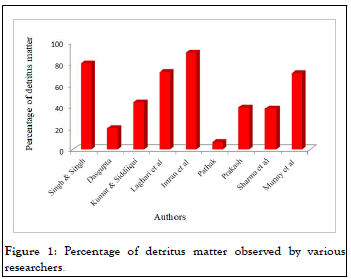
Figure 1: Percentage of detritus matter observed by various researchers.
The available literatures on food and feeding pattern of L. calbasu in substrate based or substrate free situations explained a kind of niche sharing by L. calbasu towards different food types along with its ontogenic development (Example behavioral feature from the earliest stage to maturity of the life cycle). The microorganism as well as macroorganism in natural ecosystem provides a great diversity offers a variety of food for fishes. The differences of the diverse food items mainly depend upon their accessibility revealed by the fish, as also the intensity of feeding which is influenced by the growth increment and maturation stages in many fishes. The feeding nature of fishes varies according to season and locality. L. calbasu as an omnivorous fish species, having the composition of food items adult as plant items 58% while 12% protozoa, 10% crustacean, 5% mollusks and rest mud and sand with 15%. The Kalbasu feed on algal matter and macrocrustacea from South Indian waters. The L. calbasu as a bottom feeder that feed on worms and snails, which found at the bottom of pond [8].
The gut content of L. calbasu have maximum contribution of decay matter with 39.15% and remaining 20.07% zooplankton, 16.18% phytoplankton. The plant materials and insects items also shared notable proportion 14.41% and 10.19%, respectively. L. calbasu feeds chiefly organic detritus materials with more than 80% throughout research work with monthly variation from the Ganga river. He also observed that the gut content varied monthly. The 60%, 10%, 5%, 20% and 8% of the vegetable matter, microphyte tissue, filamentous algae, roots of macrophyte and detritus, respectively in the gut of L. calbasu from the Nadia districts of West Bengal. Decaying organic matter (44.08%), mollucs (19.52%), sand and mud particles (12.24%), diatoms (8.34%), in the gut content of L. calbasu from the Ganga river whereas 45.2% decaying organic matter, 19.27% mollucs, 11.76% sand and mud particles and 8.24% diatoms from the Yamuna river. The L. calbasu consumed 71.98% predominantly on organic debris followed by 8.56% sand and mud particles from Keenjhar Lake District Thatta, Sindh, Pakistan [9].
In fact, low consumer fishes (low number of species) have a wider range of food sources than do high consumers. The food resources and food web alterations are mostly caused by climate change. These variables may affect fish growth by changing the quantity and quality of fish food items. In general, the growth of a fish is influenced by the quality and quantity of food materials available in ecosystem and consumed.
Food items plays one of the most vital roles in the life history of fishes by way of controlling their abundance, growth, maturation, fecundity and migration. Major food items of L. calbasu were based on detritus which comprised about 91.80% from the Yamuna river. The detritus (38.2%) dominated the gut contents of L. calbasu followed by diatoms (20.8%), green algae (18.5%), blue green algae (15.0%) and others (7.5%) from Jawahar Sagar Lake (Rajasthan). While, the gut contents of L. calbasu were dominated by diatoms (36.5%) followed by detritus (35.9%), green algae (18.9%) and blue green algae (8.9%) from inhabiting Kishore Sagar Lake (Rajasthan).
L. calbasu is a bottom feeder fish species in habit. The nature of diet in juvenile and adult fishes from Loni reservoir (Madhya Pradesh, India) was same but zooplankton, which occurred in negligible quantities in the adult, is the most preferred item in the diet of juvenile and the decayed organic food, which composed maximum in the adult, ranked fifth in juvenile. The food of juvenile was zooplankton (39.5), diatoms (22.2%), algal matter (4.4%), plant (7.6%), decayed organic food (7.0%) and sand and mud (4.4%).
The food item of Labeo calbasu consists of phytoplankton, zooplankton, algae, plant material and mud and sand. All the food items examined, the highest composition was phytoplankton (60%) and the lowest was algae and plant material (20%). The L. calbasu was helped to transfer nutrients from bottom sediment to the water column via bioturbation of benthic organic matter. L. calbasu is herbivore as well as detritivore in nature and feeds on plants, decaying organic matter, rotifer, diatom and mollusks. In fact, as a true bottom feeder L. calbasu mouth protrudes downwards when open and has a distinct fringe on the upper lip.
In fact, the diet of fishes are important in ecological research as it reveals potential competition for the available food resources, exploitation pressure and predator-prey interactions. The maximum size of fishes is also regulated by feeding intensity. The diet of fishes is contributing to the understanding of the ecosystem’s structure, the trophic dynamics in the food webs and changes in abundance and diversity of organisms.
It may be concluded that the Labeo calbasu is mostly detritus feeder and herbivorous. But, it feeds in the bottom (bottom feeder) of the water bodies (Example ponds, rivers and reservoirs). It is also helping for the cleaning of bottom (aquaculture ponds and river bed). As the resulting, feeding nature of L. calbasu may have been helping to increasing of the aquaculture production especially Asian countries or native places due to use of high dose of food materials in culture ponds. Therefore very necessary for believe as a cultivable fish species in the ponds and reservoir and this will require closer collaboration between aquaculture scientists, fish farmers and environmental managers (example river sector).
The author is highly thankful to Dr. Absar Alam, Senior Scientist, ICAR-Central Inland Fisheries Research Institute, Prayagraj for help and guidance in the preparation of manuscript.
The author of this work declares that he has no conflicts of interest.
Citation: Dwivedi AC (2025) Chronological Description of Feeding Prototype of Labeo calbasu (Hamilton, 1822) with Special Reference to the Cleaning of Bottom (Substratum): A Review. J Res Dev. 13:282.
Received: 06-Sep-2024, Manuscript No. JRD-24-33890; Editor assigned: 09-Sep-2024, Pre QC No. JRD-24-33890 (PQ); Reviewed: 23-Sep-2024, QC No. JRD-24-33890; Revised: 12-Jun-2025, Manuscript No. JRD-24-33890 (R); Published: 19-Jun-2025 , DOI: 10.35248/2311-3278.25.13.282
Copyright: © 2025 Dwivedi AC. This is an open-access article distributed under the terms of the Creative Commons Attribution License, which permits unrestricted use, distribution, and reproduction in any medium, provided the original author and source are credited.