Journal of Clinical Toxicology
Open Access
ISSN: 2161-0495
ISSN: 2161-0495
Case Report - (2026)Volume 16, Issue 1
We report the case of a 33-year-old Sri Lankan male who developed methaemoglobinaemia following the deliberate ingestion of Indoxacarb, a widely used pesticide. The patient reached with cyanosis and breathing distress and not using a large development in oxygen saturation no matter high-go with the flow oxygen remedy. The analysis of methaemoglobinaemia become suspected and supported by way of bedside testing and the arterial blood gasoline findings. Set off remedy with intravenous methylene blue led to big scientific development. This example illustrates the significance of good enough consciousness among healthcare experts, early reputation and prompt remedy of indoxacarb-caused methaemoglobinaemia to save you deadly effects, particularly in the aid restrained putting wherein facilities for detecting methaemoglobin is not available.
Indoxacarb; Healthcare experts; Methaemoglobinaemia; Methaemoglobin
Indoxacarb is an oxadiazine-elegance insecticide commonly used for pest control in agricultural region in Sri Lanka. Human publicity to Indoxacarb is rare but can bring about excessive toxicity, particularly after deliberate ingestion. One vast toxicological impact of Indoxacarb poisoning is methaemoglobinaemia, a fatal condition if left untreated, wherein haemoglobin is oxidized to methaemoglobin, lowering its ability to move oxygen. Instances of methaemoglobinaemia happening following Indoxacarb ingestion are particularly uncommon [1]. Set off diagnosis and speedy initiation of treatment, in particular with intravenous methylene blue, are important in handling this circumstance [2].
A 33-year-antique Sri Lankan male, a farmer, offered to the emergency department two hours after deliberate ingestion of approximately 50 ml of Avaunt, an Indoxacarb containing insecticide. The patient complained of shortness of breath, abdominal pain, nausea and headache. He had no previous history of any psychiatric illness or substance abuse.
On initial examination, the patient become aware with a Glasgow Coma Scale score of 15/15. Strikingly, he exhibited relevant and peripheral cyanosis however had warm peripheries. He became dyspnoeic, with a respiration price of 24 breaths per minute and on pulse oximetry the oxygen saturation became 86% on room air. Auscultation of the lungs was unremarkable with clean lung fields. His pulse fee turned into 96 beats in keeping with minute, and his blood pressure turned into a 130/80 mmHg and no cardiac murmurs had been detected. The stomach become soft and non-gentle on palpation. Equal, round and reactive scholars were identified by pupillary examination and no localized neurological abnormalities were discovered.
The patient's oxygen saturation remained low at 88%-90%, a sign of methaemoglobinaemia, even after receiving 15 liters of oxygen per minute using a non-rebreather mask [3]. The muddybrown hue of the patient's venous blood was observed, which is a typical visual indicator of methaemoglobinemia [4]. A 12-lead ECG revealed a normal sinus rhythm with no ischemic alterations and capillary blood glucose was 124 mg/dL.
A diagnosis of Indoxacarb-induced methaemoglobinemia was suspected based on clinical presentation. The following findings were obtained from standard Arterial Blood Gas (ABG) testing: Bicarbonate: 20 mmol/L, pH: 7.39, PaO2: 220 mmHg, PaCO2: 25 mmHg and oxygen saturation: 98%. A bedside methaemoglobin assessment was performed using absorbent paper stained with the patient's blood and compared with a standard color chart because there were no facilities to detect and quantify the amount of methaemoglobin in the blood. This method has been validated to be used as a reliable tool to estimate the percentage of methaemoglobin in the resource limited setting [5]. Methaemoglobin levels were estimated to be between 50 and 60 percent.
The affected person become handled with gastric lavage and activated charcoal to restriction the systemic absorption of Indoxacarb. Intravenous Methylene Blue (MB) at 1 mg/kg (60 mg) was administered over 5 mins, as there had been no contraindications for administration of methylene blue, as the methaemoglobin stage become greater than the remedy threshold of 20% [6].
The patient’s vitals have been intently monitored and supplemental oxygen remedy became persisted. One hour after the first dose of methylene blue, the patient’s symptoms and oxygen saturation advanced to 92%-94%, even though he remained visibly cyanotic. A repeat methaemoglobin evaluation confirmed levels had decreased to 30%-40%. A 2 d dose of intravenous methylene blue (60 mg) turned into administered.
One hour into the management of the second one dose the patient’s oxygen saturation stepped forward to 98% and he skilled relief from dyspnoea. The methaemoglobin level became referred to be reduced to 10% at this factor on reassessment. The affected person became steadily weaned off supplemental oxygen over the following six hours as his scientific repute progressed (Figure 1).
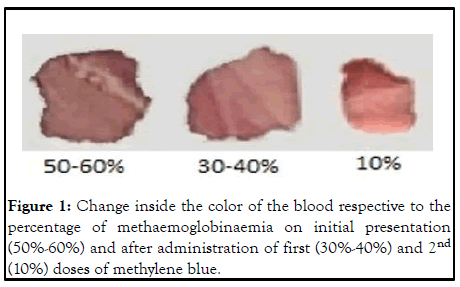
Figure 1: Change inside the color of the blood respective to the percentage of methaemoglobinaemia on initial presentation (50%-60%) and after administration of first (30%-40%) and 2nd (10%) doses of methylene blue.
Chest X-ray confirmed clean lung fields and no proof of aspiration. primary blood check effects, including full blood count (haemoglobin stage of 14 g/dL, white blood cellular rely of four. 6 × 10⁹/L, platelet remember of 304 × 109/L), renal characteristic tests (serum creatinine, blood urea), serum electrolytes and liver profile had been within everyday limits.
The patient remained haemodynamically solid at some point of hospitalization, without alterations in sensorium, seizures or different symptoms of organ dysfunction. He became discharged days later following a intellectual health assessment, for the duration of which he turned into diagnosed with mild depression. Upon discharge, intellectual health follow-up was organized to cope with the underlying psychiatric troubles contributing to the deliberate self-poisoning.
Indoxacarb is an insecticide that blocks voltage-gated sodium channels in insects, causing neuronal disease and dying. In human beings, its mechanism of toxicity appears to involve the induction of oxidative stress, which ends up inside the formation of methaemoglobin. This situation highlights the vital trouble of methaemoglobinaemia following Indoxacarb ingestion and the vital importance of timely intervention. Indoxacarb poisoning has additionally pronounced to motive acute kidney injury, although it changed into not seen in our affected person.
Clues for the diagnosis of methaemoglobinaemia are refractory cyanosis and low oxygen saturation regardless of high flows of supplemental oxygen, muddy-brown colour of blood and saturation gap among the oxygen saturation by using pulse oximetry and the saturation in arterial blood gas. Saturation hole is not diagnostic of methaemoglobinaemia as a saturation hole of more than 5% also can be seen carboxyhaemoglobinaemia and sulfhaemoglobinaemia [7].
Methaemoglobinaemia takes place when the iron within haemoglobin is oxidized from the Ferrous (Fe2+) to the Ferric (Fe3+) state, impairing its capability to bind and delivery oxygen. Medical manifestations of methaemoglobinaemia depends on the share of methaemoglobinaemia and the spectrum of clinical functions consists of cyanosis, fatigue, weakness, headache, primary apprehensive device despair, metabolic acidosis, seizures, dysrhythmias, coma and death [8]. Regular blood methaemoglobin degree is less than 1% and stages above 20% motive large cyanosis and hypoxia [9]. Stages above 30% can reason considerable hypoxia and other signs and symptoms inclusive of dyspnoea, headache and adjusted mental status. If untreated, excessive methaemoglobinaemia can bring about organ failure, seizures or even loss of life.
The first-line treatment for symptomatic methaemoglobinaemia is intravenous methylene blue, which reduces methaemoglobin again to haemoglobin via the NADPH-methaemoglobin reductase machine. Methylene blue acts with the aid of lowering methaemoglobin again to haemoglobin through the NADPHbased methaemoglobin reductase pathway, thereby restoring the oxygen-wearing functionality of haemoglobin. It ought to be administered as a bolus of 1-2 mg/kg. Even as most sufferers respond nicely to unmarried dose, repeat doses may be vital in instances of chronic symptoms or having methaemoglobin tiers above the remedy threshold of 20%, as turn out to be visible in this situation.
It’s critical to take a look at that methylene blue has contraindications, specifically in patients with Glucose-6- Phosphate Dehydrogenase (G6PD) deficiency, in which it could purpose excessive haemolysis. In such times, or whilst remedy with methylene blue is not a fulfillment, immoderate dose intravenous ascorbic acid (10 grams consistent with dose) can be used as an alternative treatment, despite the fact that the response to ascorbic acid may not be as effective and fast as with treatment with methylene blue. Exchange transfusion or hyperbaric oxygen remedy may be required in intense instances. In our patient, there has been no records of G6PD deficiency and methylene blue turned into administered without headaches.
Indoxacarb-prompted methaemoglobinaemia is an extraordinary but lifestyles-threatening scenario that requires set off reputation and remedy. This case underscores the importance of early control of intravenous methylene blue, which results in speedy development in oxygenation and backbone of symptoms and symptoms. Healthcare providers have to be privy to this fatal problem of indoxacarb ingestion and able in right away recognizing and estimating methaemoglobissessment of methaemoglobinnaemia in applicable scientific contexts, specifically wherein facilities for biochemical a degree isn't available.
[Crossref] [Google Scholar] [PubMed]
[Crossref] [Google Scholar] [PubMed]
[Crossref] [Google Scholar] [PubMed]
[Crossref] [Google Scholar] [PubMed]
[Crossref] [Google Scholar] [PubMed]
[Crossref] [Google Scholar] [PubMed]
Citation: Higgoda R (2025) Case Report: Methaemoglobinaemia following Indoxacarb Ingestion. J Clin Toxicol. 15:595.
Received: 25-Sep-2024, Manuscript No. JCT-25-34305; Editor assigned: 28-Sep-2024, Pre QC No. JCT-25-34305 (PQ); Reviewed: 12-Oct-2024, QC No. JCT-25-34305; Revised: 16-Jun-2025, Manuscript No. JCT-25-34305 (R); Published: 23-Feb-2026 , DOI: 10.35248/2161-0495.25.15.595
Copyright: © 2025 Higgoda R. This is an open-access article distributed under the terms of the Creative Commons Attribution License, which permits unrestricted use, distribution, and reproduction in any medium, provided the original author and source are credited.